An engineer compares an LLM’s fabricated claims about printheads with real-world data, revealing why statistical models fail at physical reasoning—and why technical decisions should never rely on AI alone.An engineer compares an LLM’s fabricated claims about printheads with real-world data, revealing why statistical models fail at physical reasoning—and why technical decisions should never rely on AI alone.

A Simple Hardware Question Exposes the Limits of Today’s LLMs

2025/12/05 18:29

\ As engineers and builders, we're trained to trust data and specifications. So, when I decided to stress-test a popular Large Language Model (LLM) on a piece of hardware I know intimately—printheads—the results weren't just wrong; they were a masterclass in confident fabrication.

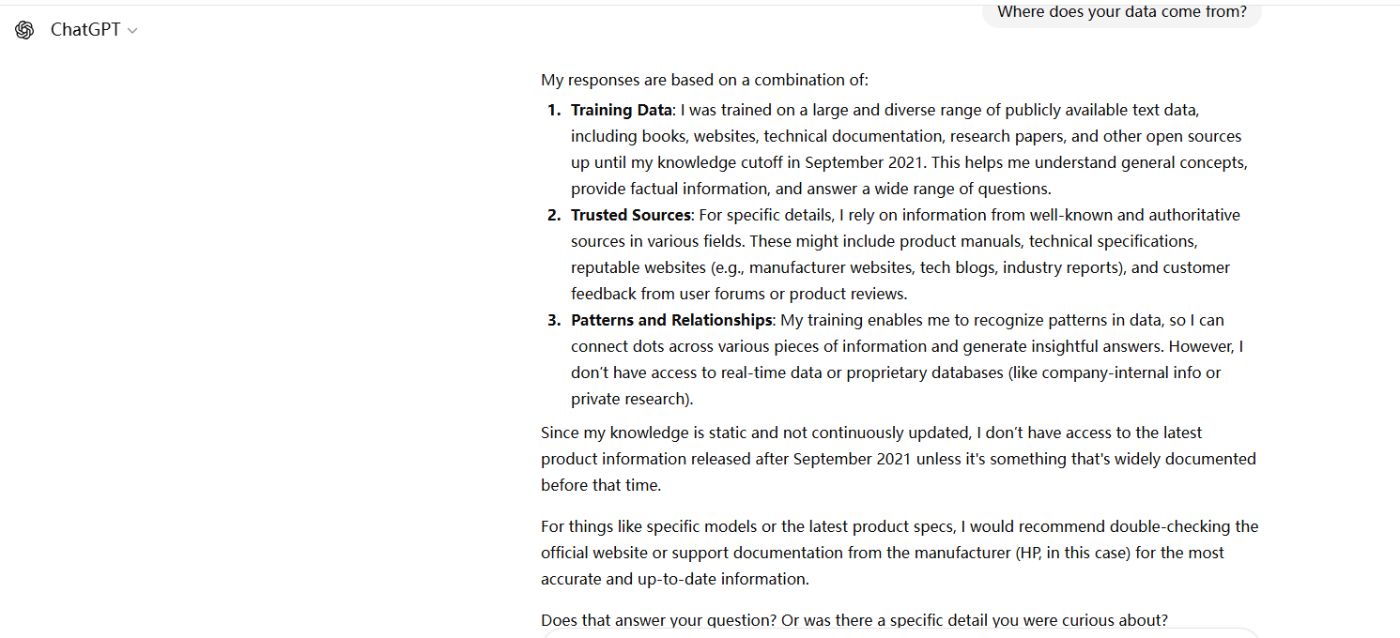
My query was straightforward: "Compare the HP 841 industrial printhead with a standard HP A3 office printhead." The LLM responded with a detailed, articulate argument that was, technically speaking, precisely backward. It touted the office-grade component as superior. This isn't a simple mistake; it's a fundamental failure of how LLMs "understand" the physical world.

\
\

The LLM's Architectural Flaw: It's a Statistician, Not an Engineer

Let's be clear: an LLM is not a reasoning engine. It's a stochastic parroting engine. Its core function is to predict the next most statistically plausible token (word fragment) based on its training corpus. It has no sensor for truth, no grounding in physics, and no concept of mechanical wear.

When asked about a technical subject, it doesn't retrieve facts from a verified database. Instead, it assembles an answer based on patterns it has seen in its training data.

The problem is, the internet is filled with:

  • Volume-skewed data: There are far more discussions, reviews, and queries about common office A3 printers than niche industrial printheads.
  • Ambiguous language: The term "A3" is often used as a proxy for "large format" or "high-quality" in casual writing, muddying the technical waters.
  • Outdated and incorrect forum posts.

The LLM absorbed this messy, imbalanced corpus and produced a response that sounded authoritative but was built on a foundation of statistical noise. It's the equivalent of asking a million people on the street about quantum mechanics and basing your thesis on the most common phrases they utter.

A Technical Reality Check: The HP 841 vs. A3 Printhead

My goal here isn't just to say the AI is wrong; it's to provide the ground truth that the LLM lacks. The difference between these components isn't a matter of opinion; it's a matter of engineering intent.

The following comparison isn't AI-generated; it's sourced from datasheets, tear-downs, and real-world deployment.

| Feature | HP 841 (Industrial PageWide) | Standard HP A3 Office Printhead | |----|----|----| | Target Application | High-throughput commercial printing, central reprographic departments | Low-to-medium volume office/desktop printing | | Core Architecture | Page-wide, fixed-array, single-pass | Scanning carriage, shuttle-based, multi-pass | | Throughput (A4) | 70-80 PPM | 15-30 PPM | | Duty Cycle | Hundreds of thousands of pages/month | Tens of thousands of pages/month | | Design Lifespan | Years (or millions of pages) | 1-2 years (or hundreds of thousands of pages) | | Cost Model | Extremely low cost-per-page | Higher cost-per-page |

The Engineering Deep Dive: Where the LLM Misses the Point

The specs above tell a clear story, but the real differentiators are in the physical design, which an LLM can never comprehend.

  1. Electrical & Contact Design:
  • HP 841: Uses a wide, dual-sided contact cable. This is for superior current delivery, lower resistance, and resilience against oxidation—a critical feature for 24/7 operation. It's built like a server power supply.

  • A3 Printhead: Typically uses a simpler, single-sided flex cable. It's sufficient for intermittent use but a single point of failure under constant load. It's a consumer-grade component.

    \

  1. Fluid Systems & Reliability:
  • HP 841: Features a sophisticated ink system with a short, tall ink sac to maintain optimal pressure and flow. Its internal architecture is designed with anti-airlock mechanisms to prevent the number one cause of printhead failure: air bubbles clogging the micro-channels.
  • A3 Printhead: Often has a longer, more passive ink path prone to starvation and air ingestion. It's the primary reason for print quality degradation and premature death.

My Perspective: Why This Matters Beyond Printers

This isn't just about printheads. It's a cautionary tale for any technical decision-maker. LLMs are phenomenal for brainstorming, boilerplate code, and summarizing well-trodden topics. 

But when your question requires:

  • Specialized, up-to-date technical knowledge
  • An understanding of physical properties and engineering constraints
  • The ability to discern between marketing fluff and technical reality

…you must treat the LLM's output as unverified, potentially hazardous draft material. It is a tool for acceleration, not a source of truth.

The final authority must always be official documentation, empirical testing, and domain expertise. In the case of the HP 841, its design is a masterpiece of industrial engineering, optimized for a single metric: total cost of ownership at scale. To claim an office-grade component is superior is to fundamentally misunderstand the problem it was built to solve.

Let's use AI for what it's good at, but never outsource our technical judgment to a model that has never held a printhead in its hand, nor seen one fail under production load.

\

Disclaimer: The articles reposted on this site are sourced from public platforms and are provided for informational purposes only. They do not necessarily reflect the views of MEXC. All rights remain with the original authors. If you believe any content infringes on third-party rights, please contact service@support.mexc.com for removal. MEXC makes no guarantees regarding the accuracy, completeness, or timeliness of the content and is not responsible for any actions taken based on the information provided. The content does not constitute financial, legal, or other professional advice, nor should it be considered a recommendation or endorsement by MEXC.

You May Also Like

Suspected $243M Crypto Hacker Arrested After Major Breakthrough in Global Heist

Suspected $243M Crypto Hacker Arrested After Major Breakthrough in Global Heist

Major breakthrough in $243M crypto heist as suspect arrested! $18.58M in crypto seized, linked to suspected hacker’s wallet. Dubai villa raid leads to possible arrest of crypto thief. A major breakthrough in the investigation into the $243 million crypto theft has emerged, as blockchain investigator ZachXBT claims that a British hacker, suspected of orchestrating one of the largest individual thefts in crypto history, may have been arrested. On December 5, ZachXBT revealed in a Telegram post that Danny (also known as Meech or Danish Zulfiqar Khan), the primary suspect behind the attack, was likely apprehended by law enforcement. ZachXBT pointed to a significant find: approximately $18.58 million worth of crypto currently sitting in an Ethereum wallet linked to the suspect. The investigator claimed that several addresses connected to Zulfiqar had consolidated funds to this address, mirroring patterns previously seen in law enforcement seizures. This discovery has raised suspicions that authorities may have closed in on the hacker. Moreover, ZachXBT mentioned that Zulfiqar was last known to be in Dubai, where it is alleged that a villa was raided, and multiple individuals associated with the hacker were arrested. He also noted that several contacts of Zulfiqar had gone silent in recent days, adding to the growing belief that law enforcement had made a major move against the hacker. However, no official statements from Dubai Police or UAE regulators have confirmed the arrest, and local media reports remain silent on the matter. Also Read: Song Chi-hyung: The Visionary Behind Upbit and the Future of Blockchain Innovation The $243 Million Genesis Creditor Heist: How the Attack Unfolded The arrest of Zulfiqar may be linked to one of the largest known individual crypto heists. In September 2024, ZachXBT uncovered that three attackers were involved in stealing 4,064 BTC (valued at $243 million at the time) from a Genesis creditor. The attack was carried out using sophisticated social engineering tactics. The hackers impersonated Google support to trick the victim into resetting two-factor authentication on their Gemini account, giving them access to the victim’s private keys. From there, they drained the wallet, moving the stolen BTC through a complex network of exchanges and swap services. ZachXBT previously identified the suspects by their online handles, “Greavys,” “Wiz,” and “Box,” later tying them to individuals Malone Lam, Veer Chetal, and Jeandiel Serrano. The U.S. Department of Justice later charged two of the suspects with orchestrating a $230 million crypto scam involving the theft. Further court documents revealed that the criminals had used a mix of SIM swaps, social engineering, and even physical burglaries to carry out the theft, spending millions on luxury items like cars and travel. ZachXBT’s tracking work has played a key role in uncovering several related thefts, including a $2 million scam in which Chetal was involved while out on bond. The news of Zulfiqar’s potential arrest could mark a significant turning point in the investigation, although full details are yet to emerge. Also Read: Kevin O’Leary Warns: Only Bitcoin and Ethereum Will Survive Crypto’s Reality Check! The post Suspected $243M Crypto Hacker Arrested After Major Breakthrough in Global Heist appeared first on 36Crypto.
Share
Coinstats2025/12/06 18:27
Breaking: CME Group Unveils Solana and XRP Options

Breaking: CME Group Unveils Solana and XRP Options

CME Group launches Solana and XRP options, expanding crypto offerings. SEC delays Solana and XRP ETF approvals, market awaits clarity. Strong institutional demand drives CME’s launch of crypto options contracts. In a bold move to broaden its cryptocurrency offerings, CME Group has officially launched options on Solana (SOL) and XRP futures. Available since October 13, 2025, these options will allow traders to hedge and manage exposure to two of the most widely traded digital assets in the market. The new contracts come in both full-size and micro-size formats, with expiration options available daily, monthly, and quarterly, providing flexibility for a diverse range of market participants. This expansion aligns with the rising demand for innovative products in the crypto space. Giovanni Vicioso, CME Group’s Global Head of Cryptocurrency Products, noted that the new options offer increased flexibility for traders, from institutions to active individual investors. The growing liquidity in Solana and XRP futures has made the introduction of these options a timely move to meet the needs of an expanding market. Also Read: Vitalik Buterin Reveals Ethereum’s Bold Plan to Stay Quantum-Secure and Simple! Rapid Growth in Solana and XRP Futures Trading CME Group’s decision to roll out options on Solana and XRP futures follows the substantial growth in these futures products. Since the launch of Solana futures in March 2025, more than 540,000 contracts, totaling $22.3 billion in notional value, have been traded. In August 2025, Solana futures set new records, with an average daily volume (ADV) of 9,000 contracts valued at $437.4 million. The average daily open interest (ADOI) hit 12,500 contracts, worth $895 million. Similarly, XRP futures, which launched in May 2025, have seen significant adoption, with over 370,000 contracts traded, totaling $16.2 billion. XRP futures also set records in August 2025, with an ADV of 6,600 contracts valued at $385 million and a record ADOI of 9,300 contracts, worth $942 million. Institutional Demand for Advanced Hedging Tools CME Group’s expansion into options is a direct response to growing institutional interest in sophisticated cryptocurrency products. Roman Makarov from Cumberland Options Trading at DRW highlighted the market demand for more varied crypto products, enabling more advanced risk management strategies. Joshua Lim from FalconX also noted that the new options products meet the increasing need for institutional hedging tools for assets like Solana and XRP, further cementing their role in the digital asset space. The launch of options on Solana and XRP futures marks another step toward the maturation of the cryptocurrency market, providing a broader range of tools for managing digital asset exposure. SEC’s Delay on Solana and XRP ETF Approvals While CME Group expands its offerings, the broader market is also watching the progress of Solana and XRP exchange-traded funds (ETFs). The U.S. Securities and Exchange Commission (SEC) has delayed its decisions on multiple crypto-related ETF filings, including those for Solana and XRP. Despite the delay, analysts anticipate approval may be on the horizon. This week, REX Shares and Osprey Funds are expected to launch an XRP ETF that will hold XRP directly and allocate at least 40% of its assets to other XRP-related ETFs. Despite the delays, some analysts believe that approval could come soon, fueling further interest in these assets. The delay by the SEC has left many crypto investors awaiting clarity, but approval of these ETFs could fuel further momentum in the Solana and XRP futures markets. Also Read: Tether CEO Breaks Silence on $117,000 Bitcoin Price – Market Reacts! The post Breaking: CME Group Unveils Solana and XRP Options appeared first on 36Crypto.
Share
Coinstats2025/09/18 02:35