Ethereum saw a validator drop after the Fusaka upgrade due to a Prysm bug, and while recovery was quick, client diversity concerns remain. Ethereum faced a tough moment after the Fusaka upgrade. A bug in the Prysm consensus client caused a fall in validator votes, which pushed the network close to losing finality.  Developers acted […] The post Ethereum Sees Drop In Network Validator Participation After Fusaka Upgrade appeared first on Live Bitcoin News.Ethereum saw a validator drop after the Fusaka upgrade due to a Prysm bug, and while recovery was quick, client diversity concerns remain. Ethereum faced a tough moment after the Fusaka upgrade. A bug in the Prysm consensus client caused a fall in validator votes, which pushed the network close to losing finality.  Developers acted […] The post Ethereum Sees Drop In Network Validator Participation After Fusaka Upgrade appeared first on Live Bitcoin News.

Ethereum Sees Drop In Network Validator Participation After Fusaka Upgrade

2025/12/06 01:00

Ethereum saw a validator drop after the Fusaka upgrade due to a Prysm bug, and while recovery was quick, client diversity concerns remain.

Ethereum faced a tough moment after the Fusaka upgrade. A bug in the Prysm consensus client caused a fall in validator votes, which pushed the network close to losing finality. 

Developers acted fast and the network recovered, but the event raised new questions about client diversity.

Ethereum Validator Drop After Fusaka

Ethereum hit a sudden 25% drop in voting participation right after the Fusaka upgrade.

The fall happened due to a flaw in Prysm version v7.0.0. The client produced old states when it processed outdated attestations, and this caused nodes to stop working as expected. 

Prysm developers shared a temporary fix and told validators to start the client with a special flag.

However, Beaconcha.in data showed the hit clearly. At epoch 411448, sync participation dropped to 75% and voting participation reached about 74.7%. 
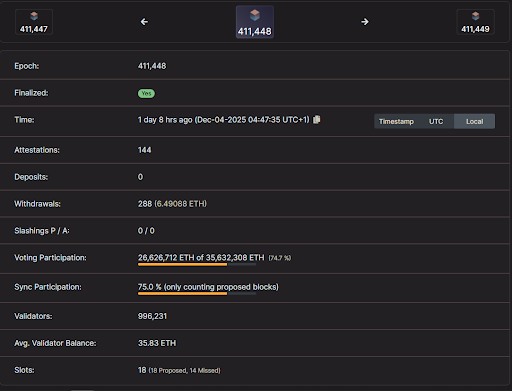
sync participation dropped to 75% and voting participation reached about 74.7% at Epoch 411448sync participation dropped to 75% and voting participation reached about 74.7% at Epoch 411448 | source: BeaconChai.in

Notably, Ethereum needs at least two-thirds of stakers to vote to keep finality. That means the network sat only a few percentage points away from losing that safety line.

Ethereum Client Diversity Brings Fresh Worries

Ethereum saw a fast recovery. At epoch 411712, voting participation climbed close to 99% and sync participation reached 97%. Before the issue, the network usually saw more than 99% of votes. 

The recovery proved that the issue stayed tied to one client group.

Validator data lined up with the scale of the drop. Prysm had about 22.7% of validators before the bug. That number dropped to 18% after the event. This matched the fall in voting participation and showed that the failure stayed focused on Prysm users.

A similar problem happened in 2022. Ethereum lost finality twice due to older attestation bugs in both Prysm and Teku. Back then, Prysm ran on most Ethereum consensus nodes. 

That created a higher risk because one client error could push the entire network into trouble.

Ethereum still has uneven client usage. Current MigaLabs data shows Lighthouse holds 52.55% of nodes while Prysm holds around 18%. 

Developers want no single client above 33% and that limit keeps the network safe, even if one client breaks. 

Thus, the recent event proved that the network still needs more balance.

Ethereum Faces Finality Challenge

Ethereum finality plays a major role in keeping the chain stable. If voting participation drops below two-thirds, the chain loses finality. 

Blocks can still appear, but they do not count as finalised. That creates real problems because bridges can freeze and rollups can halt withdrawals. Exchanges can also raise confirmation limits and users may face delays and higher risks during that period.

Prysm developers warned that the bug made nodes produce old states. This blocked proper voting and caused the sudden drop. 

The quick recovery, helped by the workaround, kept the chain safe. Yet the event served as a reminder. 

The network needs strong client diversity to protect itself from single-point failures.

Related Reading: Ethereum Rallies Strongly Past $3,000 Before the Upcoming Fusaka Upgrade

Ethereum Gains From Fusaka Despite Setback

The Fusaka upgrade still brought clear gains for Ethereum. It added PeerDAS through EIP-7594. 

This upgrade reduces bandwidth use and prepares Ethereum for higher throughput. It also supports more activity and lowers pressure on the base layer. In sum, the upgrade helps rollups scale and lowers costs for users.

Fusaka also increases blob capacity, which helps layer 2 networks. This means cheaper operations and smoother performance during heavy usage. It also makes Ethereum more suitable for large applications that need fast and cheap transactions.

Overall, the next months will show how validators respond and how fast the ecosystem builds on the upgrade.

The post Ethereum Sees Drop In Network Validator Participation After Fusaka Upgrade appeared first on Live Bitcoin News.

Disclaimer: The articles reposted on this site are sourced from public platforms and are provided for informational purposes only. They do not necessarily reflect the views of MEXC. All rights remain with the original authors. If you believe any content infringes on third-party rights, please contact service@support.mexc.com for removal. MEXC makes no guarantees regarding the accuracy, completeness, or timeliness of the content and is not responsible for any actions taken based on the information provided. The content does not constitute financial, legal, or other professional advice, nor should it be considered a recommendation or endorsement by MEXC.

You May Also Like

Polygon Tops RWA Rankings With $1.1B in Tokenized Assets
Polygon Tops RWA Rankings With $1.1B in Tokenized Assets

The post Polygon Tops RWA Rankings With $1.1B in Tokenized Assets appeared on BitcoinEthereumNews.com. Key Notes A new report from Dune and RWA.xyz highlights Polygon’s role in the growing RWA sector. Polygon PoS currently holds $1.13 billion in RWA Total Value Locked (TVL) across 269 assets. The network holds a 62% market share of tokenized global bonds, driven by European money market funds. The Polygon POL $0.25 24h volatility: 1.4% Market cap: $2.64 B Vol. 24h: $106.17 M network is securing a significant position in the rapidly growing tokenization space, now holding over $1.13 billion in total value locked (TVL) from Real World Assets (RWAs). This development comes as the network continues to evolve, recently deploying its major “Rio” upgrade on the Amoy testnet to enhance future scaling capabilities. This information comes from a new joint report on the state of the RWA market published on Sept. 17 by blockchain analytics firm Dune and data platform RWA.xyz. The focus on RWAs is intensifying across the industry, coinciding with events like the ongoing Real-World Asset Summit in New York. Sandeep Nailwal, CEO of the Polygon Foundation, highlighted the findings via a post on X, noting that the TVL is spread across 269 assets and 2,900 holders on the Polygon PoS chain. The Dune and https://t.co/W6WSFlHoQF report on RWA is out and it shows that RWA is happening on Polygon. Here are a few highlights: – Leading in Global Bonds: Polygon holds 62% share of tokenized global bonds (driven by Spiko’s euro MMF and Cashlink euro issues) – Spiko U.S.… — Sandeep | CEO, Polygon Foundation (※,※) (@sandeepnailwal) September 17, 2025 Key Trends From the 2025 RWA Report The joint publication, titled “RWA REPORT 2025,” offers a comprehensive look into the tokenized asset landscape, which it states has grown 224% since the start of 2024. The report identifies several key trends driving this expansion. According to…
Share
BitcoinEthereumNews2025/09/18 00:40
Team Launches AI Tools to Boost KYC and Mainnet Migration for Investors

Team Launches AI Tools to Boost KYC and Mainnet Migration for Investors

The post Team Launches AI Tools to Boost KYC and Mainnet Migration for Investors appeared on BitcoinEthereumNews.com. The Pi Network team has announced the implementation of upgrades to simplify verification and increase the pace of its Mainnet migration. This comes before the token unlock happening this December. Pi Network Integrates AI Tools to Boost KYC Process In a recent blog post, the Pi team said it has improved its KYC process with the same AI technology as Fast Track KYC. This will cut the number of applications waiting for human review by 50%. As a result, more Pioneers will be able to reach Mainnet eligibility sooner. Fast Track KYC was first introduced in September to help new and non-users set up a Mainnet wallet. This was in an effort to reduce the long wait times caused by the previous rule. The old rule required completing 30 mining sessions before qualifying for verification. Fast Track cannot enable migration on its own. However, it is now fully part of the Standard KYC process which allows access to Mainnet. This comes at a time when the network is set for another unlock in December. About 190 million tokens will unlock worth approximately $43 million at current estimates.  These updates will help more Pioneers finish their migration faster especially when there are fewer validators available. This integration allows Pi’s validation resources to serve as a platform utility. In the future, applications that need identity verification or human-verified participation can use this system. Team Releases Validator Rewards Update The Pi Network team provided an update about validator rewards. They expect to distribute the first rewards by the end of Q1 2026. This delay happened because they needed to analyze a large amount of data collected since 2021. Currently, 17.5 million users have completed the KYC process, and 15.7 million users have moved to the Mainnet. However, there are around 3 million users…
Share
BitcoinEthereumNews2025/12/06 16:08
Taiko Makes Chainlink Data Streams Its Official Oracle

Taiko Makes Chainlink Data Streams Its Official Oracle

The post Taiko Makes Chainlink Data Streams Its Official Oracle appeared on BitcoinEthereumNews.com. Key Notes Taiko has officially integrated Chainlink Data Streams for its Layer 2 network. The integration provides developers with high-speed market data to build advanced DeFi applications. The move aims to improve security and attract institutional adoption by using Chainlink’s established infrastructure. Taiko, an Ethereum-based ETH $4 514 24h volatility: 0.4% Market cap: $545.57 B Vol. 24h: $28.23 B Layer 2 rollup, has announced the integration of Chainlink LINK $23.26 24h volatility: 1.7% Market cap: $15.75 B Vol. 24h: $787.15 M Data Streams. The development comes as the underlying Ethereum network continues to see significant on-chain activity, including large sales from ETH whales. The partnership establishes Chainlink as the official oracle infrastructure for the network. It is designed to provide developers on the Taiko platform with reliable and high-speed market data, essential for building a wide range of decentralized finance (DeFi) applications, from complex derivatives platforms to more niche projects involving unique token governance models. According to the project’s official announcement on Sept. 17, the integration enables the creation of more advanced on-chain products that require high-quality, tamper-proof data to function securely. Taiko operates as a “based rollup,” which means it leverages Ethereum validators for transaction sequencing for strong decentralization. Boosting DeFi and Institutional Interest Oracles are fundamental services in the blockchain industry. They act as secure bridges that feed external, off-chain information to on-chain smart contracts. DeFi protocols, in particular, rely on oracles for accurate, real-time price feeds. Taiko leadership stated that using Chainlink’s infrastructure aligns with its goals. The team hopes the partnership will help attract institutional crypto investment and support the development of real-world applications, a goal that aligns with Chainlink’s broader mission to bring global data on-chain. Integrating real-world economic information is part of a broader industry trend. Just last week, Chainlink partnered with the Sei…
Share
BitcoinEthereumNews2025/09/18 03:34