Smart infrastructure, research funding and a growing digital backbone took centre stage on Thursday, December 4, 2025, as…Smart infrastructure, research funding and a growing digital backbone took centre stage on Thursday, December 4, 2025, as…

AoT 7.0: “Lagos has achieved over 10 major security wins using smart surveillance” – Deputy governor

2025/12/06 14:00

Smart infrastructure, research funding and a growing digital backbone took centre stage on Thursday, December 4, 2025, as Lagos State leaders outlined the next phase of the state’s innovation agenda at AoT 7.0.

Lagos State Commissioner for Innovation, Science, and Technology, Tunbosun Alake, said the state has completed more than 85 research projects and committed about NGN2 billion to innovation funding. He added that Lagos is expanding its clean energy and green technology footprint and has contributed 15,000 kilometres to ongoing fibre deployment across the state.
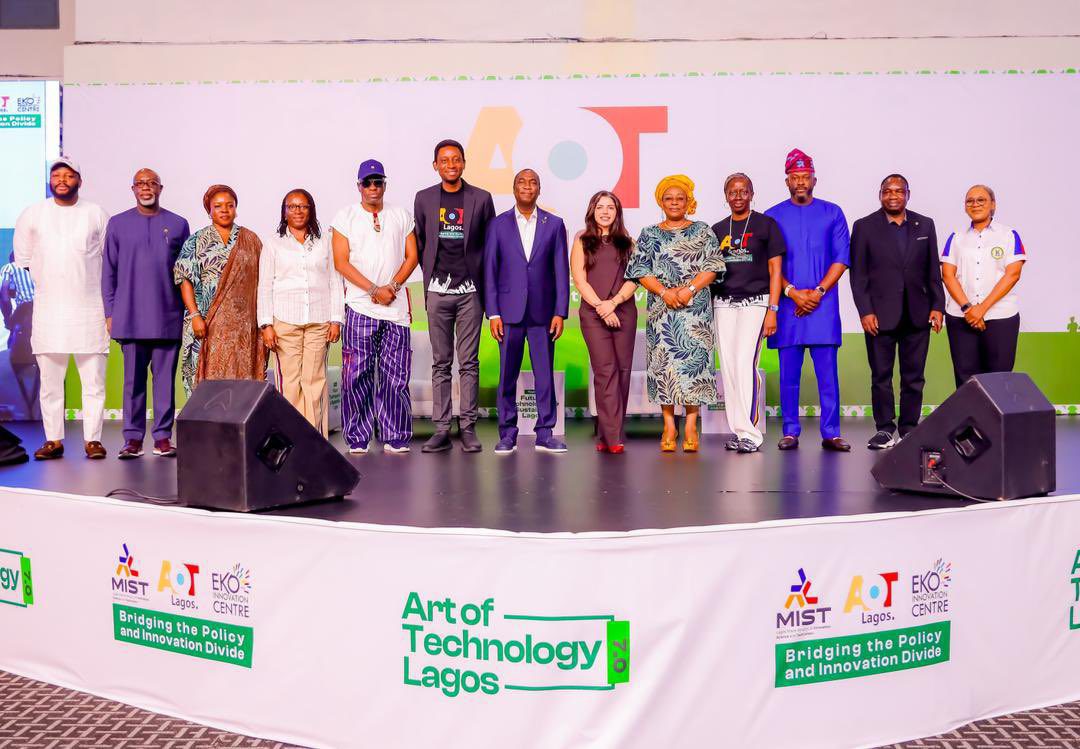
AOT 7.0 speakers

Lagos’ digital gains, next steps for a smarter city

In his keynote, Deputy Governor Obafemi Hamzat said the event represents a future “where ideas become solutions and where Lagos continues to define the innovation agenda of our country and our continent.”

He said this year’s theme, Future Technologies and Sustainable Lagos, aligns with the mission of building a city that is digital, resilient, inclusive and globally competitive.

Hamzat noted that Lagos is now considered “the fastest rising innovation centre on the planet,” a development he credited to collaboration between private and public players in the ecosystem.

According to him, the state’s investments in infrastructure and digital systems are aimed at increasing the contribution of technology and innovation to Lagos’ GDP.

For us, we see technology not just as an enabler. We see it as a foundation for sustainable growth, efficient governance, and a resilient city,” Hamzat said.

The deputy governor highlighted milestones from the last five years, starting with the state’s push toward a smarter and safer city. He said the smart city transformation is already delivering visible impact through infrastructure like the intelligent transport system and automated traffic enforcement. These tools, he said, show how automation improves compliance, transparency and safety.

Hamzat stated that the Safe City intelligent video surveillance network has aided several operations.

Connectivity remains a major pillar of the government’s strategy. Hamzat said that between 2020 and 2024, the state deployed 2,500 kilometres of fibre optic and duct infrastructure. “A connected Lagos will be a prosperous Lagos,” he said, adding that the network has enabled more than one million residents to gain new or improved broadband access within four years.

This connectivity, he said, is powering one of Africa’s fastest-growing digital economies, with Lagos now hosting a strong cluster of data centres, cloud platforms and enterprise networks.

Read also: Airtel Nigeria to take on MTN, set to build 38MW data centre in Lagos

On governance, Hamzat said, and earlier stated by Alake, the state is shifting to a digital-first model. In five years, more than 16 ministries, departments and agencies now offer front-facing digital services.

Licencing, tax processes, permits, revenue collection and public records are transitioning into unified data systems. He said the Lagos data portal, which receives over 10,000 daily visitors, is becoming the country’s standard for e-governance. “We are building a government that works at the speed of a citizen,” he said.

Funding research and innovation remains a priority for the state. Through the Lagos State Science Research and Innovation Council, Hamzat echoed Alake’s comment that the government has committed almost NGN2 billion to support innovators, researchers and startups.

More than 75 startups across real tech, agritech, construction tech, edtech and climate tech have received grants and support. He described this pipeline as the engine of long-term competitiveness and said Lagos is now the number one sovereign funder of research and development in the country.

Hamzat also highlighted the newly commissioned Lagos State Cybersecurity Council, which he called the first of its kind at the sub-national level.

The council, made up of private sector experts, regulators and global technology leaders, will develop a cybersecurity framework for Lagos, strengthen readiness against threats, build talent capacity and promote secure data practices.

Cybersecurity is no longer optional. It is the firewall protecting our ambitions,” the deputy governor said.

Hamzat said Lagos is accelerating into a fully digital economy, powered by e-governance, smart city systems, the Internet of Things, fintech and artificial intelligence.

He added that the Lagos Innovation Bill now in public review will institutionalise innovation as a core part of the state’s socioeconomic strategy and expand access to funding for startups and researchers. “Infrastructure, policy, talent and investment are all moving in alignment,” he said.

He added that artificial intelligence will support predictive governance, healthcare, traffic optimisation and smart urban planning, while IoT systems will support water management, flood monitoring and environmental sustainability.

Hamzat described the present moment as one that will define how Lagos plans, operates and competes in the decade ahead. “We are not just building technology. We must also secure it,” he said.

Disclaimer: The articles reposted on this site are sourced from public platforms and are provided for informational purposes only. They do not necessarily reflect the views of MEXC. All rights remain with the original authors. If you believe any content infringes on third-party rights, please contact service@support.mexc.com for removal. MEXC makes no guarantees regarding the accuracy, completeness, or timeliness of the content and is not responsible for any actions taken based on the information provided. The content does not constitute financial, legal, or other professional advice, nor should it be considered a recommendation or endorsement by MEXC.

You May Also Like

Team Launches AI Tools to Boost KYC and Mainnet Migration for Investors

Team Launches AI Tools to Boost KYC and Mainnet Migration for Investors

The post Team Launches AI Tools to Boost KYC and Mainnet Migration for Investors appeared on BitcoinEthereumNews.com. The Pi Network team has announced the implementation of upgrades to simplify verification and increase the pace of its Mainnet migration. This comes before the token unlock happening this December. Pi Network Integrates AI Tools to Boost KYC Process In a recent blog post, the Pi team said it has improved its KYC process with the same AI technology as Fast Track KYC. This will cut the number of applications waiting for human review by 50%. As a result, more Pioneers will be able to reach Mainnet eligibility sooner. Fast Track KYC was first introduced in September to help new and non-users set up a Mainnet wallet. This was in an effort to reduce the long wait times caused by the previous rule. The old rule required completing 30 mining sessions before qualifying for verification. Fast Track cannot enable migration on its own. However, it is now fully part of the Standard KYC process which allows access to Mainnet. This comes at a time when the network is set for another unlock in December. About 190 million tokens will unlock worth approximately $43 million at current estimates.  These updates will help more Pioneers finish their migration faster especially when there are fewer validators available. This integration allows Pi’s validation resources to serve as a platform utility. In the future, applications that need identity verification or human-verified participation can use this system. Team Releases Validator Rewards Update The Pi Network team provided an update about validator rewards. They expect to distribute the first rewards by the end of Q1 2026. This delay happened because they needed to analyze a large amount of data collected since 2021. Currently, 17.5 million users have completed the KYC process, and 15.7 million users have moved to the Mainnet. However, there are around 3 million users…
Share
BitcoinEthereumNews2025/12/06 16:08
Solana Nears $124 Support Amid Cautious Sentiment and Liquidity Reset Potential

Solana Nears $124 Support Amid Cautious Sentiment and Liquidity Reset Potential

The post Solana Nears $124 Support Amid Cautious Sentiment and Liquidity Reset Potential appeared on BitcoinEthereumNews.com. Solana ($SOL) is approaching a critical support level at $124, where buyers must defend to prevent further declines amid cautious market conditions. A successful hold could initiate recovery toward $138 or higher, while failure might lead to deeper corrections. Solana’s price risks dropping to $124 if current support zones weaken under selling pressure. Reclaiming key resistance around $138 may drive $SOL toward $172–$180 targets. Recent data shows liquidity resets often precede multi-week uptrends, with historical patterns suggesting potential recovery by early 2026. Solana ($SOL) support at $124 tested amid market caution: Will buyers defend or trigger deeper drops? Explore analysis, liquidity signals, and recovery paths for informed trading decisions. What Is the Current Support Level for Solana ($SOL)? Solana ($SOL) is currently testing a vital support level at $124, following a decline from the $144–$146 resistance zone. Analysts from TradingView indicate that after failing to maintain momentum above $138, the token dipped toward $131 and mid-range support near $134. This positioning underscores the importance of buyer intervention to stabilize the price and prevent further erosion. Solana ($SOL) is in a crucial stage right now, with possible price drops toward important support zones. Recent price activity signals increased downside risks, analysts caution. TradingView contributor Ali notes that Solana may find quick support at $124 after falling from the $144–$146 resistance range. The token eventually tested $131 after failing to hold over $138 and plummeting toward mid-range support near $134. Source: Ali Market indicators reveal downward momentum, with potential short-term volatility around $130–$132 before possibly easing to $126–$127. Should this threshold break, $SOL could slide to the firmer support at $124–$125, according to observations from established charting platforms. Overall sentiment remains guarded, as highlighted by experts monitoring on-chain data. Ali warns that without robust buying interest, additional selling could intensify. TradingView analyst…
Share
BitcoinEthereumNews2025/12/06 16:33