Details BSGAL's implementation on the LVIS dataset using CenterNet2 with ResNet-50/Swin-L backbones.Details BSGAL's implementation on the LVIS dataset using CenterNet2 with ResNet-50/Swin-L backbones.

Technical Details: BSGAL Training, Swin-L Backbone, and Dynamic Threshold Strategy

2025/12/07 02:00

Abstract and 1 Introduction

  1. Related work

    2.1. Generative Data Augmentation

    2.2. Active Learning and Data Analysis

  2. Preliminary

  3. Our method

    4.1. Estimation of Contribution in the Ideal Scenario

    4.2. Batched Streaming Generative Active Learning

  4. Experiments and 5.1. Offline Setting

    5.2. Online Setting

  5. Conclusion, Broader Impact, and References

    \

A. Implementation Details

B. More ablations

C. Discussion

D. Visualization

A. Implementation Details

A.1. Dataset

We choose LVIS (Gupta et al., 2019) as the dataset for our experiments. LVIS is a large-scale instance segmentation dataset, comprising approximately 160,000 images with over 2 million high-quality instance segmentation annotations across 1203 real-world categories. The dataset is further divided into three categories: rare, common, and frequent, based on their occurrence across images. Instances marked as ‘rare’ appear in 1-10 images, ‘common’ instances appear in 11-100 images, whereas ‘frequent’ instances appear in more than 100 images. The overall dataset exhibits a long-tail distribution, closely resembling the data distribution in the real world, and is widely applied under multiple settings, including few-shot segmentation (Liu et al., 2023) and open-world segmentation (Wang et al., 2022; Zhu et al., 2023). Therefore, we believe that selecting LVIS allows for a better reflection of the model’s performance in real-world scenarios. We use the official LVIS dataset splits, with about 100,000 images in the training set and 20,000 images in the validation set.

A.2. Data Generation

Our data generation and annotation process is consistent with Zhao et al. (2023), and we briefly introduce it here. We first use StableDiffusion V1.5 (Rombach et al., 2022a) (SD) as the generative model. For the 1203 categories in LVIS (Gupta et al., 2019), we generate 1000 images per category, with image resolution 512 × 512. The prompt template for generation is “a photo of a single {CATEGORY NAME}”. We use U2Net (Qin et al., 2020), SelfReformer (Yun and Lin, 2022), UFO (Su et al., 2023), and CLIPseg (Luddecke and Ecker ¨ , 2022) respectively to annotate the raw generative images, and select the mask with the highest CLIP score as the final annotation. To ensure data quality, images with CLIP scores below 0.21 are filtered out as low-quality images. During training, we also employ the instance paste strategy provided by Zhao et al. (2023) for data augmentation. For each instance, we randomly resize it to match the distribution of its category in the training set. The maximum number of pasted instances per image is set to 20.

\ In addition, to further expand the diversity of generated data and make our research more universal, we also use other generative models, including DeepFloyd-IF (Shonenkov et al., 2023) (IF) and Perfusion (Tewel et al., 2023) (PER), with 500 images per category per model. For IF, we use the pre-trained model provided by the author, and the generated images are the output of Stage II, with a resolution of 256×256. For PER, the base model we use is StableDiffusion V1.5. For each category, we fine-tune the model using the images croped from the training set, with 400 fine-tuning steps. We use the fine-tuned model to generate images.

\ Table 7. Comparison of different generated data.
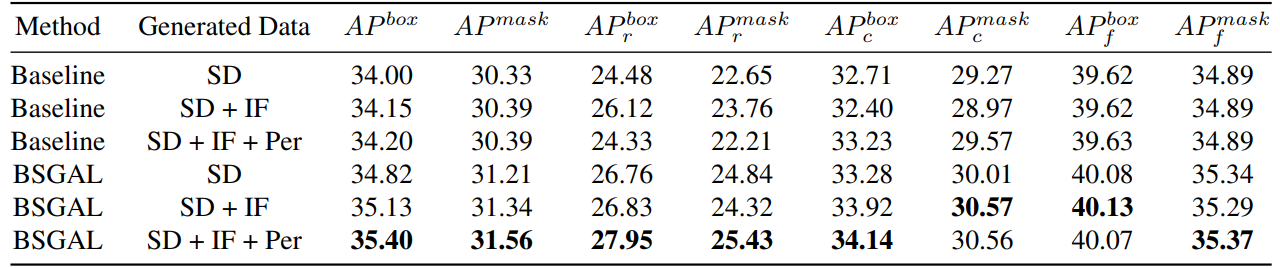
\ We also explore the effect of using different generated data on the model performance (see Table 7). We can see that based on the original StableDiffusion V1.5, using other generative models can bring some performance improvement, but this improvement is not obvious. Specifically, for specific frequency categories, we found that IF has a more significant improvement for rare categories, while PER has a more significant improvement for common categories. This is likely because IF data is more diverse, while PER data is more consistent with the distribution of the training set. Considering that the overall performance has been improved to a certain extent, we finally adopt the generated data of SD + IF + PER for subsequent experiments.

A.3. Model Training

Follow Zhao et al. (2023), We use CenterNet2 (Zhou et al., 2021) as our segmentation model, with ResNet-50 (He et al., 2016) or Swin-L (Liu et al., 2022) as the backbone. For ResNet-50, the maximum training iteration is set to 90,000 and the model is initialized with weights first pretrained on ImageNet-22k then finetuned on LVIS (Gupta et al., 2019), as Zhao

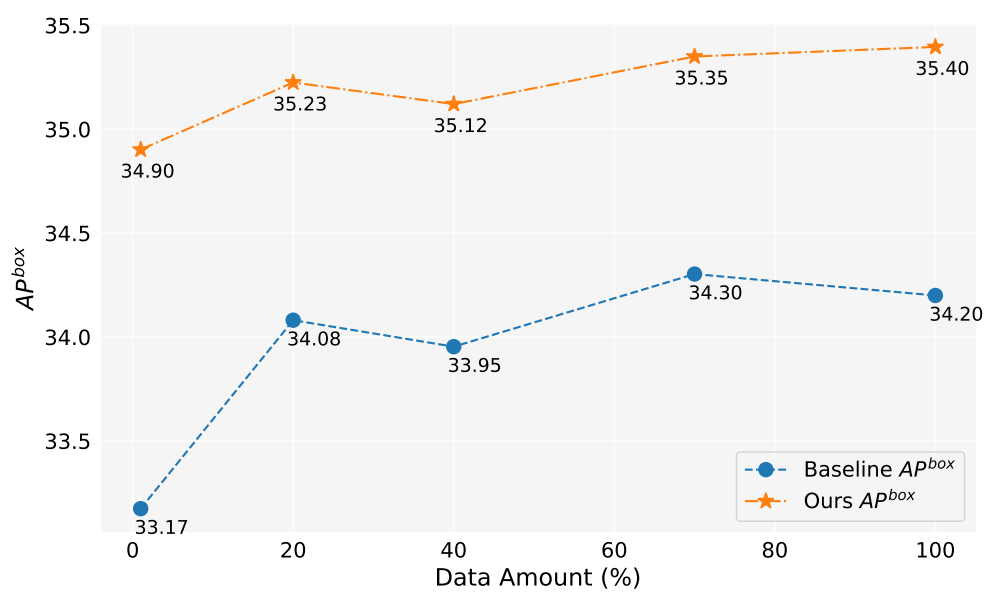
\ Figure 5. Model performances when using different amount of generated data.
\ et al. (2023) did. And we use 4 Nvidia 4090 GPUs with a batch size of 16 during training. As for Swin-L, the maximum training iteration is set to 180,000 and the model is initialized with weights pretrained on ImageNet-22k, since our early experiments show that this initialization can bring a slight improvement compared to the weights trained with LVIS. And we use 4 Nvidia A100 GPUs with a batch size of 16 for training. Besides, due to the large number of parameters of Swin-L, the additional memory occupied by saving the gradient is large, so we actually use the algorithm in Algorithm 2.

\ The other unspecified parameters also follow the same settings as X-Paste (Zhao et al., 2023), such as the AdamW (Loshchilov and Hutter, 2017) optimizer with an initial learning rate of 1e−4.

A.4. Data Amount

In this work, we have generated over 2 million images. Figure 5 shows the model performances when using different amount of generated data(1%,10%,40%,70%,100%). Overall, as the amount of generated data increases, the performance of the model also improves, but there is also some fluctuation. Our method is always better than the baseline, which proves the effectiveness and robustness of our method.

A.5. Contribution Estimation

\ Thus, we essentially calculate the cosine similarity. Then we conducted an experimental comparison, as shown in Table 8,

\ Table 8. Comparison of using grad normalization or not.

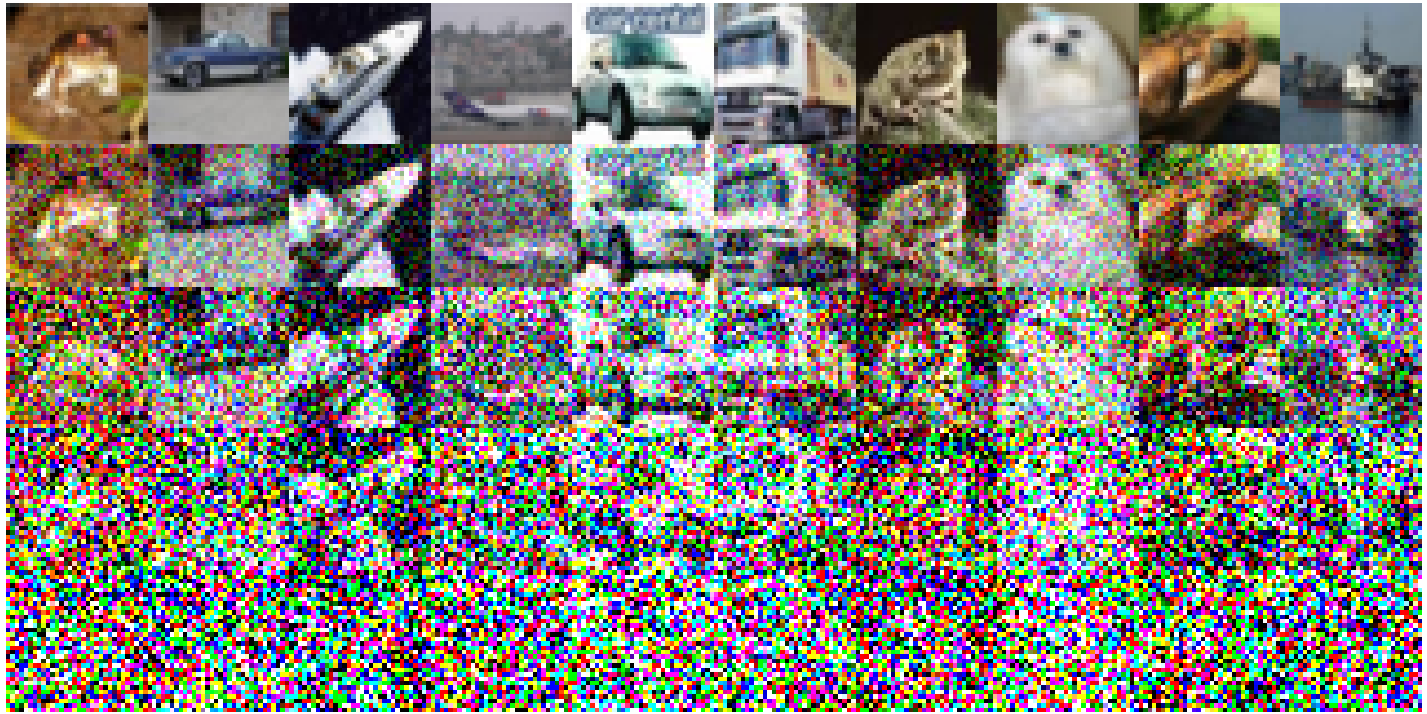
\ Figure 6. Illustration of noisy images exhibiting various noise scales and categories. Each row, from top to bottom, signifies different noise levels, specifically 0, 40, 100, 200, and 400, respectively. All images are sourced from the CIFAR-10 dataset.

\ we can see that if we normalize the gradient, our method will have a certain improvement. In addition, since we need to keep two different thresholds, it is difficult to ensure the consistency of the acceptance rate. So we adopt a dynamic threshold strategy, pre-set an acceptance rate, maintain a queue to save the contribution of the previous iter, and then dynamically adjust the threshold according to the queue, so that the acceptance rate stays at the pre-set acceptance rate.

A.6. Toy Experiment

The following are the specific experimental settings implemented on CIFAR-10: We employed a simple ResNet18 as the baseline model and conducted training over 200 epochs, and the accuracy after training on the original training set is 93.02%. The learning rate is set at 0.1, utilizing the SGD optimizer. A momentum of 0.9 is in effect, with a weight decay of 5e-4. We use a cosine annealing learning rate scheduler. The constructed noisy images are depicted in Figure 6. A decline in image quality is observed as the noise level escalates. Notably, when the noise level reaches 200, the images become significantly challenging to identify. For Table 1, we use Split1 as R, while G consists of ‘Split2 + Noise40’, ‘Split3 + Noise100’, ‘Split4 + Noise200’,

A.7. A Simplification Only Forward Once

\

:::info Authors:

(1) Muzhi Zhu, with equal contribution from Zhejiang University, China;

(2) Chengxiang Fan, with equal contribution from Zhejiang University, China;

(3) Hao Chen, Zhejiang University, China (haochen.cad@zju.edu.cn);

(4) Yang Liu, Zhejiang University, China;

(5) Weian Mao, Zhejiang University, China and The University of Adelaide, Australia;

(6) Xiaogang Xu, Zhejiang University, China;

(7) Chunhua Shen, Zhejiang University, China (chunhuashen@zju.edu.cn).

:::


:::info This paper is available on arxiv under CC BY-NC-ND 4.0 Deed (Attribution-Noncommercial-Noderivs 4.0 International) license.

:::

\

Disclaimer: The articles reposted on this site are sourced from public platforms and are provided for informational purposes only. They do not necessarily reflect the views of MEXC. All rights remain with the original authors. If you believe any content infringes on third-party rights, please contact service@support.mexc.com for removal. MEXC makes no guarantees regarding the accuracy, completeness, or timeliness of the content and is not responsible for any actions taken based on the information provided. The content does not constitute financial, legal, or other professional advice, nor should it be considered a recommendation or endorsement by MEXC.

You May Also Like

CME Group to Launch Solana and XRP Futures Options

CME Group to Launch Solana and XRP Futures Options

The post CME Group to Launch Solana and XRP Futures Options appeared on BitcoinEthereumNews.com. An announcement was made by CME Group, the largest derivatives exchanger worldwide, revealed that it would introduce options for Solana and XRP futures. It is the latest addition to CME crypto derivatives as institutions and retail investors increase their demand for Solana and XRP. CME Expands Crypto Offerings With Solana and XRP Options Launch According to a press release, the launch is scheduled for October 13, 2025, pending regulatory approval. The new products will allow traders to access options on Solana, Micro Solana, XRP, and Micro XRP futures. Expiries will be offered on business days on a monthly, and quarterly basis to provide more flexibility to market players. CME Group said the contracts are designed to meet demand from institutions, hedge funds, and active retail traders. According to Giovanni Vicioso, the launch reflects high liquidity in Solana and XRP futures. Vicioso is the Global Head of Cryptocurrency Products for the CME Group. He noted that the new contracts will provide additional tools for risk management and exposure strategies. Recently, CME XRP futures registered record open interest amid ETF approval optimism, reinforcing confidence in contract demand. Cumberland, one of the leading liquidity providers, welcomed the development and said it highlights the shift beyond Bitcoin and Ethereum. FalconX, another trading firm, added that rising digital asset treasuries are increasing the need for hedging tools on alternative tokens like Solana and XRP. High Record Trading Volumes Demand Solana and XRP Futures Solana futures and XRP continue to gain popularity since their launch earlier this year. According to CME official records, many have bought and sold more than 540,000 Solana futures contracts since March. A value that amounts to over $22 billion dollars. Solana contracts hit a record 9,000 contracts in August, worth $437 million. Open interest also set a record at 12,500 contracts.…
Share
BitcoinEthereumNews2025/09/18 01:39
SHIB Created Overnight Millionaires: Don’t Miss MoonBull Now, the Top Crypto Presale of 2025

SHIB Created Overnight Millionaires: Don’t Miss MoonBull Now, the Top Crypto Presale of 2025

Top crypto presale searches are exploding again as traders hunt for the next runaway hit.SHIB shook the market with wild price swings and overnight meme-fuelled headlines.Millions watched it break resistance like a cat chasing laser lights.But today’s market is shifting toward structured meme ecosystems with real token mechanics.SHIB still moves, but its major upside window already passed for many late entrants.MoonBull is now turning heads as the second chance everyone hoped for. MoonBull presale momentum has been growing faster than a penguin sliding downhill on fresh ice. Its rollout feels like a rare shot for anyone who missed SHIB’s early chaos or DOGE’s legendary liftoff. The presale is already attracting students, analysts, developers, and traders across North America who see how its tokenomics mix structure with meme culture. While SHIB offered early believers a rocket ride, MoonBull presale provides something investors crave in 2025: a fair entry, transparent mechanics, and a price curve designed to reward early movers before the crowd shows up with peanuts in hand. SHIB: The Original Meme Rocket Still Holds Cultural Power SHIB earned its place in crypto folklore. It delivered incredible returns to early holders who jumped in when the price looked like tiny crumbs on the chart. But like a hippo trying to dance on ice, SHIB’s late-stage volatility made it difficult for new investors to find stable footing. Its community remains active, and major exchange listings added legitimacy, yet the explosive 1000x window has cooled over time. SHIB still moves on major announcements, influencer buzz, and ecosystem upgrades, but the odds of repeating its original breakout scale have narrowed. This is why many SHIB fans are exploring MoonBull as their next opportunity. SHIB Created Overnight Millionaires: Don’t Miss MoonBull Now, the Top Crypto Presale of 2025 4 MoonBull ($MOBU) Presale: The Most Exciting Top Crypto Presale Opportunity Right Now MoonBull is rapidly becoming the center of attention for investors scanning the market for the next top crypto presale particularly those who watched SHIB soar and wished they had entered earlier. Its presale is live and advancing through a structured 23-stage progression, where every completed stage increases the price and heightens scarcity. Stage 6 remains one of the most attractive entry windows at $0.00008388, giving early backers access before higher stages push valuations upward. With more than $640K secured and over 2100 holders already onboard, MoonBull continues demonstrating real traction and expanding momentum. A $50,000 allocation at Stage 6 showcases the scale of potential gains. At the current price, this amount yields approximately 596 million tokens. Should the projected listing value of $0.00616 materialize, those tokens would approach a valuation of nearly $3.67 million. Figures like these explain why MoonBull is frequently described as a “second chance” or a “1000x contender” within community circles. Its design merges meme appeal with structural features including burns, reflections, liquidity support, staking incentives, and governance utility. Altogether, MoonBull aims to transform those who missed earlier crypto explosions into early beneficiaries of the next major market cycle. SHIB Created Overnight Millionaires: Don’t Miss MoonBull Now, the Top Crypto Presale of 2025 5 Conclusion Based on our research and market trends, MoonBull stands out as the top crypto presale capturing attention across the United States, Canada, and Mexico. SHIB proved what meme communities can achieve, but its biggest run already happened. MoonBull offers something different: a structured path, rising stages, strong tokenomics, staking, governance, burns, and early pricing that gives regular investors a realistic chance for life-changing upside. With Stage 6 still open, the window to enter before demand skyrockets is shrinking quickly. Anyone searching for their “second chance” in crypto will likely find MoonBull at the center of conversations. SHIB Created Overnight Millionaires: Don’t Miss MoonBull Now, the Top Crypto Presale of 2025 6 For More Information: Website: Visit the Official MOBU Website  Telegram: Join the MOBU Telegram Channel Twitter: Follow MOBU ON X (Formerly Twitter) Frequently Asked Questions for Top Crypto Presale How to find meme coin presale? Meme coin presales appear on official project sites, launchpads, and verified crypto communities. Always check audits, tokenomics, liquidity lock details, and smart contract transparency before contributing. What is the best crypto presale to invest in 2025? Investors favor presales with clear tokenomics, rising stage pricing, strong communities, and deflationary systems. MoonBull currently leads due to its structure, scarcity model, and early entry advantage. Does MoonBull have long-term utility beyond the presale? MoonBull includes burns, reflections, staking, governance, and liquidity systems that support long-term growth. These mechanics help stabilize price action and reward holders over time. Which meme coin will explode in 2025? Analysts expect structured meme tokens with strong tokenomics to dominate. MoonBull is gaining attention because it blends narrative power with measurable mechanics that support growth. Do meme coins have presales? Many meme coins offer presales, but quality varies. Structured presales like MoonBull’s 23-stage model provide better transparency and more predictable price progression. Glossary of Key Terms Meme Coin:A cryptocurrency built around internet culture, humor, or viral trends. While often community-driven, strong meme coins combine entertainment value with real token utility and long-term mechanics. Presale:An early investment phase where tokens are sold before public listing. Prices usually increase in stages, giving early buyers a significant cost advantage and stronger upside potential. Liquidity Lock:A security measure that locks liquidity pool funds for a set period. This prevents developers from withdrawing liquidity and helps stabilize market confidence. Reflections:A passive reward system that distributes a portion of each transaction to token holders. The goal is to encourage holding and create long-term sustainability. Burn Mechanism:A deflationary feature that permanently removes tokens from circulation. Reduced supply increases scarcity and can support price growth over time. APY (Annual Percentage Yield):A measure of yearly return earned on staked tokens. Higher APY rates like MoonBull’s 95% can significantly increase token holdings over time. Governance:A system allowing token holders to vote on project decisions, proposals, burns, campaigns, and strategic changes. More tokens equal more voting power. Article Summary  MoonBull emerges as the top crypto presale for investors searching for their next major opportunity after missing SHIB’s early surge. With 23 rising stages, burns, reflections, staking, governance, and strong transparency, MoonBull offers a structured path to potential exponential returns. SHIB retains cultural impact but presents limited upside compared to its early history. MoonBull’s Stage 6 pricing delivers rare entry potential, especially with projections showing massive upside at listing. For traders seeking second-chance momentum with real mechanics behind it, MoonBull presents one of the strongest setups in the 2025 market cycle. Disclaimer This article is for informational purposes only and does not constitute financial advice. Readers should conduct their own research before investing in any cryptocurrency or presale project. Read More: SHIB Created Overnight Millionaires: Don’t Miss MoonBull Now, the Top Crypto Presale of 2025">SHIB Created Overnight Millionaires: Don’t Miss MoonBull Now, the Top Crypto Presale of 2025
Share
Coinstats2025/12/07 08:15