

BTC Recalibrates After Fed Cut as AI Correlation Deepens, Says Nansen

Crypto markets are stabilizing after the Federal Reserve’s latest rate cut, with traders reassessing how a more data-dependent policy path may influence liquidity conditions heading into early 2026.
According to a new note from on-chain analytics firm Nansen, the combination of revised forward guidance, fresh liquidity tools, and shifting cross-asset dynamics has created a more complex environment for digital assets.
Earlier today, Bitcoin briefly rallied above $92,000 before retreating, mirroring broader volatility across risk markets following the Federal Open Market Committee (FOMC) meeting.
Aurelie Barthere, Principal Research Analyst at Nansen, said markets were braced for a rate cut paired with hawkish messaging but instead received a cut accompanied by “uncertain, data-dependent” guidance. The Fed’s introduction of T-bill purchases and removal of the cap on the standing repo facility added to the perception of a potential liquidity boost in the first quarter of 2026.
AI Stocks Drive BTC’s Latest Pullback
Bitcoin’s post-FOMC dip occurred alongside sharp moves in large U.S. AI names following Oracle’s earnings release. Barthere notes that while the AI sector continues to post strong earnings and capex growth, valuations have climbed to levels that are increasingly difficult to justify as 2026 approaches.
She added that BTC has shown rising correlation with AI-themed equities—a relationship she expects to persist. “I expect that relationship to continue until we see a more meaningful sell-off that fully ‘cleans’ valuations in the sector,” she said. As long as AI stocks react sharply to earnings surprises or guidance revisions, BTC is likely to echo those swings.
Key Resistance at $91K as Positioning Stays Stretched
From a technical and market-structure perspective, Barthere emphasized $91,000 as the dominant resistance level for BTC. Sustained trading above that mark for several weeks would be needed to confirm a renewed uptrend.
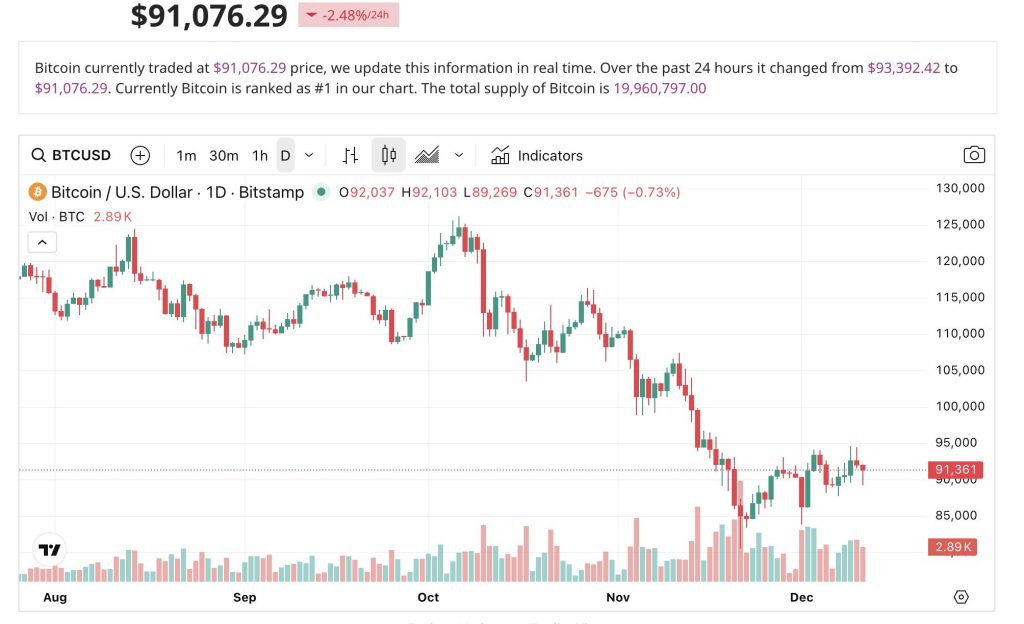
However, the derivatives markets are showing stretched positioning with open interest in both futures and options at record highs. Elevated leverage increases the risk of abrupt moves if sentiment shifts or liquidity thins.
Heading into year-end, traders are holding considerable downside protection. Options imply a 48% probability that BTC reclaims $91,000, and futures funding rates remain only mildly positive, suggesting leveraged longs are not aggressively dominating.
2026 Outlook: Bullish Options, Risk of Disappointment
Looking further ahead, Nansen notes that options markets are structurally bullish for 2026, reflecting expectations for improved liquidity, macro stability, and continued institutional inflows.
However, Barthere cautioned that such positioning could prove vulnerable if economic data or earnings trends fail to meet optimistic assumptions. With markets recalibrating, traders will be watching how liquidity dynamics evolve and whether BTC can break cleanly above resistance to regain upward momentum.
In September, Nansen announced the launch of Nansen AI, a mobile agent designed to transform how investors and traders interact with blockchain data.
You May Also Like

Why Multicoin Capital’s Kyle Samani Is Leaving Crypto for AI and Robotics

SUI Price Rebounds Above $1 as HashKey Enables Trading Support

BitGo wins BaFIN nod to offer regulated crypto trading in Europe
BitGo’s move creates further competition in a burgeoning European crypto market that is expected to generate $26 billion revenue this year, according to one estimate. BitGo, a digital asset infrastructure company with more than $100 billion in assets under custody, has received an extension of its license from Germany’s Federal Financial Supervisory Authority (BaFin), enabling it to offer crypto services to European investors. The company said its local subsidiary, BitGo Europe, can now provide custody, staking, transfer, and trading services. Institutional clients will also have access to an over-the-counter (OTC) trading desk and multiple liquidity venues.The extension builds on BitGo’s previous Markets-in-Crypto-Assets (MiCA) license, also issued by BaFIN, and adds trading to the existing custody, transfer and staking services. BitGo acquired its initial MiCA license in May 2025, which allowed it to offer certain services to traditional institutions and crypto native companies in the European Union.Read more