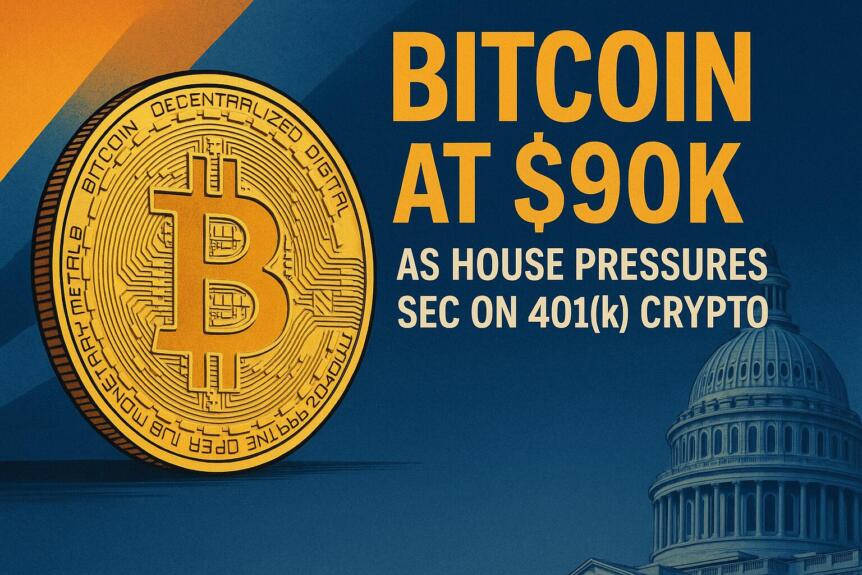
Bitcoin at $90K follows a House committee letter urging the SEC to allow crypto assets in 401(k) plans, reshaping U.S. retirement rules.Bitcoin at $90K follows a House committee letter urging the SEC to allow crypto assets in 401(k) plans, reshaping U.S. retirement rules.

Bitcoin at $90K as House Pressures SEC on 401(k) Crypto
2025/12/13 21:09
Bitcoin At $90k As House Pressures Sec On 401(K) Crypto

Bitcoin at $90K followed congressional pressure urging the SEC to open retirement plans to digital assets.
The House Financial Services Committee sent a formal letter demanding regulatory amendments aligned with executive policy.
As a result, Bitcoin at $90K reflected modest market response tied to potential retirement fund access.

Bitcoin at $90K Reflects Policy Shift Toward Retirement Inclusion

Bitcoin at $90K comes after lawmakers pushed regulators to revise long-standing retirement investment restrictions.
The committee referenced an August 2025 executive order directing agencies to remove barriers to alternative assets.
Therefore, the action reinforced a broader federal effort to modernize retirement investment frameworks.

Lawmakers supported the initiative through the Retirement Investment Choice Act, which seeks to codify executive directives.
Supporters argued existing rules limit retirement savers from accessing evolving financial instruments.
Consequently, Bitcoin at $90K gained relevance within discussions on diversification and regulatory parity.

The letter urged the SEC to clarify permissible structures for digital assets inside defined contribution plans.
Such clarity could reduce legal uncertainty faced by plan administrators under federal retirement law.
Accordingly, Bitcoin at $90K symbolized potential entry into mainstream retirement planning channels.

Ethereum and Digital Assets Gain Legislative Attention Alongside Bitcoin at $90K

Ethereum also entered the discussion as lawmakers addressed broader digital asset inclusion within retirement systems.
The initiative extended beyond a single asset and targeted structural acceptance of blockchain-based investments.
Thus, regulators faced pressure to assess multiple digital assets under uniform fiduciary standards.

Opponents highlighted volatility and suitability concerns tied to digital assets in retirement accounts.
Labor groups warned that speculative exposure could undermine long-term retirement security.
Still, lawmakers maintained that informed choice and disclosure can address fiduciary responsibilities.

The SEC now faces expectations to balance innovation with investor protection mandates.
Any action may redefine how digital assets fit within regulated retirement offerings.
As a result, Bitcoin at $90K remained central to debates shaping future asset classifications.

Institutional Impact Grows as Bitcoin at $90K Signals Structural Change

Institutional implications extend beyond retail access to retirement accounts.
Legal recognition could provide protection for asset managers previously constrained by compliance risk.
Therefore, Bitcoin at $90K underscored a possible shift from permissibility questions toward allocation frameworks.

Asset managers have already explored packaged products designed for defined contribution plans.
Such products aim to meet fiduciary standards while offering controlled digital asset exposure.
Hence, Bitcoin at $90K aligned with accelerating institutional product development.

The SEC response will influence timing rather than direction, according to policy observers.
Congressional pressure suggests sustained momentum regardless of immediate regulatory outcomes.
Ultimately, Bitcoin at $90K reflects an evolving intersection between digital assets and U.S. retirement policy.

This article was originally published as Bitcoin at $90K as House Pressures SEC on 401(k) Crypto on Crypto Breaking News – your trusted source for crypto news, Bitcoin news, and blockchain updates.

Market Opportunity
Housecoin Logo
Housecoin Price(HOUSE)
$0.001899
$0.001899$0.001899
-4.95%
USD
Housecoin (HOUSE) Live Price Chart
Disclaimer: The articles reposted on this site are sourced from public platforms and are provided for informational purposes only. They do not necessarily reflect the views of MEXC. All rights remain with the original authors. If you believe any content infringes on third-party rights, please contact service@support.mexc.com for removal. MEXC makes no guarantees regarding the accuracy, completeness, or timeliness of the content and is not responsible for any actions taken based on the information provided. The content does not constitute financial, legal, or other professional advice, nor should it be considered a recommendation or endorsement by MEXC.

You May Also Like

China Blocks Nvidia’s RTX Pro 6000D as Local Chips Rise

China Blocks Nvidia’s RTX Pro 6000D as Local Chips Rise

The post China Blocks Nvidia’s RTX Pro 6000D as Local Chips Rise appeared on BitcoinEthereumNews.com. China Blocks Nvidia’s RTX Pro 6000D as Local Chips Rise China’s internet regulator has ordered the country’s biggest technology firms, including Alibaba and ByteDance, to stop purchasing Nvidia’s RTX Pro 6000D GPUs. According to the Financial Times, the move shuts down the last major channel for mass supplies of American chips to the Chinese market. Why Beijing Halted Nvidia Purchases Chinese companies had planned to buy tens of thousands of RTX Pro 6000D accelerators and had already begun testing them in servers. But regulators intervened, halting the purchases and signaling stricter controls than earlier measures placed on Nvidia’s H20 chip. Image: Nvidia An audit compared Huawei and Cambricon processors, along with chips developed by Alibaba and Baidu, against Nvidia’s export-approved products. Regulators concluded that Chinese chips had reached performance levels comparable to the restricted U.S. models. This assessment pushed authorities to advise firms to rely more heavily on domestic processors, further tightening Nvidia’s already limited position in China. China’s Drive Toward Tech Independence The decision highlights Beijing’s focus on import substitution — developing self-sufficient chip production to reduce reliance on U.S. supplies. “The signal is now clear: all attention is focused on building a domestic ecosystem,” said a representative of a leading Chinese tech company. Nvidia had unveiled the RTX Pro 6000D in July 2025 during CEO Jensen Huang’s visit to Beijing, in an attempt to keep a foothold in China after Washington restricted exports of its most advanced chips. But momentum is shifting. Industry sources told the Financial Times that Chinese manufacturers plan to triple AI chip production next year to meet growing demand. They believe “domestic supply will now be sufficient without Nvidia.” What It Means for the Future With Huawei, Cambricon, Alibaba, and Baidu stepping up, China is positioning itself for long-term technological independence. Nvidia, meanwhile, faces…
Share
BitcoinEthereumNews2025/09/18 01:37
The Truth Machine: Why SMX Is Becoming the Most Watched Microcap of 2025

The Truth Machine: Why SMX Is Becoming the Most Watched Microcap of 2025

Every industry eventually hits the moment where the narrative collapses under its own weight. Plastic recycling just hit that wall. Too many promises, not enough
Share
Techbullion2025/12/16 03:39
XRP crypto price Analysis: 1D Bearish, Exhaustion Rising

XRP crypto price Analysis: 1D Bearish, Exhaustion Rising

The post XRP crypto price Analysis: 1D Bearish, Exhaustion Rising appeared on BitcoinEthereumNews.com. The market is grinding lower under seller control, and even
Share
BitcoinEthereumNews2025/12/16 03:40