This article was first published on The Bit Journal. Hyperliquid valuation has quietly become one of the most serious debates in crypto finance. What started asThis article was first published on The Bit Journal. Hyperliquid valuation has quietly become one of the most serious debates in crypto finance. What started as

Hyperliquid Valuation Is Drawing Comparisons to Solana: Here is Why

2025/12/17 19:00
4 min read

This article was first published on The Bit Journal.

Hyperliquid valuation has quietly become one of the most serious debates in crypto finance. What started as a decentralized trading protocol is now being discussed in the same breath as large financial infrastructure platforms. That shift alone says something important about where the market may be heading next.

The discussion gained momentum after a major institutional research report framed Hyperliquid as infrastructure rather than speculative DeFi. According to the source, the protocol’s fee design, validator economics, and capital flows resemble those of a platform business more than those of a typical token project. That framing has caught the attention of analysts who usually avoid DeFi narratives.

A DeFi Platform Built Around Real Usage

The Hyperliquid DeFi ecosystem stands out because it earns revenue the old-fashioned way. It charges fees on real trades. CoinMarketCap data shows that crypto perpetual futures reached $60 trillion in total volume in 2025. Most of that activity still flows through centralized exchanges.

Hyperliquid targets the existing market instead of chasing new demand. That matters. History shows platforms grow faster when they pull users from established venues. One well-cited market study notes that “liquidity follows execution quality, not incentives.” That idea sits at the heart of Hyperliquid’s strategy.
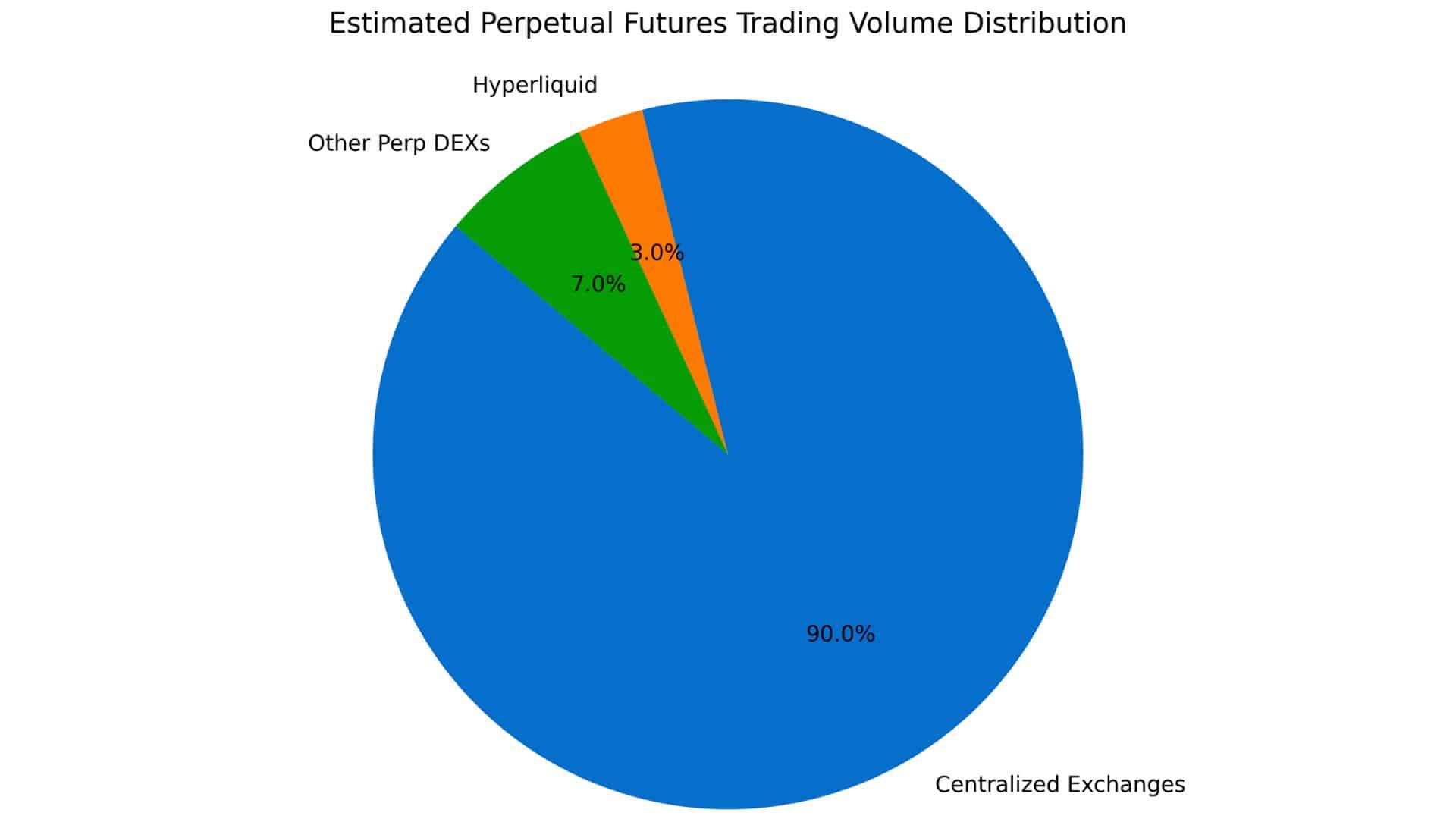
Hyperliquid DeFiCEXs Still Dominate Perp Trading as Hyperliquid Emerges

Why Hyperliquid Valuation Keeps Getting Compared to Solana

The Hyperliquid valuation debate often circles back to Solana’s last major cycle. Early Solana investors focused on speed and throughput. Over time, the conversation shifted toward cash flow, developer stickiness, and settlement value.

A similar change is now happening with Hyperliquid DeFi. Instead of emissions, nearly all protocol revenue is allocated to token buybacks. That means growth reduces supply. Analysts view this structure as closer to traditional equity logic than typical DeFi reward models.

Fees That Change the Long-Term Equation

The fee model sits at the center of the Hyperliquid valuation thesis. When trading volume rises, buybacks increase. This creates a clear link between usage and value. Financial studies on market design suggest buyback-driven systems tend to attract longer-term capital because they reduce dilution risk.

CoinMarketCap figures show that even modest gains in market share from centralized exchanges could generate hundreds of millions in annual fees. That scale explains why institutional desks now take the model seriously.

Competition Exists, but Liquidity Has Memory

Rival platforms have challenged Hyperliquid, including incentive-heavy derivatives exchanges. Some briefly posted higher monthly volume. Analysts noticed unusually high volume-to-open-interest ratios. That often signals reward-driven activity rather than conviction trading.

As incentives fade, traders usually return to platforms with deeper liquidity and tighter spreads. Research on exchange competition shows this pattern repeating across markets. That behavior continues to support the Hyperliquid DeFi growth outlook.

A Valuation Model Still Under Debate

A 50x multiple remains controversial. Critics question whether a leverage-driven trading network deserves infrastructure-style pricing. Supporters argue that decentralized trading systems with sustainable fees should be analyzed using the same analytical framework as payment rails.

This tension now defines the Hyperliquid valuation conversation. It is no longer about hype cycles. It is about whether decentralized finance can produce durable, predictable revenue.

Conclusion: A Signal Bigger Than One Protocol

The real story behind Hyperliquid valuation goes beyond price targets. It signals how markets may value DeFi platforms in the future. If fee-based models continue to outperform incentive-driven systems, Hyperliquid DeFi could become a reference point for future projects. That shift would reshape how crypto infrastructure is built and priced.

Glossary of Key Terms

Perpetual Futures: Derivatives with no expiration date.

Token Buyback: Using revenue to reduce circulating supply.

Open Interest: Total active derivative positions.

DeFi Infrastructure: Blockchain systems supporting financial activity.

FAQs About Hyperliquid Valuation

1. What is Hyperliquid?

A decentralized perpetual futures trading platform.

2. Why is Hyperliquid valuation important?

It reflects a shift toward infrastructure-style pricing in DeFi.

3. Is Hyperliquid DeFi profitable?

It generates real trading fees linked to usage.

4. How can readers track Hyperliquid’s market performance?

Price data, volume trends, and market rankings can be followed through regularly updated listings on CoinMarketCap.

Sources & References

Coinmarketcap

Bisorg

Cfainstitute

Read More: Hyperliquid Valuation Is Drawing Comparisons to Solana: Here is Why">Hyperliquid Valuation Is Drawing Comparisons to Solana: Here is Why

Market Opportunity
Bitdealer Logo
Bitdealer Price(BIT)
$0,0006796
$0,0006796$0,0006796
-0,05%
USD
Bitdealer (BIT) Live Price Chart
Disclaimer: The articles reposted on this site are sourced from public platforms and are provided for informational purposes only. They do not necessarily reflect the views of MEXC. All rights remain with the original authors. If you believe any content infringes on third-party rights, please contact service@support.mexc.com for removal. MEXC makes no guarantees regarding the accuracy, completeness, or timeliness of the content and is not responsible for any actions taken based on the information provided. The content does not constitute financial, legal, or other professional advice, nor should it be considered a recommendation or endorsement by MEXC.

You May Also Like

XRP Ignites As Spot Volume Skyrockets

XRP Ignites As Spot Volume Skyrockets

XRP surprised this weekend with a sudden surge of +2,860% on its spot flows in barely eight hours. This historic peak, occurring in a quiet market, reignites speculation
Share
Coinstats2026/02/09 05:05
Cloud mining is gaining popularity around the world. LgMining’s efficient cloud mining platform helps you easily deploy digital assets and lead a new wave of crypto wealth.

Cloud mining is gaining popularity around the world. LgMining’s efficient cloud mining platform helps you easily deploy digital assets and lead a new wave of crypto wealth.

The post Cloud mining is gaining popularity around the world. LgMining’s efficient cloud mining platform helps you easily deploy digital assets and lead a new wave of crypto wealth. appeared on BitcoinEthereumNews.com. SPONSORED POST* As the cryptocurrency market continues its recovery, Ethereum has once again become the center of attention for investors. Recently, the well-known crypto mining platform LgMining predicted that Ethereum may surpass its previous all-time high and surge past $5,000. In light of this rare market opportunity, choosing a high-efficiency, secure, and low-cost mining platform has become the top priority for many investors. With its cutting-edge hardware, intelligent technology, and low-cost renewable energy advantages, LgMining Cloud Mining is rapidly emerging as a leader in the cloud mining industry. Ethereum: The Driving Force of the Crypto Market Ethereum is not only the second-largest cryptocurrency by market capitalization but also the backbone of the blockchain smart contract ecosystem. From DeFi (Decentralized Finance) to NFTs (Non-Fungible Tokens) and the broader Web3.0 infrastructure, most innovations are built on Ethereum. This widespread utility gives Ethereum tremendous growth potential. With the upcoming scalability upgrades, the Ethereum network is expected to offer improved performance and transaction speed—likely triggering a fresh wave of market enthusiasm. According to the LgMining research team, Ethereum’s share among institutional and retail investors continues to grow. Combined with shifting monetary policies and global economic uncertainties, Ethereum is expected to break past its previous high of over $4,000 and aim for $5,000 or more in the coming months. LgMining Cloud Mining: Unlocking a Low-Barrier Path to Wealth Traditional crypto mining often requires expensive mining rigs, stable electricity, and complex maintenance—making it inaccessible for the average person. LgMining Cloud Mining breaks down these barriers, allowing anyone to easily participate in mining Ethereum and Bitcoin without owning hardware. LgMining builds its robust and efficient mining infrastructure around three core advantages: 1. High-End Equipment LgMining uses top-tier mining hardware with exceptional computing power and reliability. The platform’s ASIC and GPU miners are carefully selected and tested to…
Share
BitcoinEthereumNews2025/09/18 03:04
Polygon Tops RWA Rankings With $1.1B in Tokenized Assets

Polygon Tops RWA Rankings With $1.1B in Tokenized Assets

The post Polygon Tops RWA Rankings With $1.1B in Tokenized Assets appeared on BitcoinEthereumNews.com. Key Notes A new report from Dune and RWA.xyz highlights Polygon’s role in the growing RWA sector. Polygon PoS currently holds $1.13 billion in RWA Total Value Locked (TVL) across 269 assets. The network holds a 62% market share of tokenized global bonds, driven by European money market funds. The Polygon POL $0.25 24h volatility: 1.4% Market cap: $2.64 B Vol. 24h: $106.17 M network is securing a significant position in the rapidly growing tokenization space, now holding over $1.13 billion in total value locked (TVL) from Real World Assets (RWAs). This development comes as the network continues to evolve, recently deploying its major “Rio” upgrade on the Amoy testnet to enhance future scaling capabilities. This information comes from a new joint report on the state of the RWA market published on Sept. 17 by blockchain analytics firm Dune and data platform RWA.xyz. The focus on RWAs is intensifying across the industry, coinciding with events like the ongoing Real-World Asset Summit in New York. Sandeep Nailwal, CEO of the Polygon Foundation, highlighted the findings via a post on X, noting that the TVL is spread across 269 assets and 2,900 holders on the Polygon PoS chain. The Dune and https://t.co/W6WSFlHoQF report on RWA is out and it shows that RWA is happening on Polygon. Here are a few highlights: – Leading in Global Bonds: Polygon holds 62% share of tokenized global bonds (driven by Spiko’s euro MMF and Cashlink euro issues) – Spiko U.S.… — Sandeep | CEO, Polygon Foundation (※,※) (@sandeepnailwal) September 17, 2025 Key Trends From the 2025 RWA Report The joint publication, titled “RWA REPORT 2025,” offers a comprehensive look into the tokenized asset landscape, which it states has grown 224% since the start of 2024. The report identifies several key trends driving this expansion. According to…
Share
BitcoinEthereumNews2025/09/18 00:40