A statistical mirage briefly convinced the crypto market this week that mid-sized whales had purchased roughly $5 billion of Bitcoin. During the past week, socialA statistical mirage briefly convinced the crypto market this week that mid-sized whales had purchased roughly $5 billion of Bitcoin. During the past week, social

Bitcoin’s viral $5 billion whale buy signal was actually a dangerous trap set by institutional accounting

A statistical mirage briefly convinced the crypto market this week that mid-sized whales had purchased roughly $5 billion of Bitcoin.

During the past week, social media feeds filled with charts showing that roughly 54,000 Bitcoins are flooding into “shark” wallets, which are addresses holding between 100 and 1,000 coins.

As a result, many industry players interpreted this as evidence that aggressive BTC accumulation was underway, in anticipation of a breakout.

Notably, the story circulated as Bitcoin pushed back toward $90,000 on Dec. 17, driven by perceptions of institutional demand.

However, CryptoSlate's review of the blockchain data suggests the demand was a phantom. The “purchased” coins did not come from new buyers entering the market.

Instead, they migrated from the massive cold-storage vaults of custodial giants, which appear to be breaking large, distinct holdings into smaller chunks.

As the BTC market matures into an institutional asset class, this episode highlights a widening gap between the complex reality of ETF-era market structure and the simplified on-chain signals traders still use to navigate it.

The BTC great wallet migration

The flaw in the bullish thesis lies in a failure to track the other side of the ledger.

CryptoVizart, a Glassnode analyst, reported that the “shark” cohort’s aggregate balance has swelled by approximately 270,000 Bitcoin since Nov. 16. At a price of $90,000, that represents nearly $24.3 billion in apparent buying pressure.

Bitcoin Sharks Net PositionBitcoin Sharks Net Position Changes (Source: Glassnode)

Viewed in isolation, this chart implies a massive vote of confidence from high-net-worth individuals.

However, when matched against the “Mega-Whale” cohort—entities holding more than 100,000 Bitcoin—the signal inverts. During the exact window that the sharks gained 270,000 coins, the mega-whale cohort shed roughly 300,000.

Bitcoin Shark HoldingsBitcoin Shark Holdings (Source: Glassnode)

The two lines move in near lockstep. The supply didn’t vanish from the market; it just moved down a tier.

Cryptovizart said:

In institutional finance, money does not teleport. When billions of dollars leave the largest wallets and a nearly identical amount appears instantly in mid-sized wallets within the same network, it indicates an internal transfer rather than a sale.

Audit Season and The Collateral Shuffle

Meanwhile, the timing of this shuffle—mid-December—is unlikely to be a coincidence. It appears driven by the mundane realities of corporate accounting and the operational requirements of the ETF market.

First, the audit season is approaching. Publicly traded miners, ETF issuers, and exchanges are subject to standard year-end verification processes.

Auditors often require funds to be segregated into specific wallet structures to verify ownership, forcing custodians to move assets from commingled omnibus accounts into discrete addresses.

This creates a blizzard of on-chain volume that has zero economic impact.

Second, custodians may be preparing for the maturation of the crypto-collateral market.

With spot ETF options now trading, the need for efficient collateral management is rising. A 50,000 BTC block is unwieldy as collateral for a standard margin requirement; fifty separate 1,000 BTC addresses are operationally superior.

Notably, the available market data support this view. Coinbase has shifted approximately 640,000 Bitcoin between internal wallets in recent weeks, according to exchange flow data.

Timechain Index founder Sani also reported that Fidelity Digital Assets executed a similar restructuring, moving over 57,000 Bitcoin in a single day into addresses clustered just below the 1,000 Bitcoin threshold.

This suggests the plumbing of a financialized asset being prepped for leverage, not the footprint of spot accumulation.

The leverage trap

If the $5 billion in spot demand was a mirage, the question remains: what drove yesterday’s violent price action? The data points to derivatives leverage rather than spot conviction.

As the “shark accumulation” charts went viral, open interest in leveraged long positions spiked.

However, the BTC price action that followed was fragile. Bitcoin experienced a rapid spike to $90,000, followed by an immediate collapse to roughly $86,000—a pattern traders often associate with liquidity hunts rather than organic trend shifts.

The Kobeissi Letter reported that market liquidations drove the move. Roughly $120 million in short positions were forced closed on the way up, followed minutes later by the wipeout of $200 million in longs on the way down.

This was corroborated by blockchain analytical firm Santiment, which also stated:

Bitcoin Leverage Chart Showing Increased Bitcoin Leverage and Volatility (Source: Santiment)

So, the market didn't re-rate BTC based on its fundamental value. Instead, it washed out speculative positions that were chasing a narrative.

The liquidity illusion

The risk for investors who rely on these metrics is a phenomenon known as the “Liquidity Illusion.”

For the past week, bulls have pointed to the shark accumulation as evidence of a rising floor price. The logic suggests that if “smart money” bought billions at $88,000, they will defend that level.

However, if that accumulation is merely an accounting adjustment by a custodian, that support level may not exist. The coins in those shark wallets are likely held by the same entities that had them last month, strictly for clients who may sell at any moment.

Considering this, one can conclude that the on-chain heuristics that worked in prior cycles are breaking down in the ETF era.

In a world where few major custodians control the vast majority of institutional supply, a simple database query is no longer a reliable proxy for market sentiment.

The post Bitcoin’s viral $5 billion whale buy signal was actually a dangerous trap set by institutional accounting appeared first on CryptoSlate.

Market Opportunity
1 Logo
1 Price(1)
$0.006193
$0.006193$0.006193
+7.42%
USD
1 (1) Live Price Chart
Disclaimer: The articles reposted on this site are sourced from public platforms and are provided for informational purposes only. They do not necessarily reflect the views of MEXC. All rights remain with the original authors. If you believe any content infringes on third-party rights, please contact service@support.mexc.com for removal. MEXC makes no guarantees regarding the accuracy, completeness, or timeliness of the content and is not responsible for any actions taken based on the information provided. The content does not constitute financial, legal, or other professional advice, nor should it be considered a recommendation or endorsement by MEXC.

You May Also Like

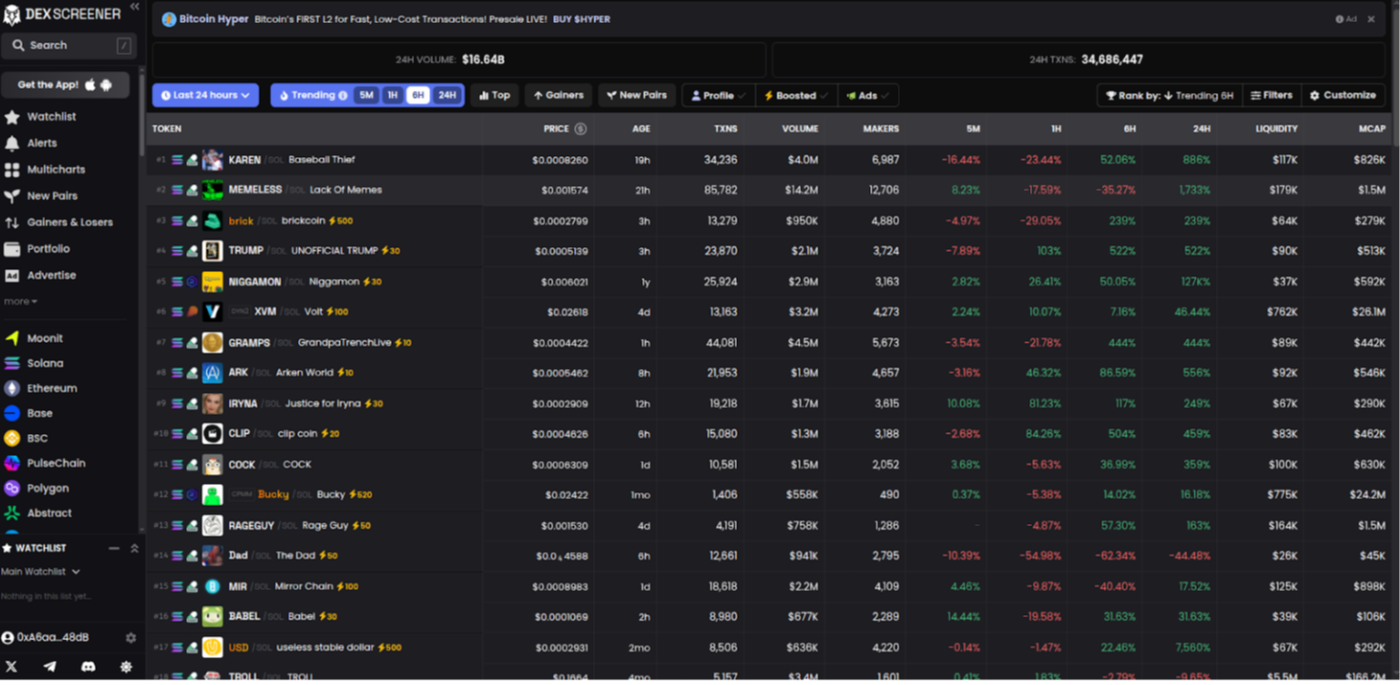
Building a DEXScreener Clone: A Step-by-Step Guide

Building a DEXScreener Clone: A Step-by-Step Guide

DEX Screener is used by crypto traders who need access to on-chain data like trading volumes, liquidity, and token prices. This information allows them to analyze trends, monitor new listings, and make informed investment decisions. In this tutorial, I will build a DEXScreener clone from scratch, covering everything from the initial design to a functional app. We will use Streamlit, a Python framework for building full-stack apps.
Share
Hackernoon2025/09/18 15:05
Which DOGE? Musk's Cryptic Post Explodes Confusion

Which DOGE? Musk's Cryptic Post Explodes Confusion

A viral chart documenting a sharp decline in U.S. federal employment during President Trump's second term has sparked unexpected confusion in cryptocurrency markets
Share
Coinstats2025/12/20 01:13
Google's AP2 protocol has been released. Does encrypted AI still have a chance?

Google's AP2 protocol has been released. Does encrypted AI still have a chance?

Following the MCP and A2A protocols, the AI Agent market has seen another blockbuster arrival: the Agent Payments Protocol (AP2), developed by Google. This will clearly further enhance AI Agents' autonomous multi-tasking capabilities, but the unfortunate reality is that it has little to do with web3AI. Let's take a closer look: What problem does AP2 solve? Simply put, the MCP protocol is like a universal hook, enabling AI agents to connect to various external tools and data sources; A2A is a team collaboration communication protocol that allows multiple AI agents to cooperate with each other to complete complex tasks; AP2 completes the last piece of the puzzle - payment capability. In other words, MCP opens up connectivity, A2A promotes collaboration efficiency, and AP2 achieves value exchange. The arrival of AP2 truly injects "soul" into the autonomous collaboration and task execution of Multi-Agents. Imagine AI Agents connecting Qunar, Meituan, and Didi to complete the booking of flights, hotels, and car rentals, but then getting stuck at the point of "self-payment." What's the point of all that multitasking? So, remember this: AP2 is an extension of MCP+A2A, solving the last mile problem of AI Agent automated execution. What are the technical highlights of AP2? The core innovation of AP2 is the Mandates mechanism, which is divided into real-time authorization mode and delegated authorization mode. Real-time authorization is easy to understand. The AI Agent finds the product and shows it to you. The operation can only be performed after the user signs. Delegated authorization requires the user to set rules in advance, such as only buying the iPhone 17 when the price drops to 5,000. The AI Agent monitors the trigger conditions and executes automatically. The implementation logic is cryptographically signed using Verifiable Credentials (VCs). Users can set complex commission conditions, including price ranges, time limits, and payment method priorities, forming a tamper-proof digital contract. Once signed, the AI Agent executes according to the conditions, with VCs ensuring auditability and security at every step. Of particular note is the "A2A x402" extension, a technical component developed by Google specifically for crypto payments, developed in collaboration with Coinbase and the Ethereum Foundation. This extension enables AI Agents to seamlessly process stablecoins, ETH, and other blockchain assets, supporting native payment scenarios within the Web3 ecosystem. What kind of imagination space can AP2 bring? After analyzing the technical principles, do you think that's it? Yes, in fact, the AP2 is boring when it is disassembled alone. Its real charm lies in connecting and opening up the "MCP+A2A+AP2" technology stack, completely opening up the complete link of AI Agent's autonomous analysis+execution+payment. From now on, AI Agents can open up many application scenarios. For example, AI Agents for stock investment and financial management can help us monitor the market 24/7 and conduct independent transactions. Enterprise procurement AI Agents can automatically replenish and renew without human intervention. AP2's complementary payment capabilities will further expand the penetration of the Agent-to-Agent economy into more scenarios. Google obviously understands that after the technical framework is established, the ecological implementation must be relied upon, so it has brought in more than 60 partners to develop it, almost covering the entire payment and business ecosystem. Interestingly, it also involves major Crypto players such as Ethereum, Coinbase, MetaMask, and Sui. Combined with the current trend of currency and stock integration, the imagination space has been doubled. Is web3 AI really dead? Not entirely. Google's AP2 looks complete, but it only achieves technical compatibility with Crypto payments. It can only be regarded as an extension of the traditional authorization framework and belongs to the category of automated execution. There is a "paradigm" difference between it and the autonomous asset management pursued by pure Crypto native solutions. The Crypto-native solutions under exploration are taking the "decentralized custody + on-chain verification" route, including AI Agent autonomous asset management, AI Agent autonomous transactions (DeFAI), AI Agent digital identity and on-chain reputation system (ERC-8004...), AI Agent on-chain governance DAO framework, AI Agent NPC and digital avatars, and many other interesting and fun directions. Ultimately, once users get used to AI Agent payments in traditional fields, their acceptance of AI Agents autonomously owning digital assets will also increase. And for those scenarios that AP2 cannot reach, such as anonymous transactions, censorship-resistant payments, and decentralized asset management, there will always be a time for crypto-native solutions to show their strength? The two are more likely to be complementary rather than competitive, but to be honest, the key technological advancements behind AI Agents currently all come from web2AI, and web3AI still needs to keep up the good work!
Share
PANews2025/09/18 07:00