President Donald Trump successfully rallied House Republicans back into line Tuesday night after personally meeting with GOP holdouts who had blocked major crypto legislation earlier in the day. The late-evening intervention secured commitments from 11 of the 12 Republicans needed to advance the stablecoin-focused GENIUS Act and companion crypto bills. Trump Steps Up After Unexpected Defeat The House voted 196-223 against a procedural rule Tuesday during “Crypto Week” that would have allowed the GENIUS Act, the CLARITY Act, and the Anti-CBDC Surveillance State Act to advance to floor debate. The unexpected defeat threatened to derail the administration’s push for comprehensive digital asset legislation. Trump wrote on Truth Social. Many Republicans who voted against the bills expressed concerns that the GENIUS Act could enable a central bank digital currency despite language explicitly prohibiting the Federal Reserve from creating one. The bill states it “shall not be construed as expanding the Fed’s authority to offer services directly to the public.” The turnaround came after months of bipartisan work on the GENIUS Act, which passed the Senate 68-30 in June with 18 Democrats joining most Republicans. The legislation requires stablecoin issuers to maintain full dollar backing and establishes clear federal oversight frameworks. Republican Revolt Nearly Derails Crypto Legislation Thirteen Republicans initially voted against the procedural rule, citing fears about potential CBDC authorization. The “no” votes included prominent conservatives such as Reps. Marjorie Taylor Greene (Ga.), Chip Roy (Texas), and Andy Biggs (Ariz.). “ I just voted NO on the Rule for the GENIUS Act because it does not include a ban on Central Bank Digital Currency and because Speaker Johnson did not allow us to submit amendments, ” Rep. Greene wrote on X. The revolt occurred despite House Republicans’ strategy to advance the Senate version without amendments, thereby expediting the bill’s arrival at Trump’s desk. This approach was designed to deliver the first major crypto legislation to clear both chambers of Congress. Speaker Mike Johnson participated in Tuesday’s Oval Office meeting via telephone and committed to scheduling the re-vote as early as possible Wednesday morning. 🚨NOTICE OF ACTION🚨 The Committee granted, by a recorded vote of 8-4, a rule providing for consideration of H.R. 4016, H.R. 3633, H.R. 1919, and S. 1582. Thanks to @HouseAppropsGOP , @FinancialCmte , and @HouseAgGOP for their testimony tonight. pic.twitter.com/oAqzRkXVRa — House Rules Committee (@RulesReps) July 15, 2025 The Committee on Rules had granted an 8-4 vote providing consideration for the crypto bills following testimony from key House committees. Rep. Warren Davidson, a Republican who generally supports crypto policy, opposed the GENIUS Act strategy , calling the decision to separate the bills “designed to ultimately fail.” However, Financial Services Chair French Hill defended the approach, stating the bills “will protect investors, consumers, and make America a leader in financial technology.” Even Congressman Tim Moore has voiced his support on X in a post he made a few hours ago. Congress has a real opportunity to ensure America leads on crypto. The House must pass the CLARITY Act, the GENIUS Act, and the Anti-CBDC Surveillance State Act to protect innovation, privacy, and the future of the U.S. dollar. pic.twitter.com/dZsRMh40fT — Congressman Tim Moore (@RepTimMooreNC) July 15, 2025 The GENIUS Act would establish federal licensing requirements for stablecoin issuers and mandate full backing with U.S. dollars or equivalent liquid assets. Consumer protections are included for bankruptcy scenarios, with stablecoin holders receiving priority payments. Treasury Chief Champions Stablecoins as Dollar Reinforcement Tool Treasury Secretary Scott Bessent has become one of the key advocates for the GENIUS Act, declaring that stablecoins can “reinforce dollar supremacy” rather than threaten U.S. monetary dominance. His comments directly address European concerns about American digital asset policies. Crypto is not a threat to the dollar. In fact, stablecoins can reinforce dollar supremacy. Digital assets are one of the most important phenomena in the world right now, yet they have been ignored by national governments for far too long. This administration is committed to… pic.twitter.com/vWsLgYyNW7 — Treasury Secretary Scott Bessent (@SecScottBessent) June 18, 2025 The Treasury chief characterized crypto as “one of the most important phenomena in the world right now “ while criticizing how digital assets have been “ignored by national governments for far too long.” His embrace contrasts sharply with growing European resistance to U.S. stablecoin expansion. Italian Economy Minister Giancarlo Giorgetti warned that U.S. stablecoin policies could pose a “more dangerous impact on the euro than trade tariffs.” European officials fear dollar-denominated stablecoins could undermine monetary sovereignty by offering Europeans alternative payment methods that bypass local financial institutions. The stablecoin market has grown from under $10 billion to $239 billion in five years, with 98% of stablecoins pegged to the dollar and 80% of transactions occurring outside the United States. This expansion has prompted the European Central Bank to accelerate its digital euro project , though implementation remains years away. In light of the near-conclusion of the political drama surrounding the GENIUS Act, Federal banking regulators issued guidance on Monday, clarifying that banks can provide cryptocurrency custody services in both fiduciary and non-fiduciary arrangements. The joint statement from the Federal Reserve, FDIC, and OCC emphasized existing risk-management protocols while removing previous restrictions on crypto business engagement.President Donald Trump successfully rallied House Republicans back into line Tuesday night after personally meeting with GOP holdouts who had blocked major crypto legislation earlier in the day. The late-evening intervention secured commitments from 11 of the 12 Republicans needed to advance the stablecoin-focused GENIUS Act and companion crypto bills. Trump Steps Up After Unexpected Defeat The House voted 196-223 against a procedural rule Tuesday during “Crypto Week” that would have allowed the GENIUS Act, the CLARITY Act, and the Anti-CBDC Surveillance State Act to advance to floor debate. The unexpected defeat threatened to derail the administration’s push for comprehensive digital asset legislation. Trump wrote on Truth Social. Many Republicans who voted against the bills expressed concerns that the GENIUS Act could enable a central bank digital currency despite language explicitly prohibiting the Federal Reserve from creating one. The bill states it “shall not be construed as expanding the Fed’s authority to offer services directly to the public.” The turnaround came after months of bipartisan work on the GENIUS Act, which passed the Senate 68-30 in June with 18 Democrats joining most Republicans. The legislation requires stablecoin issuers to maintain full dollar backing and establishes clear federal oversight frameworks. Republican Revolt Nearly Derails Crypto Legislation Thirteen Republicans initially voted against the procedural rule, citing fears about potential CBDC authorization. The “no” votes included prominent conservatives such as Reps. Marjorie Taylor Greene (Ga.), Chip Roy (Texas), and Andy Biggs (Ariz.). “ I just voted NO on the Rule for the GENIUS Act because it does not include a ban on Central Bank Digital Currency and because Speaker Johnson did not allow us to submit amendments, ” Rep. Greene wrote on X. The revolt occurred despite House Republicans’ strategy to advance the Senate version without amendments, thereby expediting the bill’s arrival at Trump’s desk. This approach was designed to deliver the first major crypto legislation to clear both chambers of Congress. Speaker Mike Johnson participated in Tuesday’s Oval Office meeting via telephone and committed to scheduling the re-vote as early as possible Wednesday morning. 🚨NOTICE OF ACTION🚨 The Committee granted, by a recorded vote of 8-4, a rule providing for consideration of H.R. 4016, H.R. 3633, H.R. 1919, and S. 1582. Thanks to @HouseAppropsGOP , @FinancialCmte , and @HouseAgGOP for their testimony tonight. pic.twitter.com/oAqzRkXVRa — House Rules Committee (@RulesReps) July 15, 2025 The Committee on Rules had granted an 8-4 vote providing consideration for the crypto bills following testimony from key House committees. Rep. Warren Davidson, a Republican who generally supports crypto policy, opposed the GENIUS Act strategy , calling the decision to separate the bills “designed to ultimately fail.” However, Financial Services Chair French Hill defended the approach, stating the bills “will protect investors, consumers, and make America a leader in financial technology.” Even Congressman Tim Moore has voiced his support on X in a post he made a few hours ago. Congress has a real opportunity to ensure America leads on crypto. The House must pass the CLARITY Act, the GENIUS Act, and the Anti-CBDC Surveillance State Act to protect innovation, privacy, and the future of the U.S. dollar. pic.twitter.com/dZsRMh40fT — Congressman Tim Moore (@RepTimMooreNC) July 15, 2025 The GENIUS Act would establish federal licensing requirements for stablecoin issuers and mandate full backing with U.S. dollars or equivalent liquid assets. Consumer protections are included for bankruptcy scenarios, with stablecoin holders receiving priority payments. Treasury Chief Champions Stablecoins as Dollar Reinforcement Tool Treasury Secretary Scott Bessent has become one of the key advocates for the GENIUS Act, declaring that stablecoins can “reinforce dollar supremacy” rather than threaten U.S. monetary dominance. His comments directly address European concerns about American digital asset policies. Crypto is not a threat to the dollar. In fact, stablecoins can reinforce dollar supremacy. Digital assets are one of the most important phenomena in the world right now, yet they have been ignored by national governments for far too long. This administration is committed to… pic.twitter.com/vWsLgYyNW7 — Treasury Secretary Scott Bessent (@SecScottBessent) June 18, 2025 The Treasury chief characterized crypto as “one of the most important phenomena in the world right now “ while criticizing how digital assets have been “ignored by national governments for far too long.” His embrace contrasts sharply with growing European resistance to U.S. stablecoin expansion. Italian Economy Minister Giancarlo Giorgetti warned that U.S. stablecoin policies could pose a “more dangerous impact on the euro than trade tariffs.” European officials fear dollar-denominated stablecoins could undermine monetary sovereignty by offering Europeans alternative payment methods that bypass local financial institutions. The stablecoin market has grown from under $10 billion to $239 billion in five years, with 98% of stablecoins pegged to the dollar and 80% of transactions occurring outside the United States. This expansion has prompted the European Central Bank to accelerate its digital euro project , though implementation remains years away. In light of the near-conclusion of the political drama surrounding the GENIUS Act, Federal banking regulators issued guidance on Monday, clarifying that banks can provide cryptocurrency custody services in both fiduciary and non-fiduciary arrangements. The joint statement from the Federal Reserve, FDIC, and OCC emphasized existing risk-management protocols while removing previous restrictions on crypto business engagement.

Trump Secures 11 GOP Votes for GENIUS Act Following Oval Office Meeting — Vote Expected Tomorrow

4 min read

President Donald Trump successfully rallied House Republicans back into line Tuesday night after personally meeting with GOP holdouts who had blocked major crypto legislation earlier in the day.

The late-evening intervention secured commitments from 11 of the 12 Republicans needed to advance the stablecoin-focused GENIUS Act and companion crypto bills.

Trump Steps Up After Unexpected Defeat

The House voted 196-223 against a procedural rule Tuesday during “Crypto Week” that would have allowed the GENIUS Act, the CLARITY Act, and the Anti-CBDC Surveillance State Act to advance to floor debate.

The unexpected defeat threatened to derail the administration’s push for comprehensive digital asset legislation.
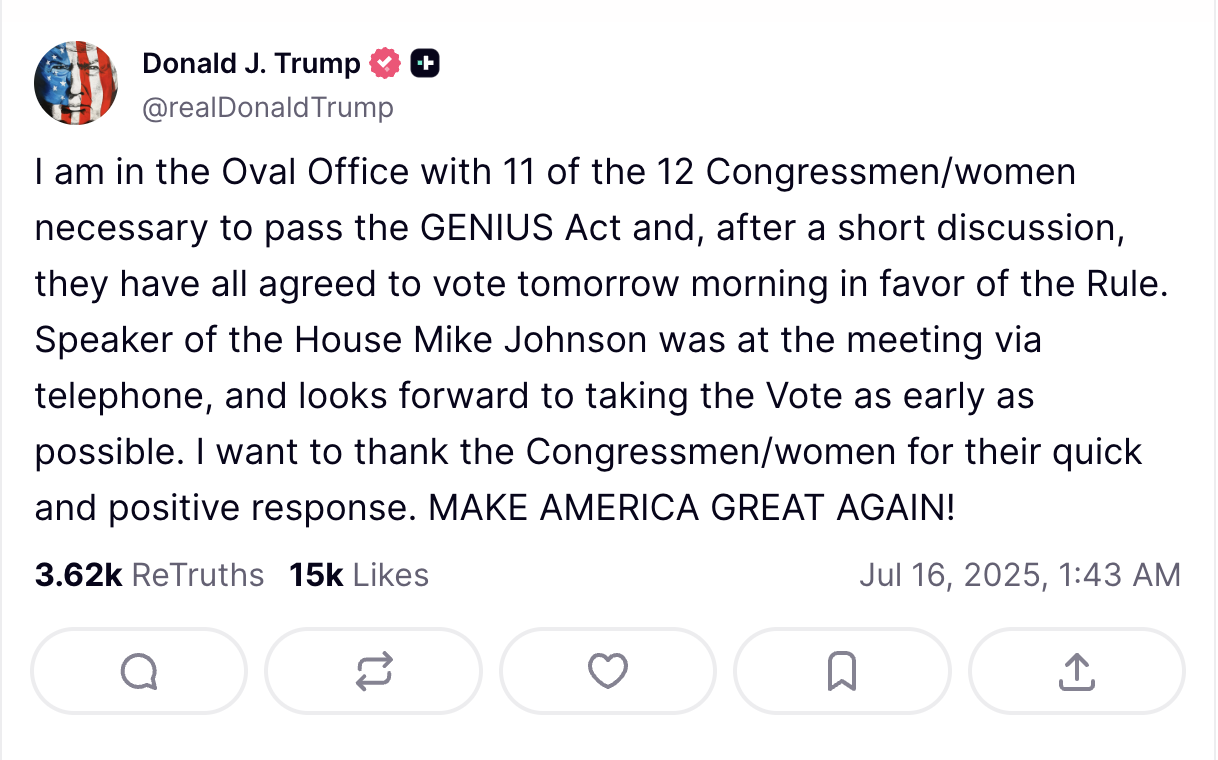
Trump Secures 11 GOP Votes for GENIUS Act Following Oval Office Meeting — Vote Expected TomorrowTrump wrote on Truth Social.

Many Republicans who voted against the bills expressed concerns that the GENIUS Act could enable a central bank digital currency despite language explicitly prohibiting the Federal Reserve from creating one.

The bill states it “shall not be construed as expanding the Fed’s authority to offer services directly to the public.”

The turnaround came after months of bipartisan work on the GENIUS Act, which passed the Senate 68-30 in June with 18 Democrats joining most Republicans.

The legislation requires stablecoin issuers to maintain full dollar backing and establishes clear federal oversight frameworks.

Republican Revolt Nearly Derails Crypto Legislation

Thirteen Republicans initially voted against the procedural rule, citing fears about potential CBDC authorization.

The “no” votes included prominent conservatives such as Reps. Marjorie Taylor Greene (Ga.), Chip Roy (Texas), and Andy Biggs (Ariz.).

I just voted NO on the Rule for the GENIUS Act because it does not include a ban on Central Bank Digital Currency and because Speaker Johnson did not allow us to submit amendments,” Rep. Greene wrote on X.

The revolt occurred despite House Republicans’ strategy to advance the Senate version without amendments, thereby expediting the bill’s arrival at Trump’s desk.

This approach was designed to deliver the first major crypto legislation to clear both chambers of Congress.

Speaker Mike Johnson participated in Tuesday’s Oval Office meeting via telephone and committed to scheduling the re-vote as early as possible Wednesday morning.

The Committee on Rules had granted an 8-4 vote providing consideration for the crypto bills following testimony from key House committees.

Rep. Warren Davidson, a Republican who generally supports crypto policy, opposed the GENIUS Act strategy, calling the decision to separate the bills “designed to ultimately fail.”

However, Financial Services Chair French Hill defended the approach, stating the bills “will protect investors, consumers, and make America a leader in financial technology.”

Even Congressman Tim Moore has voiced his support on X in a post he made a few hours ago.

The GENIUS Act would establish federal licensing requirements for stablecoin issuers and mandate full backing with U.S. dollars or equivalent liquid assets.

Consumer protections are included for bankruptcy scenarios, with stablecoin holders receiving priority payments.

Treasury Chief Champions Stablecoins as Dollar Reinforcement Tool

Treasury Secretary Scott Bessent has become one of the key advocates for the GENIUS Act, declaring that stablecoins can “reinforce dollar supremacy” rather than threaten U.S. monetary dominance.

His comments directly address European concerns about American digital asset policies.

The Treasury chief characterized crypto as “one of the most important phenomena in the world right now while criticizing how digital assets have been “ignored by national governments for far too long.”

His embrace contrasts sharply with growing European resistance to U.S. stablecoin expansion.

Italian Economy Minister Giancarlo Giorgetti warned that U.S. stablecoin policies could pose a “more dangerous impact on the euro than trade tariffs.”

European officials fear dollar-denominated stablecoins could undermine monetary sovereignty by offering Europeans alternative payment methods that bypass local financial institutions.

The stablecoin market has grown from under $10 billion to $239 billion in five years, with 98% of stablecoins pegged to the dollar and 80% of transactions occurring outside the United States.

This expansion has prompted the European Central Bank to accelerate its digital euro project, though implementation remains years away.

In light of the near-conclusion of the political drama surrounding the GENIUS Act, Federal banking regulators issued guidance on Monday, clarifying that banks can provide cryptocurrency custody services in both fiduciary and non-fiduciary arrangements.

The joint statement from the Federal Reserve, FDIC, and OCC emphasized existing risk-management protocols while removing previous restrictions on crypto business engagement.

Market Opportunity
NEAR Logo
NEAR Price(NEAR)
$1.17
$1.17$1.17
+2.00%
USD
NEAR (NEAR) Live Price Chart
Disclaimer: The articles reposted on this site are sourced from public platforms and are provided for informational purposes only. They do not necessarily reflect the views of MEXC. All rights remain with the original authors. If you believe any content infringes on third-party rights, please contact service@support.mexc.com for removal. MEXC makes no guarantees regarding the accuracy, completeness, or timeliness of the content and is not responsible for any actions taken based on the information provided. The content does not constitute financial, legal, or other professional advice, nor should it be considered a recommendation or endorsement by MEXC.

You May Also Like

Taiko and Chainlink to Unleash Reliable Onchain Data for DeFi Ecosystem

Taiko and Chainlink to Unleash Reliable Onchain Data for DeFi Ecosystem

Taiko and Chainlink Data Streams to deliver secure, high-speed onchain data by empowering next-generation DeFi protocols and institutional-grade adoption.
Share
Blockchainreporter2025/09/18 06:10
Why The Green Bay Packers Must Take The Cleveland Browns Seriously — As Hard As That Might Be

Why The Green Bay Packers Must Take The Cleveland Browns Seriously — As Hard As That Might Be

The post Why The Green Bay Packers Must Take The Cleveland Browns Seriously — As Hard As That Might Be appeared on BitcoinEthereumNews.com. Jordan Love and the Green Bay Packers are off to a 2-0 start. Getty Images The Green Bay Packers are, once again, one of the NFL’s better teams. The Cleveland Browns are, once again, one of the league’s doormats. It’s why unbeaten Green Bay (2-0) is a 8-point favorite at winless Cleveland (0-2) Sunday according to betmgm.com. The money line is also Green Bay -500. Most expect this to be a Packers’ rout, and it very well could be. But Green Bay knows taking anyone in this league for granted can prove costly. “I think if you look at their roster, the paper, who they have on that team, what they can do, they got a lot of talent and things can turn around quickly for them,” Packers safety Xavier McKinney said. “We just got to kind of keep that in mind and know we not just walking into something and they just going to lay down. That’s not what they going to do.” The Browns certainly haven’t laid down on defense. Far from. Cleveland is allowing an NFL-best 191.5 yards per game. The Browns gave up 141 yards to Cincinnati in Week 1, including just seven in the second half, but still lost, 17-16. Cleveland has given up an NFL-best 45.5 rushing yards per game and just 2.1 rushing yards per attempt. “The biggest thing is our defensive line is much, much improved over last year and I think we’ve got back to our personality,” defensive coordinator Jim Schwartz said recently. “When we play our best, our D-line leads us there as our engine.” The Browns rank third in the league in passing defense, allowing just 146.0 yards per game. Cleveland has also gone 30 straight games without allowing a 300-yard passer, the longest active streak in the NFL.…
Share
BitcoinEthereumNews2025/09/18 00:41
One Of Frank Sinatra’s Most Famous Albums Is Back In The Spotlight

One Of Frank Sinatra’s Most Famous Albums Is Back In The Spotlight

The post One Of Frank Sinatra’s Most Famous Albums Is Back In The Spotlight appeared on BitcoinEthereumNews.com. Frank Sinatra’s The World We Knew returns to the Jazz Albums and Traditional Jazz Albums charts, showing continued demand for his timeless music. Frank Sinatra performs on his TV special Frank Sinatra: A Man and his Music Bettmann Archive These days on the Billboard charts, Frank Sinatra’s music can always be found on the jazz-specific rankings. While the art he created when he was still working was pop at the time, and later classified as traditional pop, there is no such list for the latter format in America, and so his throwback projects and cuts appear on jazz lists instead. It’s on those charts where Sinatra rebounds this week, and one of his popular projects returns not to one, but two tallies at the same time, helping him increase the total amount of real estate he owns at the moment. Frank Sinatra’s The World We Knew Returns Sinatra’s The World We Knew is a top performer again, if only on the jazz lists. That set rebounds to No. 15 on the Traditional Jazz Albums chart and comes in at No. 20 on the all-encompassing Jazz Albums ranking after not appearing on either roster just last frame. The World We Knew’s All-Time Highs The World We Knew returns close to its all-time peak on both of those rosters. Sinatra’s classic has peaked at No. 11 on the Traditional Jazz Albums chart, just missing out on becoming another top 10 for the crooner. The set climbed all the way to No. 15 on the Jazz Albums tally and has now spent just under two months on the rosters. Frank Sinatra’s Album With Classic Hits Sinatra released The World We Knew in the summer of 1967. The title track, which on the album is actually known as “The World We Knew (Over and…
Share
BitcoinEthereumNews2025/09/18 00:02