

What if I put $100 in Bitcoin 10 years ago? — FinancePolice guide
We walk through the exact data to download, a simple fee assumption to apply, how to compute net BTC units using the daily close price on your purchase date, and how to model both HODL and realized-sale scenarios. You will also get guidance for an apples-to-apples comparison with the S&P 500.
Quick answer and what this article will show
This article explains, in plain steps, how to compute what $100 invested in Bitcoin ten years ago would be worth today and how that result compares to common stock benchmarks. To get an exact number you need the daily close price for your chosen purchase date, a clear fee assumption to compute net BTC received, and a decision about whether you model a sale with taxes or an unrealized HODL value.
Reliable daily historical Bitcoin price series are publicly available and let you compute the exact BTC units that $100 would have bought on a specific date; use those series as the baseline for the calculation, and list the source you used when you publish your result. CoinMarketCap historical data
A short reproducible checklist to compute historic BTC purchases
Follow items in order
This article also shows how to align the same start and end dates with an S&P 500 series for an apples-to-apples comparison, and explains why fees and taxes change the headline number.

Definition and context: what we mean by ‘put $100 in Bitcoin 10 years ago’
When we say “put $100 in Bitcoin 10 years ago” we mean a single retail purchase on a specific calendar date, using the daily close price for that date as the purchase baseline. Using the daily close is standard practice when reconstructing historical buys because it is a clear, documented snapshot for that day.
For clarity, buying $100 worth of Bitcoin on a date means computing BTC units as (dollars available for purchase after fees) divided by the daily close price. If you hold and do not sell, any gain or loss is unrealized value; if you sell later the gain becomes realized and taxable under U.S. rules. For example, an unrealized HODL position reports current value but no tax event until sale.
In this article, comparisons to “stocks” use the S&P 500 as the benchmark series. You can use either the nominal price index or a total-return series that includes dividends; choosing between those changes the comparison and should be stated in any published example.
When a reader replicates the calculation, they should name the purchase date, the exact daily close source used, the fee assumption, and whether the S&P 500 series is nominal or total-return.
Methodology: how to compute exactly what $100 bought then and is worth now
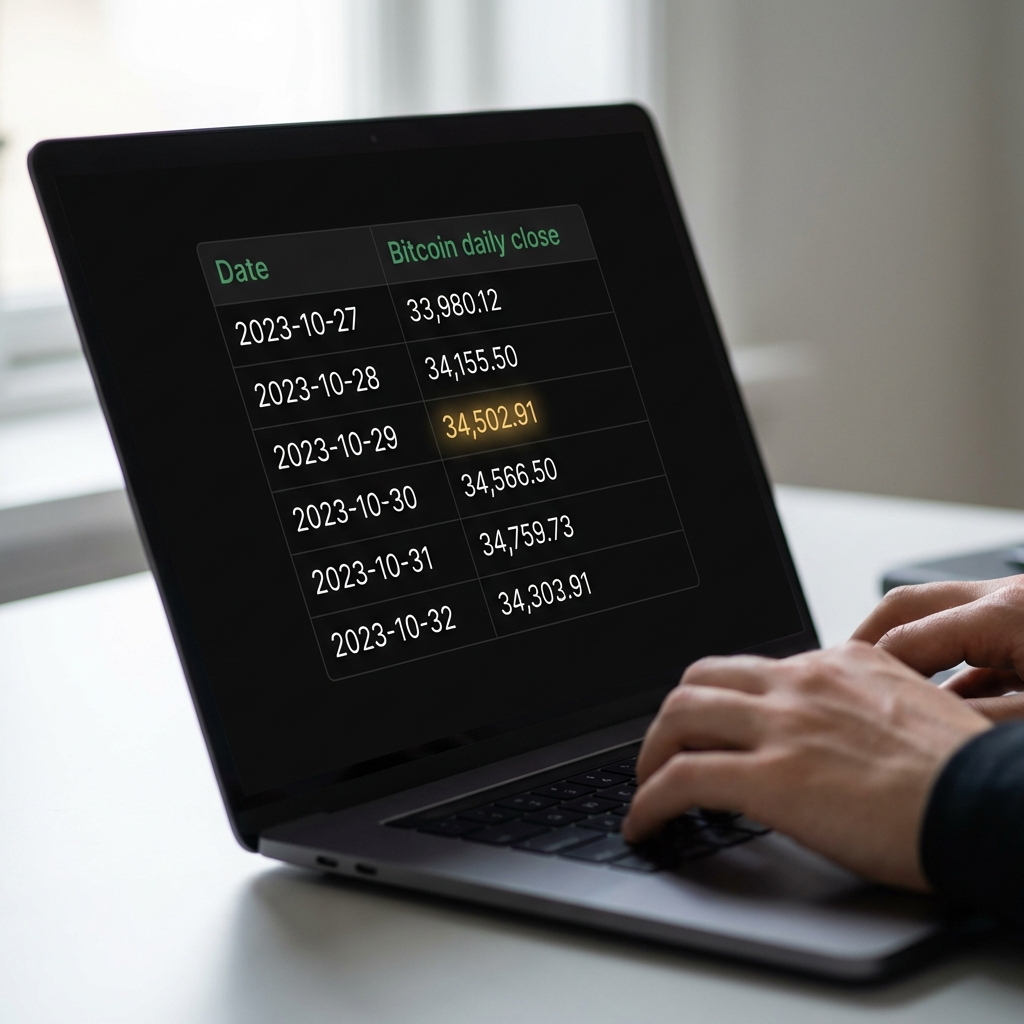
Start by picking a purchase date and downloading daily close prices for Bitcoin and the S&P 500 that cover your full hold period. Use the daily close price on the purchase date as the baseline to compute how many BTC a given dollar amount bought on that date. Authoritative daily historical files for BTC are available for download from public aggregators; you can also find compiled datasets such as one on Kaggle to speed processing. Kaggle cryptocurrency market history
CoinGecko historical data
Next, choose and state a fee model for the purchase. Small retail buys are affected by exchange spreads and flat fees, so subtract an explicit effective fee amount from your $100 before dividing by the daily close. After computing net BTC purchased, pick the target date and read the daily close for that date to compute the final USD value of the holding.
Checklist, in order: pick the calendar date, download the BTC daily close CSV, download the S&P 500 daily series for the same dates, state and apply fee assumptions, compute net BTC units = (100 minus fees) divided by the purchase-date close, then compute the holding value on the target date by multiplying the units by the target-date close. If you model a realized sale, compute gains and apply tax assumptions based on holding period.
Partner with FinancePolice for sponsored content and reach
Try the checklist above with a downloaded CSV and clear fee assumptions to see how sensitive the final number is to small fee changes.
See advertising options
When you publish a public result, show the gross and net calculations, link to the CSV sources you used, and list the fee and tax assumptions so readers can reproduce the math. You can also point readers to our crypto category for related coverage and examples. Finance Police crypto category
Fees and execution: how small retail buys like $100 are affected
Retail trading typically involves multiple fee components: a platform flat fee for small orders, a percentage fee on trade value, and a bid-ask spread or execution spread that effectively raises the buy price. Exchanges document these components in their fee schedules, and for small trades the flat fee and spread together can be a meaningful share of $100. Coinbase pricing and fees
For a transparent public example, pick an explicit effective fee to apply and show how it changes net BTC units. State the assumed fee in dollars or as an effective percent of the $100. Do not present a final headline number without this explicit fee line because readers will otherwise misread the purchase power of small buys.
As a simple illustrative fee model to state in an article, you might use an effective fee assumption such as a combined execution cost equal to a fixed amount plus a small percent of trade value, applied as a dollar deduction before computing BTC units. Any public calculation should label that assumption clearly and link to the fee schedule used to justify it.
Taxes and recordkeeping: what changes when you sell
In the United States the IRS treats cryptocurrency as property, so taxes on gains are determined at the time of sale or disposition and not while an investment is unrealized. That means a HODL value can be reported as a current holding value, but if you model the outcome of a sale you must compute gains against the acquisition basis and consider holding period tax rules. IRS guidance on virtual currencies
For realized-sales modeling remember to separate short-term and long-term capital gains. The holding period affects whether gains are taxed at ordinary income rates or the typically lower long-term capital gains rates, so any published example that shows net proceeds after tax should state which tax regime is being applied and the assumed marginal rate.
Good recordkeeping matters. Keep acquisition date, cost basis including fees, and sale date so you can compute the correct realized gain. If you are publishing example outcomes, state that readers in jurisdictions outside the United States should verify local rules and that tax treatment can materially change net results.
Choosing a stock benchmark: apples-to-apples with the S&P 500
To compare a $100 Bitcoin purchase against “stocks” in a fair way use an authoritative S&P 500 daily series and align the exact start and end dates. The Federal Reserve Bank of St. Louis provides a commonly used daily S&P 500 series suitable for this purpose. S&P 500 series on FRED
Decide whether to use the nominal price index or a total-return series that includes dividends. Over multi-year periods a total-return series can noticeably raise the cumulative return of the S&P 500 compared with a nominal price series, so state which you use when reporting a comparison.
Also make sure both series are expressed in the same currency and nominal terms. If you want inflation-adjusted comparisons, make that transformation explicit and document the data source for the inflation series.
Volatility, drawdowns, and risk context for Bitcoin versus stocks
Bitcoin’s historical nominal returns over many periods have been large, but they have also come with much higher volatility and deeper drawdowns than major stock indices, and market analyses document that contrast. Show both the final value and some measure of downside risk like maximum drawdown or realized volatility so readers understand the tradeoffs. Coin Metrics market reports If you want an example of how this looks with real price action, see recent Bitcoin price analysis on our site. Bitcoin price analysis
Because volatility matters, a pure HODL depiction and a realized-sale depiction can tell very different stories. If the investor sold at a temporary low, the realized outcome can be much worse than the unrealized peak suggests. Presenting a small set of alternative sale dates or a distribution of possible sale dates makes the historical comparison more informative.
When you report risk measures, include clear definitions and the exact time window used for calculation. That allows readers to judge how extreme the drawdown figures are and to reproduce the numbers from the same primary sources.
Step-by-step example: how a writer should calculate the result (no invented final numbers)
Use placeholders and exact formulas so a reader can replace values with CSV numbers. Example calculation steps: 1) Let P be the BTC daily close price on the purchase date. 2) Let F be the effective fee in dollars you choose to apply. 3) Compute units = (100 – F) / P. 4) Let Q be the BTC daily close price on the target date. 5) Final USD value = units * Q. State P, Q, F, and the source files you used so readers can verify the math.
To produce the S&P 500 comparison on the same dates, get the S&P 500 closing value on the purchase date and on the target date from the same authoritative series. If you use a total-return S&P series, state that and source it. Then compute the factor change of the index and apply that factor to $100 to get the comparable stock outcome for the same period.
Always show both gross and net outcomes in your published example: gross meaning before fees, net meaning after fees and, if modeling a sale, after taxes. Make the tax assumptions explicit and show the pre-tax gain and the tax calculation separately so readers see how taxes were applied.
Illustrative scenarios: HODL, sell at a high, and partial-sell with taxes
A HODL scenario reports the unrealized value of the holding on the target date and does not include tax payment because gains are unrealized. State the holding date and define that no tax calculation is being applied if you report a pure HODL figure.
If you model a realized sale at a later date, compute the realized gain as sale proceeds minus acquisition basis including fees, then apply the chosen marginal tax rate for short-term or long-term gains depending on holding period. Show the pre-tax proceeds, the tax amount, and the net proceeds so readers can see the impact.
You can compute the exact result by using daily close prices for the purchase and target dates, subtracting explicit fee assumptions to get net BTC units, and then comparing the final holding value to the S&P 500's change over the same dates; tax treatment only matters if you model a realized sale.
For a partial-sell, compute the proportion of units sold and apply the same basis allocation method you choose, then compute fees and the tax on the portion sold. State whether your basis allocation assumes FIFO, specific identification, or another accepted method because different methods change the reported gain in some cases.
Decision criteria: when a historical comparison matters to you
Ask whether the historical comparison will shape a decision for your time horizon and risk tolerance. If your horizon is long and you can tolerate large swings, historical nominal returns are one input among many. If your goal is short-term cash, the volatility profile may make the comparison less actionable.
Consider fee impact for small initial amounts. Flat fees hit small purchases harder than large ones, so the same fee schedule can make $100 much less efficient than larger investments. Also consider your tax situation and whether you have good records for basis and dates before relying on realized-sale simulations.
Common mistakes and pitfalls to avoid when publishing a historical calculation
Do not use midday or average prices when you mean to use a single-day purchase price. The daily close is the recommended baseline because it is a reproducible snapshot; using intraday or average prices without stating it will make results hard to replicate. Verify your source file and link to it when you publish. CoinMarketCap historical data
Do not forget to apply fees and spreads for retail buys. Omitting them overstates the BTC units acquired for a small amount like $100. Also do not ignore tax realization rules if you show a net proceeds example based on a sale; the IRS treats crypto as property and taxes gains at realization.
List all assumptions explicitly: the purchase date, the exact daily-close CSV used, the fee model and the tax assumptions. Clear assumptions let readers reproduce or critique your result without ambiguity.
Practical next steps for readers who want to run the numbers themselves
Download daily BTC prices from a public aggregator and S&P 500 daily series from the Federal Reserve FRED site. Use the purchase-date daily close for P and the target-date daily close for Q, and save both CSV files so that your calculations are reproducible. FRED S&P 500 series
Pick a conservative fee assumption for a small retail buy and show both before-fee and after-fee results. If you have your own receipts from the exchange where you traded, use those exact fees instead of a generic assumption. Keep records of acquisition date, cost basis, and receipts to support any later tax reporting.
When you present your result to others, show the CSV snapshots, the fee line, the tax assumptions if any, and the links to primary sources so readers can follow the steps and compute the same outcome on their own.
Further resources and primary sources to cite
For BTC daily historical CSVs link to CoinMarketCap or CoinGecko, for S&P 500 daily data link to FRED, for fee schedules link to an exchange help page when you use a particular fee assumption, and for U.S. tax guidance link to the IRS virtual currencies page. These are the primary sources that let a reader reproduce the calculation. CoinGecko historical data See our site crypto hub for related posts. Crypto category
For volatility and market context link to industry reports such as those by market analytics providers. For tax rules, link to primary tax guidance rather than commentary so readers get the official framework for realized gains and basis tracking.
Conclusion: balanced summary and how to interpret the numbers
To compute what $100 in Bitcoin ten years ago would be worth today, use the daily close price for your purchase date, subtract explicit fee assumptions to get net BTC purchased, and state whether you are reporting an unrealized HODL value or modeling a realized-sale with taxes. Use authoritative CSV sources and list every assumption that affects the final number.
Historical nominal returns do not promise similar future results. Bitcoin’s past performance has included both strong nominal gains and periods of very large drawdowns, so report both final value and risk context and encourage readers to verify the math with the linked primary sources.
Download a BTC daily close CSV for the purchase date, pick an explicit fee assumption, compute net dollars available for purchase, then divide by the purchase-date daily close to get BTC units.
In the United States, simply holding Bitcoin does not trigger tax on gains; taxes apply when you sell or otherwise dispose of the crypto, so model realized-sale scenarios accordingly.
Use an authoritative daily S&P 500 series such as the one on FRED and state whether you used the nominal price index or a total-return series that includes dividends.
For realized-sale tax questions consult a tax professional or the official tax guidance for your jurisdiction before acting on any modeled net-proceeds figure.
You May Also Like

How to earn from cloud mining: IeByte’s upgraded auto-cloud mining platform unlocks genuine passive earnings

RFK Jr. reveals puzzling reason why he loves working for Trump
