The Bitcoin Rainbow Chart allows you to analyze BTC price activity over time and identify whether the currency is overbought or oversold.The Bitcoin Rainbow Chart allows you to analyze BTC price activity over time and identify whether the currency is overbought or oversold.

Bitcoin Rainbow Chart: Analyze BTC Price Movements

2026/01/28 02:14
5 min read
News Brief
The Bitcoin Rainbow Chart offers a visual framework for tracking BTC price movements and identifying potential support and resistance zones through historical data presented on a logarithmic scale. This piece explores its function, how it guides investment decisions, and anticipated BTC price territories for 2026 after October's surge to $126,000.00.This widely-used tool examines Bitcoin's historical performance via a rainbow-colored line graph that illustrates logarithmic growth patterns over time. Grounded in logarithmic regression, it operates on the premise that Bitcoin's price continues climbing at growing absolute rates yet declining relative rates. Multiple colored bands span different price ranges—shifting from blue at lower thresholds to red at elevated ones—which helps traders identify market trends and determine entry or exit timing based on historical behavior.When Bitcoin occupies warmer colors, it's typically overbought, making selling reasonable, whereas cooler colors indicate oversold conditions where purchasing could prove advantageous. Analysts predict Bitcoin will trade between $47,109.00 and $553,464.00 through December 31st, 2026—approximately 18 months before the 2028 halving—with an average price around $161,473.00.However, don't depend exclusively on this chart, since analyzing prices purely through historical data overlooks daily developments, market fluctuations, and external variables impacting Bitcoin's valuation. Consider combining it with insights from credible investors and journalists, or platforms like CoinCheckup's algorithm that incorporates investor sentiment and technical indicators including Simple Moving Averages and Relative Strength Index for forecasting. Predictions suggest BTC may experience negative momentum throughout much of 2026, rebounding to $100,000.00 in February before declining to roughly $75,000.00 by November, then gaining 10.00% to close the year at $82,054.00.While the chart provides an accessible, visually engaging method for analyzing trends with long-term perspective on historical and projected performance, past patterns don't ensure future outcomes, interpretation differs among investors, and it cannot accommodate external factors or abrupt market changes. Ultimately, the Bitcoin Rainbow Chart serves as a useful tool for examining BTC price activity, though it excludes external influences. For comprehensive market awareness, stay current with crypto and financial news since they're frequently interconnected, and review regularly updated lists of leading cryptocurrencies reflecting present conditions and emerging trends for additional investment opportunities.
bitcoin rainbow cover

The Bitcoin Rainbow Chart is a visual representation of BTC price movements and its most likely support and resistance channels at any given time. It uses historical data to plot BTC prices on a logarithmic scale.

In this article, we are going to explain what the Bitcoin Rainbow Chart is, how it can be used to inform your investment decisions, and what price range we can expect BTC to reach in 2026 after the recent October rally to $126,000.

What is the Bitcoin Rainbow Chart?

The Bitcoin Rainbow Chart is a popular visualization tool used to analyze the historical price performance of Bitcoin. The chart is displayed as a rainbow-colored line graph that represents the logarithmic growth of Bitcoin’s price over time.

The Rainbow Chart is founded on a concept known as logarithmic regression, which assumes that the price of Bitcoin will keep increasing at an increasing rate in absolute terms and at a decreasing rate in relative terms. 
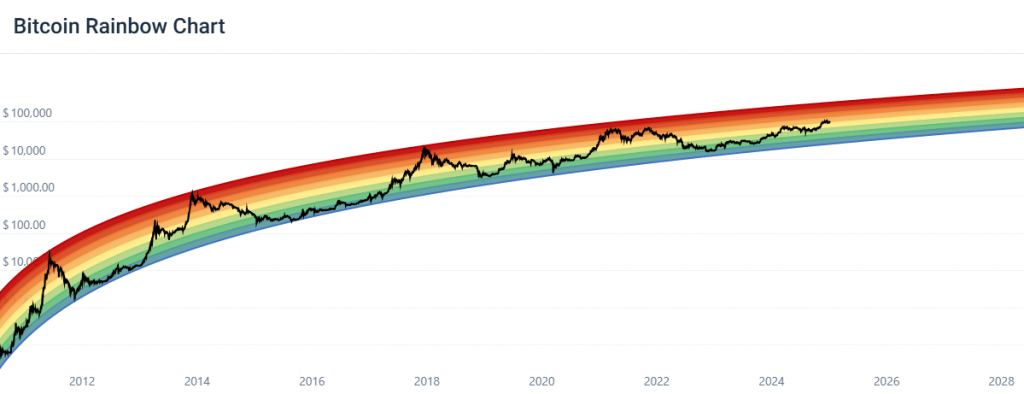
Bitcoin rainbow chart

The Bitcoin Rainbow Chart consists of multiple colored bands or zones that correspond to different price ranges. The colors of the bands transition through the rainbow spectrum, with blue indicating the lower price levels and red representing the higher price levels.

How to use the Bitcoin Rainbow Chart?

The purpose of the chart is to provide a visual representation of Bitcoin’s price cycles and potential support and resistance levels. Traders and investors may use it to gain insights into the market trends and identify potential entry or exit points based on historical price patterns.

Generally speaking, when Bitcoin is trading in hotter color bands, you could consider selling your BTC as it is likely overbought, and the price might come down. On the other hand, if BTC is trading in colder color bands, the chart suggests that the currency is oversold and that it might be a good time to buy BTC as its price will likely increase.

From the image above, we can see that Bitcoin is predicted to trade in a price range between $47,109 and $553,464 until the 31st of December 2026, about a year and a half until the 2028 halving. The average price the chart predicts for that period is $161,473.

Consider complimenting Bitcoin Rainbow Chart with another investment tool

The Bitcoin Rainbow Chart shouldn’t be used in isolation – that is to say that the chart shouldn’t be your only source of information. While analyzing price movements in a vacuum based on historical data is certainly valuable and has its place when making investment decisions, it doesn’t take into account day-to-day news, market trends, and other external factors that might have an impact on the price of Bitcoin.

The Bitcoin Rainbow Chart shouldn’t be used in isolation – that is to say that the chart shouldn’t be your only source of information. while analyzing price movements in a vacuum based on historica

You could consider complementing the Bitcoin Rainbow Chart by following the latest news and updates from successful and reputable investors and journalists, or use a prediction tool like CoinCheckup’s price prediction algorithm. While the price prediction tool has its faults as well, it is more finely tuned than the Rainbow Chart since it uses investor sentiment and technical analysis indicators like Simple Moving Averages (SMA) and Relative Strength Index (RSI) to form forecasts.

According to the Bitcoin price prediction, BTC could be headed for a period of negative price activity for most of 2026. It’s predicted to first jump back up to $100,000 in February, before dropping all the way down to around $75,000 by November. In December, it’s expected to gain 10%, ending the year at $82,054.

Pros and cons of using the Bitcoin Rainbow Chart

There are several advantages and disadvantages when it comes to the Bitcoin Rainbow Chart. In the sections below, we’re going to touch upon some of the chart’s main limitations and benefits:

Pros of the BTC Rainbow Chart:

  • Provides an accessible and visually appealing way to analyze price trends
  • Offers a long-term perspective on the cryptocurrency’s performance, both historical and future-focused
  • Can help identify potential entry and exit points for BTC trades, optimizing trading decisions

Cons of the BTC Rainbow Chart:

  • Historical price trends are not an indicator of future performance
  • The chart is open to subjective interpretation, as the reasons why certain price trends form might vary between investors
  • The chart is ill-equipped to take into consideration external factors or sudden market changes

The bottom line: The Bitcoin Rainbow Chart can be a helpful tool for analyzing BTC price activity

The Bitcoin Rainbow Chart is a graphical representation of BTC’s historical and future price movements plotted on a logarithmic scale. While the chart doesn’t consider external factors, it can provide valuable insight into BTC price movements in a vacuum. For a comprehensive overview of market trends, you should consider following the latest news covering the crypto and financial markets, as they are often intertwined.

If you are in search of additional investment ideas, check our weekly updated list of the best cryptocurrencies to buy based on current market conditions and trends.

Disclaimer: The articles reposted on this site are sourced from public platforms and are provided for informational purposes only. They do not necessarily reflect the views of MEXC. All rights remain with the original authors. If you believe any content infringes on third-party rights, please contact service@support.mexc.com for removal. MEXC makes no guarantees regarding the accuracy, completeness, or timeliness of the content and is not responsible for any actions taken based on the information provided. The content does not constitute financial, legal, or other professional advice, nor should it be considered a recommendation or endorsement by MEXC.

You May Also Like

Vàng Cán Mốc Lịch Sử 5.000 USD: Khi Dự Báo Của CEO Bitget Gracy Chen Trở Thành Hiện Thực Và Tầm Nhìn Về Đích Đến 5.400 USD

Vàng Cán Mốc Lịch Sử 5.000 USD: Khi Dự Báo Của CEO Bitget Gracy Chen Trở Thành Hiện Thực Và Tầm Nhìn Về Đích Đến 5.400 USD

Thị trường tài chính toàn cầu vừa chứng kiến một khoảnh khắc lịch sử chấn động: Giá Vàng thế giới [...] The post Vàng Cán Mốc Lịch Sử 5.000 USD: Khi Dự Báo Của
Share
Vneconomics2026/02/10 16:26
Why the Bitcoin Boom Is Not Another Tulip Mania

Why the Bitcoin Boom Is Not Another Tulip Mania

Bitcoin is an amazing success story. It was only invented in January of 2009 and was only worth a tiny fraction of a cent for each token. Over just a few years
Share
Medium2026/02/10 15:44
Non-Opioid Painkillers Have Struggled–Cannabis Drugs Might Be The Solution

Non-Opioid Painkillers Have Struggled–Cannabis Drugs Might Be The Solution

The post Non-Opioid Painkillers Have Struggled–Cannabis Drugs Might Be The Solution appeared on BitcoinEthereumNews.com. In this week’s edition of InnovationRx, we look at possible pain treatments from cannabis, risks of new vaccine restrictions, virtual clinical trials at the Mayo Clinic, GSK’s $30 billion U.S. manufacturing commitment, and more. To get it in your inbox, subscribe here. Despite their addictive nature, opioids continue to be a major treatment for pain due to a lack of effective alternatives. In an effort to boost new drugs, the FDA released new guidelines for non-opioid painkillers last week. But making these drugs hasn’t been easy. Vertex Pharmaceuticals received FDA approval for its non-opioid Journavx in January, then abandoned a next generation drug after a failed clinical trial earlier this summer. Acadia similarly abandoned a promising candidate after a failed trial in 2022. One possible basis for non-opioids might be cannabis. Earlier this year, researchers at Washington University at St. Louis and Stanford published a study showing that a cannabis-derived compound successfully eased pain in mice with minimal side effects. Munich-based pharmaceutical company Vertanical is perhaps the furthest along in this quest. It is developing a cannabinoid-based extract to treat chronic pain it hopes will soon become an approved medicine, first in the European Union and eventually in the United States. The drug, currently called Ver-01, packs enough low levels of cannabinoids (including THC) to relieve pain, but not so much that patients get high. Founder Clemens Fischer, a 50-year-old medical doctor and serial pharmaceutical and supplement entrepreneur, hopes it will become the first cannabis-based painkiller prescribed by physicians and covered by insurance. Fischer founded Vertanical, with his business partner Madlena Hohlefelder, in 2017, and has invested more than $250 million of his own money in it. With a cannabis cultivation site and drug manufacturing plant in Denmark, Vertanical has successfully passed phase III clinical trials in Germany and expects…
Share
BitcoinEthereumNews2025/09/18 05:26