Key Takeaways: 912,296.82 ETH tokens are permanently inaccessible, according to public blockchain records. BlackRock’s ETHA led ETF inflows, bringing total U.S. Ethereum ETF inflows to $5.5B. Ethereum’s self-custody model offers no built-in recovery for user-side errors. A recent GitHub post published by Coinbase Head of Product Conor Grogan has documented over 912,000 ETH that have been permanently lost due to user error or protocol failures, representing more than 0.76% of Ethereum’s circulating supply. Grogan compiled wallet addresses from public records, contract audits, and community-sourced data. The analysis excludes unknown lost-key events, covering only ETH that is provably inaccessible. A Total of 912,296.82 ETH Lost “To be clear, this $3.4B+ number significantly undershoots the actual lost/inaccessible ETH amount,” Grogan wrote. “It just covers instances where Ethereum is locked forever.” “For example, it doesn’t cover all lost private keys or things like Genesis wallets that have been forgotten,” said Grogan. Based on my research, a minimum of 913,111 Ethereum is lost forever due to user error. This is 0.76%+ of ETH supply, or $3.43 billion in lost funds If we include EIP‑1559 burned ETH (5.3M), then >5% of all ETH ever made ($23.42B) have been permanently destroyed pic.twitter.com/IlTduN7Kzx — Conor (@jconorgrogan) July 20, 2025 Major losses include 306,000 ETH trapped in a Parity multisig contract once used by the Web3 Foundation, 60,000 ETH from the failed QuadrigaCX exchange, and 11,500 ETH lost by the Akutars NFT project due to a contract error. Grogan also identified 25,000 ETH manually sent to a known burn address. The dataset incorporates findings from researcher Johannes, who documented over 12,000 ETH lost due to wallet typos, and credits contributions from Tayvano and J6sp5r. Grogan said future updates will expand the dataset to cover situations such as North Korean losses and cases involving unrecoverable private keys. Ethereum ETFs Grow with Record Inflows Ethereum ETFs have drawn over $5.5 billion in total inflows, with $3.3 billion added since mid-April. The renewed demand follows a rise in Ethereum basis yield and stronger futures activity. BlackRock’s iShares Ethereum Trust (ETHA) led with $489 million in inflows on July 17, its highest on record. ETHA brought in $1.25 billion across five sessions, raising BlackRock’s ETH ETF holdings to $6.94 billion. U.S. Ethereum ETFs collectively saw $726.74 million in daily inflows on July 17, beating the previous record. Fidelity’s FETH and Grayscale’s mini trust added $113.31 million and $54.18 million, respectively. The persistence of lost Ethereum indicates the protocol’s strict finality and lack of recourse for user-side errors. Unlike traditional financial systems that offer chargebacks or custodial recovery, Ethereum’s self-custody model makes asset recovery functionally impossible once certain errors occur. Institutional exposure now grows through vehicles like ETFs, making user education and wallet safety increasingly relevant. Preventing future losses will likely depend more on improved tooling and standards than changes to the protocol itself. Frequently Asked Questions (FAQs) Can lost ETH ever be recovered through upgrades or forks? No. Ethereum’s consensus design does not allow selective access changes without a hard fork, which would require broad network coordination and is highly unlikely. Could other chains implement loss-recovery tools without compromising decentralization? Some newer chains experiment with programmable recovery functions or guardian models, but these involve tradeoffs in user control and system trust assumptions. How is ETH loss accounted for in monetary policy models or supply tracking? Lost ETH is not officially removed from circulating supply metrics, but is often considered when estimating effective supply and scarcity. Do ETFs holding ETH face specific technical risks from these loss patterns? While ETFs use custodians to minimize risk, operational security failures in staking, slashing, or private key management could still create large-scale losses.Key Takeaways: 912,296.82 ETH tokens are permanently inaccessible, according to public blockchain records. BlackRock’s ETHA led ETF inflows, bringing total U.S. Ethereum ETF inflows to $5.5B. Ethereum’s self-custody model offers no built-in recovery for user-side errors. A recent GitHub post published by Coinbase Head of Product Conor Grogan has documented over 912,000 ETH that have been permanently lost due to user error or protocol failures, representing more than 0.76% of Ethereum’s circulating supply. Grogan compiled wallet addresses from public records, contract audits, and community-sourced data. The analysis excludes unknown lost-key events, covering only ETH that is provably inaccessible. A Total of 912,296.82 ETH Lost “To be clear, this $3.4B+ number significantly undershoots the actual lost/inaccessible ETH amount,” Grogan wrote. “It just covers instances where Ethereum is locked forever.” “For example, it doesn’t cover all lost private keys or things like Genesis wallets that have been forgotten,” said Grogan. Based on my research, a minimum of 913,111 Ethereum is lost forever due to user error. This is 0.76%+ of ETH supply, or $3.43 billion in lost funds If we include EIP‑1559 burned ETH (5.3M), then >5% of all ETH ever made ($23.42B) have been permanently destroyed pic.twitter.com/IlTduN7Kzx — Conor (@jconorgrogan) July 20, 2025 Major losses include 306,000 ETH trapped in a Parity multisig contract once used by the Web3 Foundation, 60,000 ETH from the failed QuadrigaCX exchange, and 11,500 ETH lost by the Akutars NFT project due to a contract error. Grogan also identified 25,000 ETH manually sent to a known burn address. The dataset incorporates findings from researcher Johannes, who documented over 12,000 ETH lost due to wallet typos, and credits contributions from Tayvano and J6sp5r. Grogan said future updates will expand the dataset to cover situations such as North Korean losses and cases involving unrecoverable private keys. Ethereum ETFs Grow with Record Inflows Ethereum ETFs have drawn over $5.5 billion in total inflows, with $3.3 billion added since mid-April. The renewed demand follows a rise in Ethereum basis yield and stronger futures activity. BlackRock’s iShares Ethereum Trust (ETHA) led with $489 million in inflows on July 17, its highest on record. ETHA brought in $1.25 billion across five sessions, raising BlackRock’s ETH ETF holdings to $6.94 billion. U.S. Ethereum ETFs collectively saw $726.74 million in daily inflows on July 17, beating the previous record. Fidelity’s FETH and Grayscale’s mini trust added $113.31 million and $54.18 million, respectively. The persistence of lost Ethereum indicates the protocol’s strict finality and lack of recourse for user-side errors. Unlike traditional financial systems that offer chargebacks or custodial recovery, Ethereum’s self-custody model makes asset recovery functionally impossible once certain errors occur. Institutional exposure now grows through vehicles like ETFs, making user education and wallet safety increasingly relevant. Preventing future losses will likely depend more on improved tooling and standards than changes to the protocol itself. Frequently Asked Questions (FAQs) Can lost ETH ever be recovered through upgrades or forks? No. Ethereum’s consensus design does not allow selective access changes without a hard fork, which would require broad network coordination and is highly unlikely. Could other chains implement loss-recovery tools without compromising decentralization? Some newer chains experiment with programmable recovery functions or guardian models, but these involve tradeoffs in user control and system trust assumptions. How is ETH loss accounted for in monetary policy models or supply tracking? Lost ETH is not officially removed from circulating supply metrics, but is often considered when estimating effective supply and scarcity. Do ETFs holding ETH face specific technical risks from these loss patterns? While ETFs use custodians to minimize risk, operational security failures in staking, slashing, or private key management could still create large-scale losses.

$3.4B in Ethereum Gone Forever – 912K ETH Lost to Irreversible Errors

3 min read

Key Takeaways:

  • 912,296.82 ETH tokens are permanently inaccessible, according to public blockchain records.
  • BlackRock’s ETHA led ETF inflows, bringing total U.S. Ethereum ETF inflows to $5.5B.
  • Ethereum’s self-custody model offers no built-in recovery for user-side errors.

A recent GitHub post published by Coinbase Head of Product Conor Grogan has documented over 912,000 ETH that have been permanently lost due to user error or protocol failures, representing more than 0.76% of Ethereum’s circulating supply.

Grogan compiled wallet addresses from public records, contract audits, and community-sourced data. The analysis excludes unknown lost-key events, covering only ETH that is provably inaccessible.

A Total of 912,296.82 ETH Lost

“To be clear, this $3.4B+ number significantly undershoots the actual lost/inaccessible ETH amount,” Grogan wrote. “It just covers instances where Ethereum is locked forever.”

“For example, it doesn’t cover all lost private keys or things like Genesis wallets that have been forgotten,” said Grogan.

Major losses include 306,000 ETH trapped in a Parity multisig contract once used by the Web3 Foundation, 60,000 ETH from the failed QuadrigaCX exchange, and 11,500 ETH lost by the Akutars NFT project due to a contract error. Grogan also identified 25,000 ETH manually sent to a known burn address.

The dataset incorporates findings from researcher Johannes, who documented over 12,000 ETH lost due to wallet typos, and credits contributions from Tayvano and J6sp5r.

Grogan said future updates will expand the dataset to cover situations such as North Korean losses and cases involving unrecoverable private keys.

Ethereum ETFs Grow with Record Inflows

Ethereum ETFs have drawn over $5.5 billion in total inflows, with $3.3 billion added since mid-April. The renewed demand follows a rise in Ethereum basis yield and stronger futures activity.

BlackRock’s iShares Ethereum Trust (ETHA) led with $489 million in inflows on July 17, its highest on record. ETHA brought in $1.25 billion across five sessions, raising BlackRock’s ETH ETF holdings to $6.94 billion.

U.S. Ethereum ETFs collectively saw $726.74 million in daily inflows on July 17, beating the previous record. Fidelity’s FETH and Grayscale’s mini trust added $113.31 million and $54.18 million, respectively.

The persistence of lost Ethereum indicates the protocol’s strict finality and lack of recourse for user-side errors. Unlike traditional financial systems that offer chargebacks or custodial recovery, Ethereum’s self-custody model makes asset recovery functionally impossible once certain errors occur.

Institutional exposure now grows through vehicles like ETFs, making user education and wallet safety increasingly relevant. Preventing future losses will likely depend more on improved tooling and standards than changes to the protocol itself.

Frequently Asked Questions (FAQs)

Can lost ETH ever be recovered through upgrades or forks?

No. Ethereum’s consensus design does not allow selective access changes without a hard fork, which would require broad network coordination and is highly unlikely.

Could other chains implement loss-recovery tools without compromising decentralization?

Some newer chains experiment with programmable recovery functions or guardian models, but these involve tradeoffs in user control and system trust assumptions.

How is ETH loss accounted for in monetary policy models or supply tracking?

Lost ETH is not officially removed from circulating supply metrics, but is often considered when estimating effective supply and scarcity.

Do ETFs holding ETH face specific technical risks from these loss patterns?

While ETFs use custodians to minimize risk, operational security failures in staking, slashing, or private key management could still create large-scale losses.

Market Opportunity
Threshold Logo
Threshold Price(T)
$0.008134
$0.008134$0.008134
0.00%
USD
Threshold (T) Live Price Chart
Disclaimer: The articles reposted on this site are sourced from public platforms and are provided for informational purposes only. They do not necessarily reflect the views of MEXC. All rights remain with the original authors. If you believe any content infringes on third-party rights, please contact service@support.mexc.com for removal. MEXC makes no guarantees regarding the accuracy, completeness, or timeliness of the content and is not responsible for any actions taken based on the information provided. The content does not constitute financial, legal, or other professional advice, nor should it be considered a recommendation or endorsement by MEXC.

You May Also Like

Three dormant wallets, suspected to belong to the same entity, purchased 5,970 ETH eight hours ago.

Three dormant wallets, suspected to belong to the same entity, purchased 5,970 ETH eight hours ago.

PANews reported on February 4 that, according to Lookonchain monitoring, three wallets that had been dormant for four years (likely controlled by the same entity
Share
PANews2026/02/04 11:36
BlackRock Increases U.S. Stock Exposure Amid AI Surge
BlackRock Increases U.S. Stock Exposure Amid AI Surge

The post BlackRock Increases U.S. Stock Exposure Amid AI Surge appeared on BitcoinEthereumNews.com. Key Points: BlackRock significantly increased U.S. stock exposure. AI sector driven gains boost S&P 500 to historic highs. Shift may set a precedent for other major asset managers. BlackRock, the largest asset manager, significantly increased U.S. stock and AI sector exposure, adjusting its $185 billion investment portfolios, according to a recent investment outlook report.. This strategic shift signals strong confidence in U.S. market growth, driven by AI and anticipated Federal Reserve moves, influencing significant fund flows into BlackRock’s ETFs. The reallocation increases U.S. stocks by 2% while reducing holdings in international developed markets. BlackRock’s move reflects confidence in the U.S. stock market’s trajectory, driven by robust earnings and the anticipation of Federal Reserve rate cuts. As a result, billions of dollars have flowed into BlackRock’s ETFs following the portfolio adjustment. “Our increased allocation to U.S. stocks, particularly in the AI sector, is a testament to our confidence in the growth potential of these technologies.” — Larry Fink, CEO, BlackRock The financial markets have responded favorably to this adjustment. The S&P 500 Index recently reached a historic high this year, supported by AI-driven investment enthusiasm. BlackRock’s decision aligns with widespread market speculation on the Federal Reserve’s next moves, further amplifying investor interest and confidence. AI Surge Propels S&P 500 to Historic Highs At no other time in history has the S&P 500 seen such dramatic gains driven by a single sector as the recent surge spurred by AI investments in 2023. Experts suggest that the strategic increase in U.S. stock exposure by BlackRock may set a precedent for other major asset managers. Historically, shifts of this magnitude have influenced broader market behaviors as others follow suit. Market analysts point to the favorable economic environment and technological advancements that are propelling the AI sector’s momentum. The continued growth of AI technologies is…
Share
BitcoinEthereumNews2025/09/18 02:49
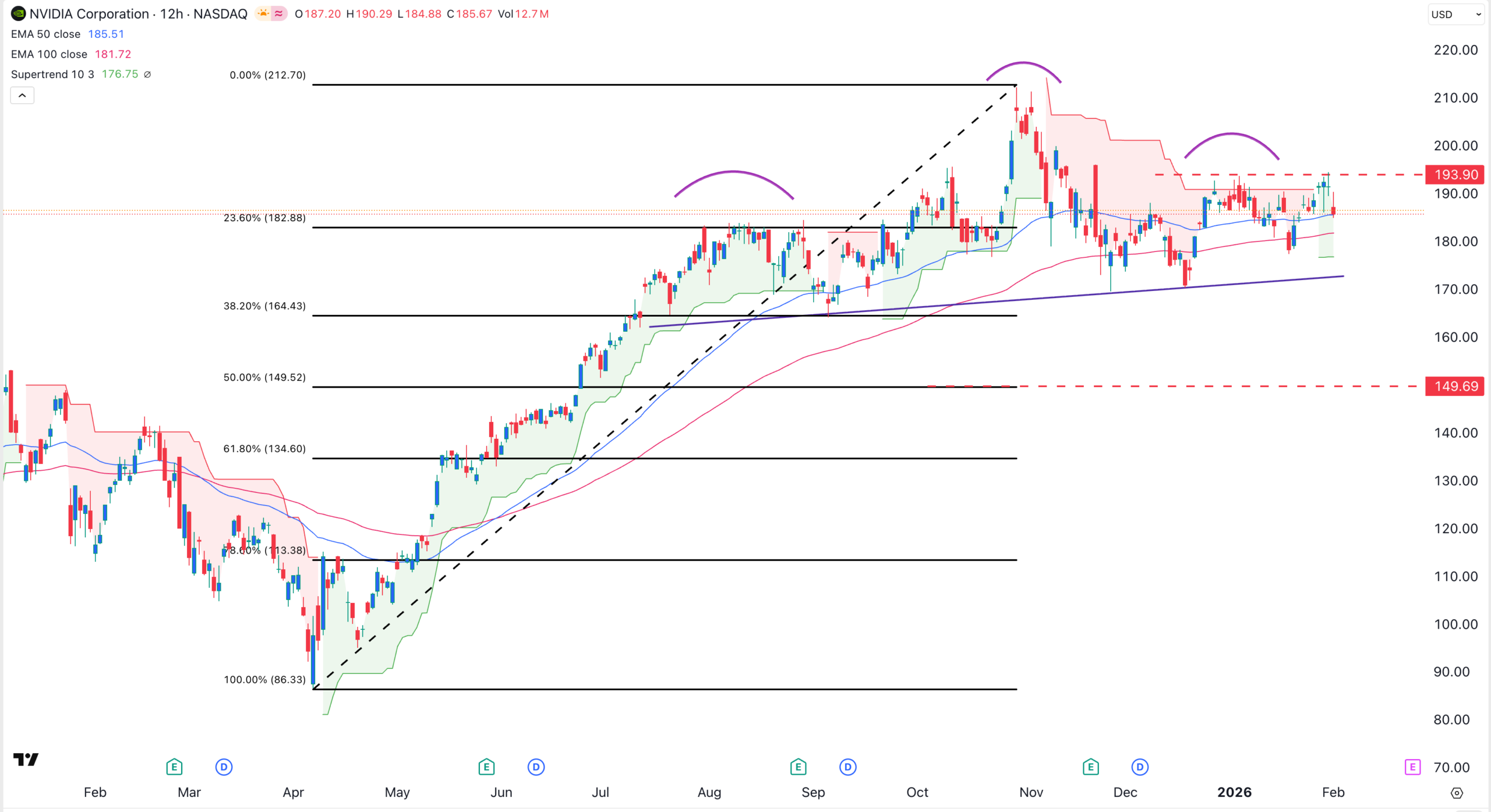
NVIDIA Stock Price Analysis as OpenAI Issues Concerns About its Chips

NVIDIA Stock Price Analysis as OpenAI Issues Concerns About its Chips

Key Insights NVIDIA stock started the week in the red. It crashed by over 2%. Meanwhile, the S&P 500, Dow Jones, and Nasdaq 100 moved close to their all-time highs
Share
Themarketperiodical2026/02/04 11:27
