Tokenized gold is experiencing an unprecedented wave of on-chain activity as spot gold prices accelerate into a parabolic phase. Data shared by CryptoQuant showsTokenized gold is experiencing an unprecedented wave of on-chain activity as spot gold prices accelerate into a parabolic phase. Data shared by CryptoQuant shows

Gold RWAs See Historic On-Chain Surge as Price Reached Above $5,500

2026/01/30 15:31
3 min read

Tokenized gold is experiencing an unprecedented wave of on-chain activity as spot gold prices accelerate into a parabolic phase.

Data shared by CryptoQuant shows transaction counts for the two largest gold-backed tokens, PAXG and XAUT, reaching record highs precisely as gold pushes toward the $5,500 level.

The synchronization between price expansion and blockchain usage highlights a structural shift in how investors access and trade traditional commodities during periods of extreme market volatility.

PAXG Transactions Spike to All-Time High

On-chain data for Pax Gold (PAXG) shows a vertical surge in transaction activity beginning in late 2025 and accelerating sharply into January 2026. Transaction counts exploded to approximately 36.7K, marking the highest level ever recorded for the token.
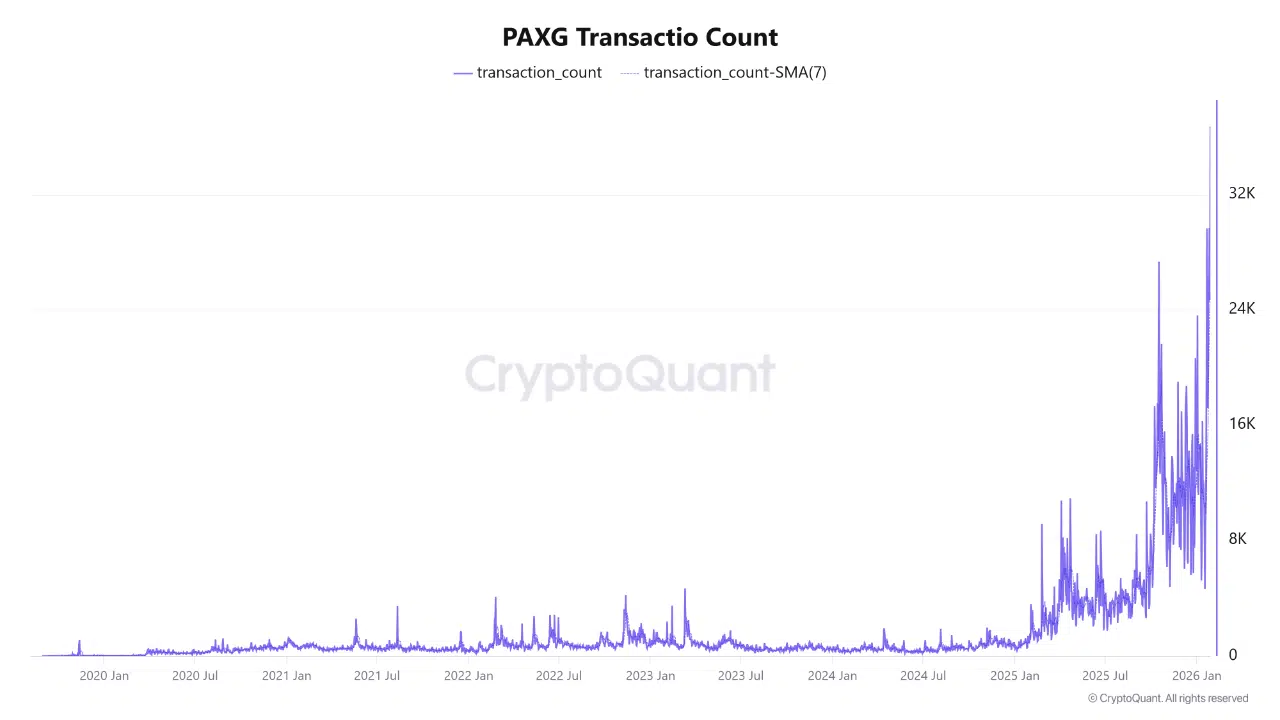
This move stands out not just for its magnitude, but for its timing. The spike coincides with gold entering a near-vertical price phase, suggesting investors increasingly favored tokenized exposure as price discovery intensified.

Rather than relying on slower, fragmented traditional settlement systems, capital rotated aggressively into on-chain gold, where liquidity, transferability, and settlement speed are significantly higher.

XAUT Activity Rises in Lockstep With Gold Price

A similar dynamic is visible in Tether Gold (XAUT) data. Transaction counts climbed steadily through 2025 before accelerating sharply alongside gold’s rally, reaching approximately 18.3K transactions.

Unlike PAXG, the XAUT chart directly overlays transaction activity with gold’s price trajectory. The correlation is striking. As the price trend steepened, on-chain activity expanded almost mechanically, reinforcing the idea that tokenized gold is increasingly used as a primary trading vehicle rather than a passive store of value.

Blockchain Becomes the Preferred Rail for Gold Liquidity

The surge across both PAXG and XAUT points to a broader behavioral shift. During periods of rapid price appreciation and heightened uncertainty, investors appear to prioritize assets that can be moved instantly, traded globally, and settled without intermediaries.

Tokenized gold offers exposure to the same underlying asset while removing many of the frictions associated with physical custody, banking rails, and market hours. As volatility rises, those advantages become increasingly relevant.

This is especially evident during parabolic moves, where delays in execution or settlement can materially impact outcomes.

Bitcoin Tops Gold and Silver in $100,000 Investment Poll

Real-World Asset Adoption Reaches a New Phase

The current data marks a meaningful validation moment for real-world assets on-chain. Gold RWAs are no longer operating on the margins of crypto markets. They are actively absorbing demand during peak valuation periods for traditional commodities.

While transaction activity may cool if gold consolidates, the baseline level of usage has likely shifted higher. The market has demonstrated that, under stress, blockchain-based gold is not just viable, it is often preferred.

As gold continues to attract global attention, on-chain RWAs appear positioned to play a growing role in how capital accesses and trades real-world value.

The post Gold RWAs See Historic On-Chain Surge as Price Reached Above $5,500 appeared first on ETHNews.

Disclaimer: The articles reposted on this site are sourced from public platforms and are provided for informational purposes only. They do not necessarily reflect the views of MEXC. All rights remain with the original authors. If you believe any content infringes on third-party rights, please contact service@support.mexc.com for removal. MEXC makes no guarantees regarding the accuracy, completeness, or timeliness of the content and is not responsible for any actions taken based on the information provided. The content does not constitute financial, legal, or other professional advice, nor should it be considered a recommendation or endorsement by MEXC.

You May Also Like

UBS CEO Targets Direct Crypto Access With “Fast Follower” Tokenization Strategy

UBS CEO Targets Direct Crypto Access With “Fast Follower” Tokenization Strategy

The tension in UBS’s latest strategy update is not between profit and innovation, but between speed and control. On February 4, 2026, as the bank reported a record
Share
Ethnews2026/02/05 04:56
When Will Altcoin Season Start? FED Rate Cut Fuels Bitcoin, but Ethereum Still Lagging

When Will Altcoin Season Start? FED Rate Cut Fuels Bitcoin, but Ethereum Still Lagging

The post When Will Altcoin Season Start? FED Rate Cut Fuels Bitcoin, but Ethereum Still Lagging appeared first on Coinpedia Fintech News The crypto market edged higher today after the U.S. Federal Reserve announced a 25 basis point rate cut, fueling optimism across risk assets. Bitcoin price today is trading around $117,000, while Ethereum holds steady near $4,600. The broader crypto market cap rose modestly, with major altcoins mixed but stable. Analysts note the short-term tone is …
Share
CoinPedia2025/09/18 14:59
Cryptos Signal Divergence Ahead of Fed Rate Decision

Cryptos Signal Divergence Ahead of Fed Rate Decision

The post Cryptos Signal Divergence Ahead of Fed Rate Decision appeared on BitcoinEthereumNews.com. Crypto assets send conflicting signals ahead of the Federal Reserve’s September rate decision. On-chain data reveals a clear decrease in Bitcoin and Ethereum flowing into centralized exchanges, but a sharp increase in altcoin inflows. The findings come from a Tuesday report by CryptoQuant, an on-chain data platform. The firm’s data shows a stark divergence in coin volume, which has been observed in movements onto centralized exchanges over the past few weeks. Bitcoin and Ethereum Inflows Drop to Multi-Month Lows Sponsored Sponsored Bitcoin has seen a dramatic drop in exchange inflows, with the 7-day moving average plummeting to 25,000 BTC, its lowest level in over a year. The average deposit per transaction has fallen to 0.57 BTC as of September. This suggests that smaller retail investors, rather than large-scale whales, are responsible for the recent cash-outs. Ethereum is showing a similar trend, with its daily exchange inflows decreasing to a two-month low. CryptoQuant reported that the 7-day moving average for ETH deposits on exchanges is around 783,000 ETH, the lowest in two months. Other Altcoins See Renewed Selling Pressure In contrast, other altcoin deposit activity on exchanges has surged. The number of altcoin deposit transactions on centralized exchanges was quite steady in May and June of this year, maintaining a 7-day moving average of about 20,000 to 30,000. Recently, however, that figure has jumped to 55,000 transactions. Altcoins: Exchange Inflow Transaction Count. Source: CryptoQuant CryptoQuant projects that altcoins, given their increased inflow activity, could face relatively higher selling pressure compared to BTC and ETH. Meanwhile, the balance of stablecoins on exchanges—a key indicator of potential buying pressure—has increased significantly. The report notes that the exchange USDT balance, around $273 million in April, grew to $379 million by August 31, marking a new yearly high. CryptoQuant interprets this surge as a reflection of…
Share
BitcoinEthereumNews2025/09/18 01:01