TRON touts H2 2025 stablecoin settlement growth and ecosystem expansion as new fraud allegations emerge against founder Justin Sun. TRON (TRON) published its secondTRON touts H2 2025 stablecoin settlement growth and ecosystem expansion as new fraud allegations emerge against founder Justin Sun. TRON (TRON) published its second

TRON stablecoin flows grow in H2 2025 while fraud claims put Justin Sun under pressure

TRON touts H2 2025 stablecoin settlement growth and ecosystem expansion as new fraud allegations emerge against founder Justin Sun.

Summary
  • TRON’s H2 2025 update highlights its push as a low-fee settlement rail for stablecoin transfers and cross-chain integrations.
  • The network reports expanding Super Representative activity and infrastructure upgrades to keep TRX embedded in stablecoin and DeFi payment flows.
  • The release lands as Justin Sun faces fresh manipulation claims from an alleged ex-partner, adding governance risk to TRX’s growth story.

TRON (TRON) published its second-half 2025 report detailing developments in stablecoin settlement and ecosystem expansion.

The report follows a previous analysis covering the first half of 2025, which documented TRON’s expansion of its Super Representatives lineup, technical integrations designed to support developers, and the launch of an additional stablecoin on the network.

The latest report focuses on stablecoin settlement operations at scale while addressing competitive pressures in the blockchain sector, according to the publication.

TRON, a decentralized blockchain platform founded in 2017, has positioned itself as a major network for stablecoin transactions. The platform’s Super Representatives serve as block producers in its delegated proof-of-stake consensus mechanism.

Details regarding specific transaction volumes, competitive metrics, and technical specifications were not immediately available in the preliminary report summary.

Disclaimer: The articles reposted on this site are sourced from public platforms and are provided for informational purposes only. They do not necessarily reflect the views of MEXC. All rights remain with the original authors. If you believe any content infringes on third-party rights, please contact service@support.mexc.com for removal. MEXC makes no guarantees regarding the accuracy, completeness, or timeliness of the content and is not responsible for any actions taken based on the information provided. The content does not constitute financial, legal, or other professional advice, nor should it be considered a recommendation or endorsement by MEXC.

You May Also Like

Shocking OpenVPP Partnership Claim Draws Urgent Scrutiny

Shocking OpenVPP Partnership Claim Draws Urgent Scrutiny

The post Shocking OpenVPP Partnership Claim Draws Urgent Scrutiny appeared on BitcoinEthereumNews.com. The cryptocurrency world is buzzing with a recent controversy surrounding a bold OpenVPP partnership claim. This week, OpenVPP (OVPP) announced what it presented as a significant collaboration with the U.S. government in the innovative field of energy tokenization. However, this claim quickly drew the sharp eye of on-chain analyst ZachXBT, who highlighted a swift and official rebuttal that has sent ripples through the digital asset community. What Sparked the OpenVPP Partnership Claim Controversy? The core of the issue revolves around OpenVPP’s assertion of a U.S. government partnership. This kind of collaboration would typically be a monumental endorsement for any private cryptocurrency project, especially given the current regulatory climate. Such a partnership could signify a new era of mainstream adoption and legitimacy for energy tokenization initiatives. OpenVPP initially claimed cooperation with the U.S. government. This alleged partnership was said to be in the domain of energy tokenization. The announcement generated considerable interest and discussion online. ZachXBT, known for his diligent on-chain investigations, was quick to flag the development. He brought attention to the fact that U.S. Securities and Exchange Commission (SEC) Commissioner Hester Peirce had directly addressed the OpenVPP partnership claim. Her response, delivered within hours, was unequivocal and starkly contradicted OpenVPP’s narrative. How Did Regulatory Authorities Respond to the OpenVPP Partnership Claim? Commissioner Hester Peirce’s statement was a crucial turning point in this unfolding story. She clearly stated that the SEC, as an agency, does not engage in partnerships with private cryptocurrency projects. This response effectively dismantled the credibility of OpenVPP’s initial announcement regarding their supposed government collaboration. Peirce’s swift clarification underscores a fundamental principle of regulatory bodies: maintaining impartiality and avoiding endorsements of private entities. Her statement serves as a vital reminder to the crypto community about the official stance of government agencies concerning private ventures. Moreover, ZachXBT’s analysis…
Share
BitcoinEthereumNews2025/09/18 02:13
Telos Advisers Welcomes Stephen Gardner as a Strategic Advisory Board Member
Telos Advisers Welcomes Stephen Gardner as a Strategic Advisory Board Member

Former Amtrak CEO brings more than 25 years of leadership experience in rail, infrastructure delivery, and national transportation policy NEWARK, N.J.–(BUSINESS
Share
AI Journal2026/02/03 02:16
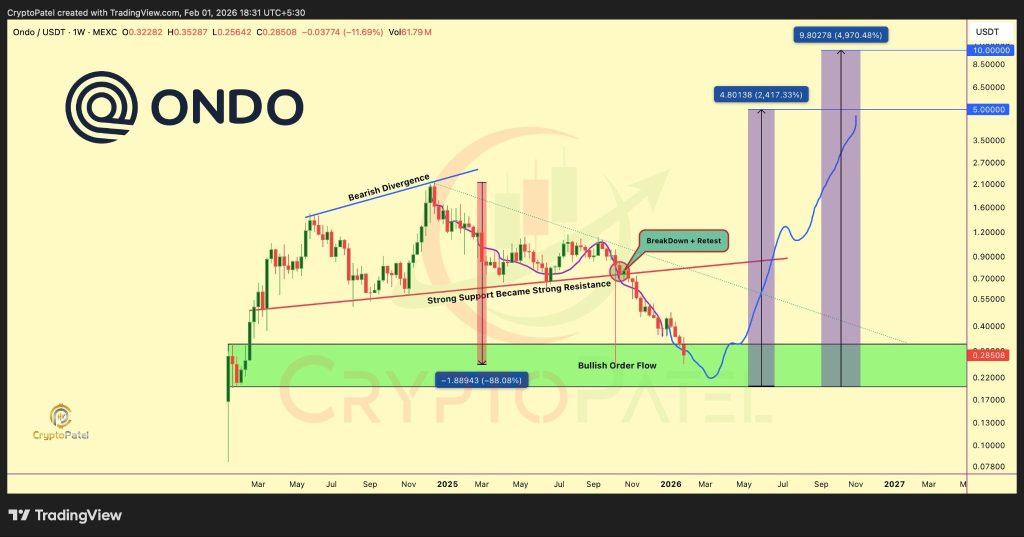
ONDO Price Crashes 88% From All-Time Highs, But Analyst Says ‘Last Hope’ Zone Is Here

ONDO Price Crashes 88% From All-Time Highs, But Analyst Says ‘Last Hope’ Zone Is Here

The ONDO price has drifted into a part of the chart that usually gets traders paying attention. After months of downside, the price is now sitting inside a zone
Share
Captainaltcoin2026/02/03 02:30