Presens Network has declared the new partnership with 4AI, which is a major advance towards the integration of real-world spatial data and decentralized AI.Presens Network has declared the new partnership with 4AI, which is a major advance towards the integration of real-world spatial data and decentralized AI.

Presens x 4AI: Turning Real-World Presence Into Actionable Intelligence for AI and Robotics

3 min read
aii-purple

Presens Network has declared the new partnership with 4AI, which is a major advance towards the integration of real-world spatial data and decentralized artificial intelligence. The joint venture introduces Presens live presence and spatial intelligence infrastructure into the autonomous agent ecosystem of 4AI, which allows AI and robotics agents to execute with real-time physical environmental awareness.

Fundamentally, the integration is meant to turn physical presence into a programmable signal, the one which can be sensed, interpreted, and acted upon by decentralized AI agents. The partnership of Presens Pulse and the decentralized AI marketplace by 4AI brings a novel intelligence tier aimed specifically at adaptive navigation, robotics, and coordination of agents.

Turning Presence Into a Machine-Readable Signal

Presens Network is constructing what it calls a spatiotemporal DePIN (Decentralized Physical Infrastructure Network) robotics network and AI. Using a network of Pulse Nodes worldwide, Presens measures the real world presence data of movement, location indicators and spatial dynamics and transforms them into machine readable and verifiable inputs.

This model restates physical presence as data primitive. Rather than data set snapshots or slow telemetry, AI agents have access to dynamic spatial awareness and can therefore react to the evolving adversary environment. This ability is essential in the nature of robotics and autonomous systems to perform safe navigation, effective logistics as well as real time decision making.

Enhancing 4AI’s Decentralized Agent Ecosystem

4AI is an autonomous decentralized AI market place on the BNB Chain wherein developers and users can request, create and launch autonomous AI agents. With the addition of Presens Pulse data, 4AI agents acquire a new layer of sense that is not just onchain or artificial input, but which is based on the real world.

This augmentation will enable AI agents in the 4AI ecosystem to no longer engage in abstract computation. Spatially relative coordination among agents is now possible, so that applications like swarm robotics, dynamic routing, real-time tracking, and place-constrained automation become possible.

The partnership is also in line with the larger vision of composable, decentralized intelligence with the sources of data, agent reasoning, and execution facilities left open and not permissioned by 4AI.

Implications for Robotics and Autonomous Systems

Perhaps, one of the strongest parts of the Presens x 4AI partnership is that it is applicable to the real-life robotics. Self-driving robots, drones, or industrial machines cannot operate efficiently without situational awareness that occurs at all times. Open-ended maps and pre-written code rules have become inadequate.

The partnership helps with adaptive navigation, smarter logistics, and robust multi-agent coordination by inputting live spatial signals into decentralized AI agents. This forms the basis of machines, which could respond to real-time environment, cooperate with other agents, and work on decentralized networks without any central control.

Building the Future of Decentralized Physical Intelligence

The agreement of the Presens Network and 4AI is the demonstration of a wider transition to Web3 and AI: not only digital intelligence but the ability to sense and operate in the real world. The alliance will bring together spatial DePIN infrastructure and decentralized AI markets and open the door to a new set of autonomous applications.

Disclaimer: The articles reposted on this site are sourced from public platforms and are provided for informational purposes only. They do not necessarily reflect the views of MEXC. All rights remain with the original authors. If you believe any content infringes on third-party rights, please contact service@support.mexc.com for removal. MEXC makes no guarantees regarding the accuracy, completeness, or timeliness of the content and is not responsible for any actions taken based on the information provided. The content does not constitute financial, legal, or other professional advice, nor should it be considered a recommendation or endorsement by MEXC.
Tags:

You May Also Like

Victra Named 2025 Recipient of Verizon’s Best Build Compliance Award
Victra Named 2025 Recipient of Verizon’s Best Build Compliance Award

Verizon Recognizes Victra for Industry-Leading Excellence in Store Design and Brand Compliance. RALEIGH, N.C., Feb. 3, 2026 /PRNewswire/ — Verizon has named Victra
Share
AI Journal2026/02/03 20:49
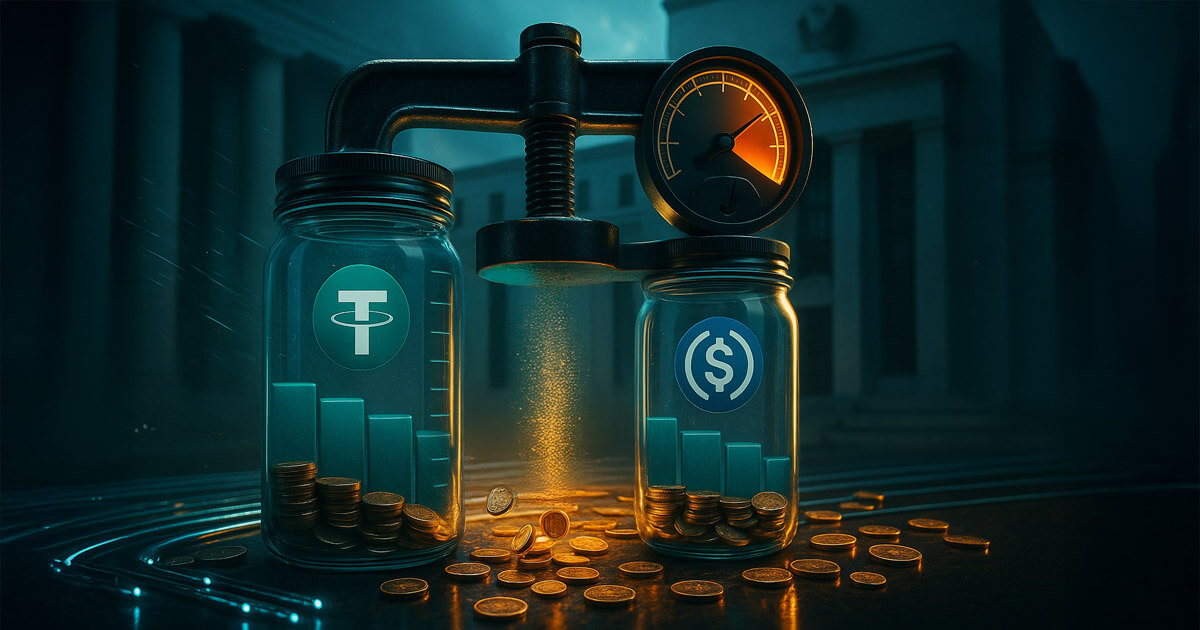
Stablecoins could face yield compression after Fed’s rate cut

Stablecoins could face yield compression after Fed’s rate cut

The post Stablecoins could face yield compression after Fed’s rate cut appeared on BitcoinEthereumNews.com. The Federal Reserve reduced its policy rate by 25 basis points to 4.00%–4.25%, the first rate cut this year. The move, framed as a response to weakening labor data, signals the start of a cautious easing cycle. Projections show two more cuts possible before year-end, with further reductions likely in 2026. Inflation remains above target, but Chairman Jerome Powell emphasized risk management over immediate price control, prioritizing stability in employment conditions. Stablecoins will be quickly affected by this. Issuers like Tether and Circle have generated large profits by holding reserves in short-term Treasuries during the high-rate environment of the past two years. That income stream now begins to erode. DeFi protocols that offered tokenized Treasury exposure face the same squeeze, with returns set to fall further if the Fed continues cutting into next year. A multi-cut easing cycle could substantially reduce stablecoin profitability, forcing issuers and protocols to adapt. The decline in dollar yields also alters the balance between holding stablecoins passively and seeking higher returns in risk assets. Bitcoin benefits most from this reallocation. As nominal rates move lower and inflation remains sticky, real yields decline, making non-yielding assets more attractive. The weaker dollar and improving risk appetite amplify the effect, positioning Bitcoin as a relative winner of the Fed’s shift. The September cut is modest, but it could bring significant changes to the crypto market. Stablecoin models built on Treasury income face structural headwinds after the rate cut, while Bitcoin and other high-beta assets stand to gain from falling real yields and increased liquidity. The Fed has opened an easing cycle, and crypto’s internal capital flows will move with it. The post Stablecoins could face yield compression after Fed’s rate cut appeared first on CryptoSlate. Source: https://cryptoslate.com/insights/stablecoins-could-face-yield-compression-after-feds-rate-cut/
Share
BitcoinEthereumNews2025/09/18 19:31
Wormhole Jumps 11% on Revised Tokenomics and Reserve Initiative

Wormhole Jumps 11% on Revised Tokenomics and Reserve Initiative

The post Wormhole Jumps 11% on Revised Tokenomics and Reserve Initiative appeared on BitcoinEthereumNews.com. Cross-chain bridge Wormhole plans to launch a reserve funded by both on-chain and off-chain revenues. Wormhole, a cross-chain bridge connecting over 40 blockchain networks, unveiled a tokenomics overhaul on Wednesday, hinting at updated staking incentives, a strategic reserve for the W token, and a smoother unlock schedule. The price of W jumped 11% on the news to $0.096, though the token is still down 92% since its debut in April 2024. W Chart In a blog post, Wormhole said it’s planning to set up a “Wormhole Reserve” that will accumulate on-chain and off-chain revenues “to support the growth of the Wormhole ecosystem.” The protocol also said it plans to target a 4% base yield for governance stakers, replacing the current variable APY system, noting that “yield will come from a combination of the existing token supply and protocol revenues.” It’s unclear whether Wormhole will draw from the reserve to fund this target. Wormhole did not immediately respond to The Defiant’s request for comment. Wormhole emphasized that the maximum supply of 10 billion W tokens will remain the same, while large annual token unlocks will be replaced by a bi-weekly distribution beginning Oct. 3 to eliminate “moments of concentrated market pressure.” Data from CoinGecko shows there are over 4.7 billion W tokens in circulation, meaning that more than half the supply is yet to be unlocked, with portions of that supply to be released over the next 4.5 years. Source: https://thedefiant.io/news/defi/wormhole-jumps-11-on-revised-tokenomics-and-reserve-initiative
Share
BitcoinEthereumNews2025/09/18 01:31