The digital asset landscape has undergone a significant transformation over the last twelve months. While Bitcoin remains the dominant force in terms of market The digital asset landscape has undergone a significant transformation over the last twelve months. While Bitcoin remains the dominant force in terms of market

Retail Investors Target Undervalued Altcoins as Market Sentiment Shifts

4 min read
Analyst Slashes Altcoin Bet

The digital asset landscape has undergone a significant transformation over the last twelve months. While Bitcoin remains the dominant force in terms of market capitalization, retail investors are increasingly looking beyond the market leader. They are seeking higher returns. 

As we move deeper into 2026, the narrative is shifting from simple accumulation to strategic diversification. There is a particular focus on lower-cap assets that offer accessible entry points.

This rotation of capital is not merely a reaction to price action. It rather suggests a maturing understanding of market cycles among retail participants. Investors are no longer just buying digital currency; they are buying into ecosystems, decentralized finance (DeFi) protocols, and utility tokens that power Web3 infrastructure. This trend is reshaping liquidity flows and altering how exchanges prioritize new listings.

The appetite for alternative cryptocurrencies, or “altcoins,” has grown substantially as Bitcoin’s price stability reduces its volatility-based appeal for aggressive traders. Institutional capital largely remains focused on established assets, but retail volume is driving activity in the mid-to-low cap sectors. This divergence has created a dual-speed market where established giants move with macroeconomic trends, while smaller projects react to community sentiment and technological upgrades.

Several factors are fueling this shift. Improved accessibility through mobile trading apps has made it easier than ever to swap assets instantly. Furthermore, the rise of Layer-2 scaling solutions has reduced transaction costs on networks like Ethereum, making it economically viable for smaller investors to trade tokens that were previously too expensive to move. Consequently, volume is surging in sectors ranging from real-world asset tokenization to gaming protocols.

Psychological Appeal of Sub-Dollar Cryptocurrencies

One of the most powerful drivers in the retail sector is “unit bias”—the psychological preference for owning whole units of a currency rather than a fraction of a Bitcoin. For a new investor, holding 10,000 units of a cheaper token often feels more significant than holding 0.005 BTC, even if the dollar value is identical. This bias heavily influences portfolio construction, leading many to target assets priced under a dollar in hopes of exponential growth.

This mentality creates specific price targets that act as magnets for liquidity. Speculators often scour the market for the next crypto to hit $1, viewing this specific price point as a major psychological victory for emerging tokens. When a token approaches this parity, it often triggers a wave of social media attention and volume, reinforcing the behavior. While this strategy is speculative, it remains a dominant force in how retail traders filter potential investments.

Evaluating Project Fundamentals and Token Utility

Despite the speculative nature of low-cap investing, data suggests that investors are becoming more discerning regarding utility and fundamentals. It is no longer enough for a project to simply be “cheap”; it must demonstrate a use case. This shift toward quality is evident in recent portfolio compositions. In 2024, 76% of crypto owners held Bitcoin, but by 2026, this has dropped slightly to 74%. Meanwhile, Solana has grown from 11% to 20%, and Litecoin has grown from 4% to 12%. Stablecoins like USDC are also growing, from 12% to 18%.

Investors are increasingly scrutinizing tokenomics, vesting schedules, and developer activity before committing capital. The rise of yield-bearing assets and liquid staking has also changed the calculus. Traders are looking for tokens that can work for them, rather than just sitting idle in a wallet. This demand for utility is pushing projects to deliver tangible value earlier in their lifecycles to capture retail attention.

Risk Management Strategies for Volatile Markets

Entering the lower-cap market requires a robust approach to risk management, as volatility in this sector significantly outpaces that of established assets. Successful traders in 2026 are adopting strict allocation limits, often capping high-risk plays at a small percentage of their total portfolio. Understanding the correlation between Bitcoin’s movements and altcoin reactions is essential for preserving capital during downturns.

Education remains the primary defense against market turbulence. With 6.9% of people worldwide currently holding crypto, the need for clear risk frameworks has never been higher. As the market continues to expand, the investors who succeed will likely be those who balance the allure of high returns with the discipline of fundamental analysis and prudent position sizing.

The post Retail Investors Target Undervalued Altcoins as Market Sentiment Shifts appeared first on The Coin Republic.

Disclaimer: The articles reposted on this site are sourced from public platforms and are provided for informational purposes only. They do not necessarily reflect the views of MEXC. All rights remain with the original authors. If you believe any content infringes on third-party rights, please contact service@support.mexc.com for removal. MEXC makes no guarantees regarding the accuracy, completeness, or timeliness of the content and is not responsible for any actions taken based on the information provided. The content does not constitute financial, legal, or other professional advice, nor should it be considered a recommendation or endorsement by MEXC.

You May Also Like

Victra Named 2025 Recipient of Verizon’s Best Build Compliance Award
Victra Named 2025 Recipient of Verizon’s Best Build Compliance Award

Verizon Recognizes Victra for Industry-Leading Excellence in Store Design and Brand Compliance. RALEIGH, N.C., Feb. 3, 2026 /PRNewswire/ — Verizon has named Victra
Share
AI Journal2026/02/03 20:49
Stablecoins could face yield compression after Fed’s rate cut

Stablecoins could face yield compression after Fed’s rate cut

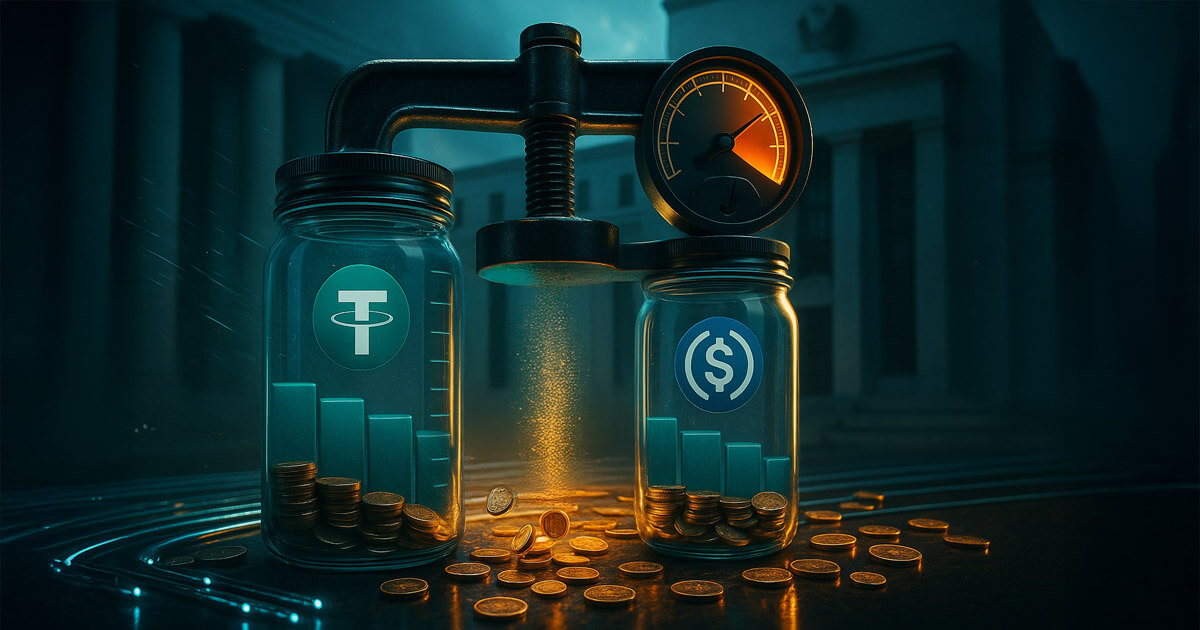
The post Stablecoins could face yield compression after Fed’s rate cut appeared on BitcoinEthereumNews.com. The Federal Reserve reduced its policy rate by 25 basis points to 4.00%–4.25%, the first rate cut this year. The move, framed as a response to weakening labor data, signals the start of a cautious easing cycle. Projections show two more cuts possible before year-end, with further reductions likely in 2026. Inflation remains above target, but Chairman Jerome Powell emphasized risk management over immediate price control, prioritizing stability in employment conditions. Stablecoins will be quickly affected by this. Issuers like Tether and Circle have generated large profits by holding reserves in short-term Treasuries during the high-rate environment of the past two years. That income stream now begins to erode. DeFi protocols that offered tokenized Treasury exposure face the same squeeze, with returns set to fall further if the Fed continues cutting into next year. A multi-cut easing cycle could substantially reduce stablecoin profitability, forcing issuers and protocols to adapt. The decline in dollar yields also alters the balance between holding stablecoins passively and seeking higher returns in risk assets. Bitcoin benefits most from this reallocation. As nominal rates move lower and inflation remains sticky, real yields decline, making non-yielding assets more attractive. The weaker dollar and improving risk appetite amplify the effect, positioning Bitcoin as a relative winner of the Fed’s shift. The September cut is modest, but it could bring significant changes to the crypto market. Stablecoin models built on Treasury income face structural headwinds after the rate cut, while Bitcoin and other high-beta assets stand to gain from falling real yields and increased liquidity. The Fed has opened an easing cycle, and crypto’s internal capital flows will move with it. The post Stablecoins could face yield compression after Fed’s rate cut appeared first on CryptoSlate. Source: https://cryptoslate.com/insights/stablecoins-could-face-yield-compression-after-feds-rate-cut/
Share
BitcoinEthereumNews2025/09/18 19:31
Wormhole Jumps 11% on Revised Tokenomics and Reserve Initiative

Wormhole Jumps 11% on Revised Tokenomics and Reserve Initiative

The post Wormhole Jumps 11% on Revised Tokenomics and Reserve Initiative appeared on BitcoinEthereumNews.com. Cross-chain bridge Wormhole plans to launch a reserve funded by both on-chain and off-chain revenues. Wormhole, a cross-chain bridge connecting over 40 blockchain networks, unveiled a tokenomics overhaul on Wednesday, hinting at updated staking incentives, a strategic reserve for the W token, and a smoother unlock schedule. The price of W jumped 11% on the news to $0.096, though the token is still down 92% since its debut in April 2024. W Chart In a blog post, Wormhole said it’s planning to set up a “Wormhole Reserve” that will accumulate on-chain and off-chain revenues “to support the growth of the Wormhole ecosystem.” The protocol also said it plans to target a 4% base yield for governance stakers, replacing the current variable APY system, noting that “yield will come from a combination of the existing token supply and protocol revenues.” It’s unclear whether Wormhole will draw from the reserve to fund this target. Wormhole did not immediately respond to The Defiant’s request for comment. Wormhole emphasized that the maximum supply of 10 billion W tokens will remain the same, while large annual token unlocks will be replaced by a bi-weekly distribution beginning Oct. 3 to eliminate “moments of concentrated market pressure.” Data from CoinGecko shows there are over 4.7 billion W tokens in circulation, meaning that more than half the supply is yet to be unlocked, with portions of that supply to be released over the next 4.5 years. Source: https://thedefiant.io/news/defi/wormhole-jumps-11-on-revised-tokenomics-and-reserve-initiative
Share
BitcoinEthereumNews2025/09/18 01:31