Arizona Attorney General Kris Mayes issued a statewide scam alert on Monday, warning residents that crypto ATM fraud has become a mounting threat after ArizonansArizona Attorney General Kris Mayes issued a statewide scam alert on Monday, warning residents that crypto ATM fraud has become a mounting threat after Arizonans

Arizona AG Warns Residents: Crypto ATM Scams Are Surging

4 min read

Arizona Attorney General Kris Mayes issued a statewide scam alert on Monday, warning residents that crypto ATM fraud has become a mounting threat after Arizonans lost over $177 million to these schemes in 2024.

Her office simultaneously launched a new fraud complaint form, enabling victims to report losses within 30 days of being scammed.

The warning comes as a broad crackdown on crypto kiosk fraud intensifies across the United States and beyond, with the FBI reporting a 99% surge in complaints and over $246 million in total losses in 2024.

From lawsuits against major operators to sweeping federal legislation, the industry is under fire as lawmakers race to protect vulnerable consumers.

Arizona’s New Laws Target Crypto Kiosk Fraud

Scammers typically reach victims through unsolicited calls or texts, impersonating banks, law enforcement, or loved ones before pressuring them to deposit cash into one of Arizona’s roughly 600 crypto ATMs.

Once funds enter a kiosk, they are nearly impossible to recover. Scottsdale police alone have already reported $5 million in losses this year.

Fraudsters are increasingly using bitcoin ATMs to victimize Arizonans — scammers stole more than $170 million from Arizonans last year using these crypto kiosks,” Mayes stated, adding that “If you’re being directed to use one, there’s a very very high chance you’re being scammed.

The state has also partnered with Yavapai County Sheriff David Rhodes to place physical “STOP” signs on Bitcoin ATMs across the state.

Beyond warnings, Arizona’s Crypto Kiosk License Fraud Prevention law, effective since September 2025, caps daily transactions at $2,000 for new customers and $10,500 for existing users.

Operators must now issue full refunds to fraud victims who file a police report within 30 days.

At that time, Governor Hobbs also signed HB 2749 to create a state Bitcoin reserve funded entirely by unclaimed digital assets

Lawsuits and Indictments Shake the Industry

While Arizona tightens consumer safeguards, legal battles are escalating elsewhere against some of the sector’s biggest players.

Washington, D.C., Attorney General Brian Schwalb sued Athena Bitcoin after an investigation revealed that 93% of the company’s deposits during its first five months in the district were directly tied to scams, with a median victim age of 71, and that one resident lost $98,000 across 19 transactions.

The company allegedly charged undisclosed fees of up to 26% while enforcing a strict no-refunds policy on fraud victims.

Athena knows that its machines are being used primarily by scammers yet chooses to look the other way so that it can continue to pocket sizable hidden transaction fees,” Schwalb declared.

The Athena case is far from isolated. Federal prosecutors in Chicago separately indicted Firas Isa, CEO of Crypto Dispensers, on money-laundering conspiracy charges after his network allegedly processed $10 million in fraud and drug proceeds.

Manhattan DA Alvin Bragg joined the pressure, urging New York lawmakers to criminalize unlicensed crypto operations and warning of a “$51 billion criminal economy,” declaring that “If you are operating a crypto business, you should be licensed.

States and Nations Race to Close Regulatory Gaps

These enforcement actions have spurred legislative responses at every level of government.

Senator Dick Durbin’s Crypto ATM Fraud Prevention Act, introduced as Bill S. 710, would mandate Treasury registration, fraud warnings, transaction caps, and victim refunds nationwide, while Wisconsin legislators have also introduced parallel bills targeting the state’s 582 kiosks with $1,000 daily caps and strict identity checks.

International regulators are moving in the same direction, with New Zealand imposing an outright ban on crypto ATMs under anti-money laundering reforms and Australian Home Affairs Minister Tony Burke declaring, “Be in no doubt, crypto ATMs are a high-risk product,” after AUSTRAC found 85% of top kiosk users’ funds were linked to scams.

Similarly, Spokane, Washington, also became the first U.S. city to ban the machines entirely after federal probes revealed widespread fraud.

Amid the tightening, industry activity is not entirely stalled. Washington state ordered Coinme to halt operations and repay $8 million after regulators found it had illegally converted unredeemed customer funds into corporate revenue, yet Polygon is reportedly eyeing an acquisition of the firm for $100 to $125 million.

Bitcoin Bancorp also recently announced plans to deploy 200 new ATMs across Texas, where over 4,000 kiosks already operate under one of the nation’s clearest regulatory frameworks.

Disclaimer: The articles reposted on this site are sourced from public platforms and are provided for informational purposes only. They do not necessarily reflect the views of MEXC. All rights remain with the original authors. If you believe any content infringes on third-party rights, please contact service@support.mexc.com for removal. MEXC makes no guarantees regarding the accuracy, completeness, or timeliness of the content and is not responsible for any actions taken based on the information provided. The content does not constitute financial, legal, or other professional advice, nor should it be considered a recommendation or endorsement by MEXC.

You May Also Like

Victra Named 2025 Recipient of Verizon’s Best Build Compliance Award
Victra Named 2025 Recipient of Verizon’s Best Build Compliance Award

Verizon Recognizes Victra for Industry-Leading Excellence in Store Design and Brand Compliance. RALEIGH, N.C., Feb. 3, 2026 /PRNewswire/ — Verizon has named Victra
Share
AI Journal2026/02/03 20:49
Stablecoins could face yield compression after Fed’s rate cut

Stablecoins could face yield compression after Fed’s rate cut

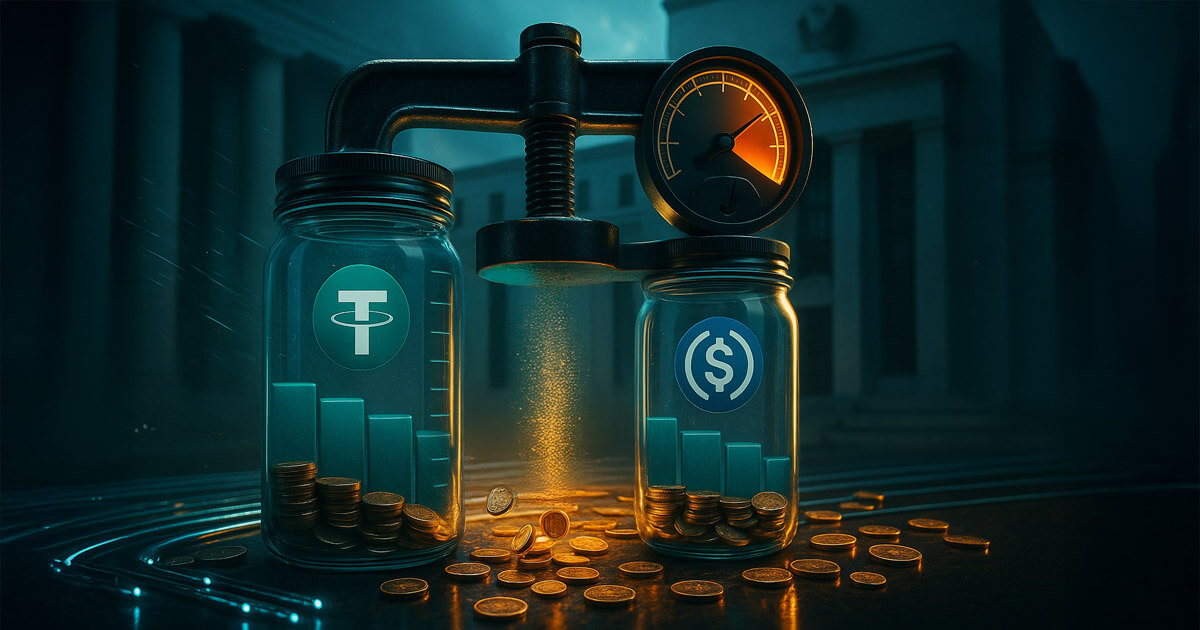
The post Stablecoins could face yield compression after Fed’s rate cut appeared on BitcoinEthereumNews.com. The Federal Reserve reduced its policy rate by 25 basis points to 4.00%–4.25%, the first rate cut this year. The move, framed as a response to weakening labor data, signals the start of a cautious easing cycle. Projections show two more cuts possible before year-end, with further reductions likely in 2026. Inflation remains above target, but Chairman Jerome Powell emphasized risk management over immediate price control, prioritizing stability in employment conditions. Stablecoins will be quickly affected by this. Issuers like Tether and Circle have generated large profits by holding reserves in short-term Treasuries during the high-rate environment of the past two years. That income stream now begins to erode. DeFi protocols that offered tokenized Treasury exposure face the same squeeze, with returns set to fall further if the Fed continues cutting into next year. A multi-cut easing cycle could substantially reduce stablecoin profitability, forcing issuers and protocols to adapt. The decline in dollar yields also alters the balance between holding stablecoins passively and seeking higher returns in risk assets. Bitcoin benefits most from this reallocation. As nominal rates move lower and inflation remains sticky, real yields decline, making non-yielding assets more attractive. The weaker dollar and improving risk appetite amplify the effect, positioning Bitcoin as a relative winner of the Fed’s shift. The September cut is modest, but it could bring significant changes to the crypto market. Stablecoin models built on Treasury income face structural headwinds after the rate cut, while Bitcoin and other high-beta assets stand to gain from falling real yields and increased liquidity. The Fed has opened an easing cycle, and crypto’s internal capital flows will move with it. The post Stablecoins could face yield compression after Fed’s rate cut appeared first on CryptoSlate. Source: https://cryptoslate.com/insights/stablecoins-could-face-yield-compression-after-feds-rate-cut/
Share
BitcoinEthereumNews2025/09/18 19:31
Wormhole Jumps 11% on Revised Tokenomics and Reserve Initiative

Wormhole Jumps 11% on Revised Tokenomics and Reserve Initiative

The post Wormhole Jumps 11% on Revised Tokenomics and Reserve Initiative appeared on BitcoinEthereumNews.com. Cross-chain bridge Wormhole plans to launch a reserve funded by both on-chain and off-chain revenues. Wormhole, a cross-chain bridge connecting over 40 blockchain networks, unveiled a tokenomics overhaul on Wednesday, hinting at updated staking incentives, a strategic reserve for the W token, and a smoother unlock schedule. The price of W jumped 11% on the news to $0.096, though the token is still down 92% since its debut in April 2024. W Chart In a blog post, Wormhole said it’s planning to set up a “Wormhole Reserve” that will accumulate on-chain and off-chain revenues “to support the growth of the Wormhole ecosystem.” The protocol also said it plans to target a 4% base yield for governance stakers, replacing the current variable APY system, noting that “yield will come from a combination of the existing token supply and protocol revenues.” It’s unclear whether Wormhole will draw from the reserve to fund this target. Wormhole did not immediately respond to The Defiant’s request for comment. Wormhole emphasized that the maximum supply of 10 billion W tokens will remain the same, while large annual token unlocks will be replaced by a bi-weekly distribution beginning Oct. 3 to eliminate “moments of concentrated market pressure.” Data from CoinGecko shows there are over 4.7 billion W tokens in circulation, meaning that more than half the supply is yet to be unlocked, with portions of that supply to be released over the next 4.5 years. Source: https://thedefiant.io/news/defi/wormhole-jumps-11-on-revised-tokenomics-and-reserve-initiative
Share
BitcoinEthereumNews2025/09/18 01:31