FTX users and law firm Fenwick & West have agreed to a proposed settlement in a lawsuit over the exchange’s fraud.FTX users and law firm Fenwick & West have agreed to a proposed settlement in a lawsuit over the exchange’s fraud.

FTX users reach settlement with Fenwick over exchange fraud claims

4 min read

In a major legal shift tied to the collapse of the cryptocurrency exchange FTX, users of the failed platform and Silicon Valley law firm Fenwick & West LLP have agreed to a proposed settlement in a long‑running lawsuit accusing the firm of helping to facilitate the massive fraud that led to the exchange’s downfall.

Filed in federal court in Florida, the class‑action lawsuit alleges that Fenwick played a central role in advising FTX in structuring aspects of its business that later enabled the misuse of customer funds and helped avoid certain regulatory requirements. Plaintiffs said the firm’s “substantial assistance” was integral to the fraud that left millions of users unable to access their assets after FTX collapsed in late 2022.

Although the terms of the settlement have not been publicly disclosed, both sides confirmed in a joint filing that they intend to submit the deal to the court for approval on February 27, 2026.

Several individuals raised concerns about the FTX fraud

Concerning the proposed settlement, sources with knowledge of the matter, who wished to remain anonymous due to its confidential nature, noted that the filing did not disclose specific details. 

What was uncovered was that both sides jointly asked the court to freeze all deadlines and pending motions in the class-action lawsuit until the settlement is submitted.

Meanwhile, it is worth noting that the lawsuit against Fenwick is part of a larger class-action suit submitted after the collapse of FTX in late 2022. Following this collapse, users have initiated legal proceedings against the exchange, famous figures have faced allegations of promoting it, and several firms have partnered with it.

Initially filed in 2023 and updated in August, the lawsuit claims Fenwick was instrumental in facilitating FTX’s fraud by providing substantial support to its operations.

This allegation prompted analysts to implement thorough investigations into FTX’s fraud. After the analysts’ intentions became public, sources sought to explain that Fenwick’s substantial assistance was the sole reason the fraud was possible. His efforts facilitated the establishment and approval of structures that promote various fraudulent activities.

Moreover, the lawsuit alleged that Fenwick provided guidance on navigating money transmitter licensing, understood how funds were being bounced, and had unclear boundaries between FTX and Alameda Research. 

Fenwick denies involvement with the massive FTX fraud

At first, Fenwick attempted to get the case withdrawn, alleging that it could not be held responsible for a fraud of which it was unaware. The company acknowledged that it provides standard and lawful legal services. 

In the meantime, after several considerations, the court decided to permit the amended FTX user complaint to proceed, denying Fenwick’s motion to dismiss the lawsuit.

When reporters reached out to Fenwick & West and the Moskowitz Law Firm representing FTX users for clarity on the situation, the firms declined to respond. Reports uncovered that this is not the first time FTX users have filed a lawsuit. In February 2024, they initiated legal action against Sullivan & Cromwell,

FTX’s former outside legal advisors. In this case, they accused the firm of playing a crucial role in the massive FTX fraud; however, eight months later, they dropped the lawsuit because they lacked adequate evidence.

Separately, the US Securities and Exchange Commission (SEC) made clear its intention to resolve its 2023 lawsuit against Gemini Trust Co. In this case, the agency alleged that the firm secured billions in funding through an unregistered crypto-lending program.

To demonstrate their commitment to dropping the case, both the federal agency and Gemini’s lawyers requested that a federal judge in New York dismiss it. According to the SEC, it adopted this decision after Gemini announced that it had settled with the New York State Department of Financial Services. Moreover, the regulated cryptocurrency exchange and custodian pledged to ensure that clients would receive a full recovery of their crypto assets.

As in previous instances, the SEC indicated that the dismissal was exercised in its discretion. Meanwhile, neither the SEC nor Gemini’s lawyer chose to respond to reporters’ requests for comment on the matter.

Don’t just read crypto news. Understand it. Subscribe to our newsletter. It's free.

Disclaimer: The articles reposted on this site are sourced from public platforms and are provided for informational purposes only. They do not necessarily reflect the views of MEXC. All rights remain with the original authors. If you believe any content infringes on third-party rights, please contact service@support.mexc.com for removal. MEXC makes no guarantees regarding the accuracy, completeness, or timeliness of the content and is not responsible for any actions taken based on the information provided. The content does not constitute financial, legal, or other professional advice, nor should it be considered a recommendation or endorsement by MEXC.

You May Also Like

Victra Named 2025 Recipient of Verizon’s Best Build Compliance Award
Victra Named 2025 Recipient of Verizon’s Best Build Compliance Award

Verizon Recognizes Victra for Industry-Leading Excellence in Store Design and Brand Compliance. RALEIGH, N.C., Feb. 3, 2026 /PRNewswire/ — Verizon has named Victra
Share
AI Journal2026/02/03 20:49
Stablecoins could face yield compression after Fed’s rate cut

Stablecoins could face yield compression after Fed’s rate cut

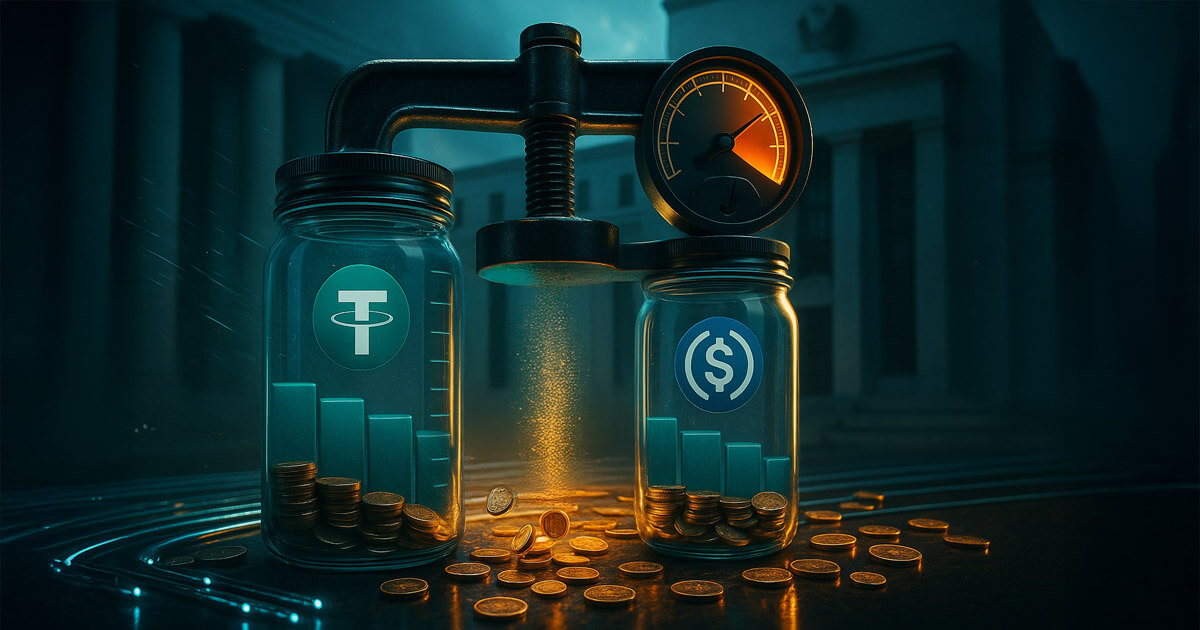
The post Stablecoins could face yield compression after Fed’s rate cut appeared on BitcoinEthereumNews.com. The Federal Reserve reduced its policy rate by 25 basis points to 4.00%–4.25%, the first rate cut this year. The move, framed as a response to weakening labor data, signals the start of a cautious easing cycle. Projections show two more cuts possible before year-end, with further reductions likely in 2026. Inflation remains above target, but Chairman Jerome Powell emphasized risk management over immediate price control, prioritizing stability in employment conditions. Stablecoins will be quickly affected by this. Issuers like Tether and Circle have generated large profits by holding reserves in short-term Treasuries during the high-rate environment of the past two years. That income stream now begins to erode. DeFi protocols that offered tokenized Treasury exposure face the same squeeze, with returns set to fall further if the Fed continues cutting into next year. A multi-cut easing cycle could substantially reduce stablecoin profitability, forcing issuers and protocols to adapt. The decline in dollar yields also alters the balance between holding stablecoins passively and seeking higher returns in risk assets. Bitcoin benefits most from this reallocation. As nominal rates move lower and inflation remains sticky, real yields decline, making non-yielding assets more attractive. The weaker dollar and improving risk appetite amplify the effect, positioning Bitcoin as a relative winner of the Fed’s shift. The September cut is modest, but it could bring significant changes to the crypto market. Stablecoin models built on Treasury income face structural headwinds after the rate cut, while Bitcoin and other high-beta assets stand to gain from falling real yields and increased liquidity. The Fed has opened an easing cycle, and crypto’s internal capital flows will move with it. The post Stablecoins could face yield compression after Fed’s rate cut appeared first on CryptoSlate. Source: https://cryptoslate.com/insights/stablecoins-could-face-yield-compression-after-feds-rate-cut/
Share
BitcoinEthereumNews2025/09/18 19:31
Wormhole Jumps 11% on Revised Tokenomics and Reserve Initiative

Wormhole Jumps 11% on Revised Tokenomics and Reserve Initiative

The post Wormhole Jumps 11% on Revised Tokenomics and Reserve Initiative appeared on BitcoinEthereumNews.com. Cross-chain bridge Wormhole plans to launch a reserve funded by both on-chain and off-chain revenues. Wormhole, a cross-chain bridge connecting over 40 blockchain networks, unveiled a tokenomics overhaul on Wednesday, hinting at updated staking incentives, a strategic reserve for the W token, and a smoother unlock schedule. The price of W jumped 11% on the news to $0.096, though the token is still down 92% since its debut in April 2024. W Chart In a blog post, Wormhole said it’s planning to set up a “Wormhole Reserve” that will accumulate on-chain and off-chain revenues “to support the growth of the Wormhole ecosystem.” The protocol also said it plans to target a 4% base yield for governance stakers, replacing the current variable APY system, noting that “yield will come from a combination of the existing token supply and protocol revenues.” It’s unclear whether Wormhole will draw from the reserve to fund this target. Wormhole did not immediately respond to The Defiant’s request for comment. Wormhole emphasized that the maximum supply of 10 billion W tokens will remain the same, while large annual token unlocks will be replaced by a bi-weekly distribution beginning Oct. 3 to eliminate “moments of concentrated market pressure.” Data from CoinGecko shows there are over 4.7 billion W tokens in circulation, meaning that more than half the supply is yet to be unlocked, with portions of that supply to be released over the next 4.5 years. Source: https://thedefiant.io/news/defi/wormhole-jumps-11-on-revised-tokenomics-and-reserve-initiative
Share
BitcoinEthereumNews2025/09/18 01:31