Musk’s xAI is recruiting a cryptocurrency finance expert to help train advanced AI models using blockchain, DeFi, and quantitative trading knowledge.Musk’s xAI is recruiting a cryptocurrency finance expert to help train advanced AI models using blockchain, DeFi, and quantitative trading knowledge.

xAI seeks crypto finance expert to help train its AI models

3 min read

xAI, the artificial intelligence firm founded by Elon Musk, has put up a job opening for a “cryptocurrency specialist” to help train its advanced AI systems. 

According to a newly posted role description, xAI is hiring individuals with deep expertise in blockchain markets, decentralized finance systems, and quantitative trading techniques. The job is meant to support the development of the AI model Grok, building on the engagement of the crypto community on the social platform X.

“X is already the #1 place where CT hangs out. Elon Musk wants to make xAI/grok the #1 research platform for crypto folks, too? Definitely a net positive for the crypto ecosystem!” wrote CoinDCX CEO Sumit Gupta.

xAI is looking to train Grok AI with crypto market intelligence

xAI’s job description reads that the candidate will be required to use internal labeling software and collaborate with engineers on digital asset markets and trading behavior. The job would require them to teach Grok to reason technically and judge before executing instructions.

Moreover, the specialist will guide models through complex trading problems in crypto markets, such as liquidity crunches and liquidations. Some of the tasks mentioned include blockchain data interpretation, token economics, derivatives, and cross-market inefficiencies. 

The job description lists analysis of on-chain activity and capital flows, along with references on decentralized lending, yield strategies, and liquidity modeling. Candidates may tackle funding rate trades, price basis gaps, order books dynamics, and miner extractable value (MEV).

The Finance expert will also provide critiques of model outputs and propose alternative methods grounded in mathematical reasoning and code-based solutions. All outputs will become company property under work-for-hire terms, while engineers and researchers will refine training tasks and feedback in collaboration with the expert.

Quantitative analysis, applied maths, and computer science are among the requirements

The xAI training team has set several requirements for hiring, mostly focused on financial education, with a sprinkle of software development. Eligible candidates must have advanced quantitative education and professional experience in blockchain trading, coupled with degrees in financial engineering, applied mathematics, computer science, or statistics. 

xAI said it prefers credentials that include professional trading backgrounds at crypto funds or market makers, but public research or open-source contributions are added advantages. Furthermore, certifications in finance or blockchain may help, though having exposure to AI model evaluation in financial contexts is a strong plus.

“Hourly pay is just one part of our total rewards package at xAI. Specific benefits vary by country; depending on your country of residence, you may have access to medical benefits. We do not offer benefits for part-time roles,” the company explained.

The training job opening comes against the backdrop of xAI’s computing infrastructure expansion, announced by CEO Musk about two weeks ago. In mid-January, the company brought its supposed “first gigawatt-scale” AI training Colossus 2 supercomputer online.

According to Musk, Colossus 2’s first installation took 122 days to reach full operational capacity. Its successor crossed the one-gigawatt threshold as it went live, but the new supercomputer, which harbors over 550,000 Nvidia GPUs, clocked two gigawatts on January 3.

The smartest crypto minds already read our newsletter. Want in? Join them.

Disclaimer: The articles reposted on this site are sourced from public platforms and are provided for informational purposes only. They do not necessarily reflect the views of MEXC. All rights remain with the original authors. If you believe any content infringes on third-party rights, please contact service@support.mexc.com for removal. MEXC makes no guarantees regarding the accuracy, completeness, or timeliness of the content and is not responsible for any actions taken based on the information provided. The content does not constitute financial, legal, or other professional advice, nor should it be considered a recommendation or endorsement by MEXC.

You May Also Like

Victra Named 2025 Recipient of Verizon’s Best Build Compliance Award
Victra Named 2025 Recipient of Verizon’s Best Build Compliance Award

Verizon Recognizes Victra for Industry-Leading Excellence in Store Design and Brand Compliance. RALEIGH, N.C., Feb. 3, 2026 /PRNewswire/ — Verizon has named Victra
Share
AI Journal2026/02/03 20:49
Stablecoins could face yield compression after Fed’s rate cut

Stablecoins could face yield compression after Fed’s rate cut

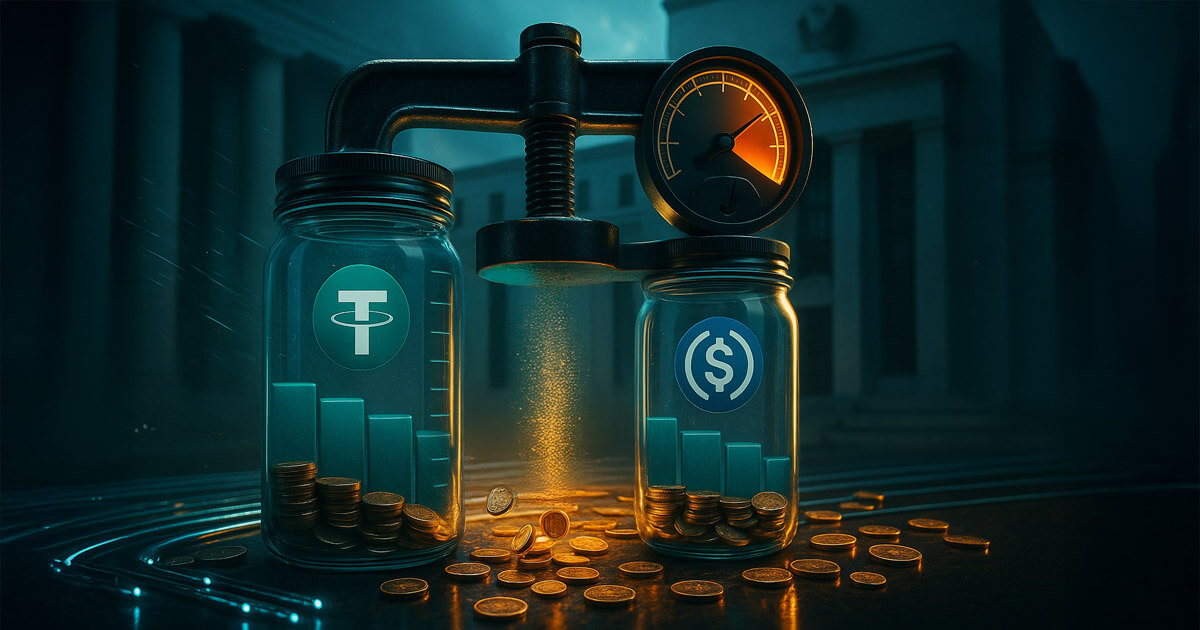
The post Stablecoins could face yield compression after Fed’s rate cut appeared on BitcoinEthereumNews.com. The Federal Reserve reduced its policy rate by 25 basis points to 4.00%–4.25%, the first rate cut this year. The move, framed as a response to weakening labor data, signals the start of a cautious easing cycle. Projections show two more cuts possible before year-end, with further reductions likely in 2026. Inflation remains above target, but Chairman Jerome Powell emphasized risk management over immediate price control, prioritizing stability in employment conditions. Stablecoins will be quickly affected by this. Issuers like Tether and Circle have generated large profits by holding reserves in short-term Treasuries during the high-rate environment of the past two years. That income stream now begins to erode. DeFi protocols that offered tokenized Treasury exposure face the same squeeze, with returns set to fall further if the Fed continues cutting into next year. A multi-cut easing cycle could substantially reduce stablecoin profitability, forcing issuers and protocols to adapt. The decline in dollar yields also alters the balance between holding stablecoins passively and seeking higher returns in risk assets. Bitcoin benefits most from this reallocation. As nominal rates move lower and inflation remains sticky, real yields decline, making non-yielding assets more attractive. The weaker dollar and improving risk appetite amplify the effect, positioning Bitcoin as a relative winner of the Fed’s shift. The September cut is modest, but it could bring significant changes to the crypto market. Stablecoin models built on Treasury income face structural headwinds after the rate cut, while Bitcoin and other high-beta assets stand to gain from falling real yields and increased liquidity. The Fed has opened an easing cycle, and crypto’s internal capital flows will move with it. The post Stablecoins could face yield compression after Fed’s rate cut appeared first on CryptoSlate. Source: https://cryptoslate.com/insights/stablecoins-could-face-yield-compression-after-feds-rate-cut/
Share
BitcoinEthereumNews2025/09/18 19:31
Wormhole Jumps 11% on Revised Tokenomics and Reserve Initiative

Wormhole Jumps 11% on Revised Tokenomics and Reserve Initiative

The post Wormhole Jumps 11% on Revised Tokenomics and Reserve Initiative appeared on BitcoinEthereumNews.com. Cross-chain bridge Wormhole plans to launch a reserve funded by both on-chain and off-chain revenues. Wormhole, a cross-chain bridge connecting over 40 blockchain networks, unveiled a tokenomics overhaul on Wednesday, hinting at updated staking incentives, a strategic reserve for the W token, and a smoother unlock schedule. The price of W jumped 11% on the news to $0.096, though the token is still down 92% since its debut in April 2024. W Chart In a blog post, Wormhole said it’s planning to set up a “Wormhole Reserve” that will accumulate on-chain and off-chain revenues “to support the growth of the Wormhole ecosystem.” The protocol also said it plans to target a 4% base yield for governance stakers, replacing the current variable APY system, noting that “yield will come from a combination of the existing token supply and protocol revenues.” It’s unclear whether Wormhole will draw from the reserve to fund this target. Wormhole did not immediately respond to The Defiant’s request for comment. Wormhole emphasized that the maximum supply of 10 billion W tokens will remain the same, while large annual token unlocks will be replaced by a bi-weekly distribution beginning Oct. 3 to eliminate “moments of concentrated market pressure.” Data from CoinGecko shows there are over 4.7 billion W tokens in circulation, meaning that more than half the supply is yet to be unlocked, with portions of that supply to be released over the next 4.5 years. Source: https://thedefiant.io/news/defi/wormhole-jumps-11-on-revised-tokenomics-and-reserve-initiative
Share
BitcoinEthereumNews2025/09/18 01:31