Source: Cryptoslate Compiled by: Blockchain Knight Analysts at VanEck say Ethereum is steadily becoming a stronger rival to Bitcoin in the race for store-of-value dominance. The driving force behind thisSource: Cryptoslate Compiled by: Blockchain Knight Analysts at VanEck say Ethereum is steadily becoming a stronger rival to Bitcoin in the race for store-of-value dominance. The driving force behind this

VanEck: Deflationary Mechanisms May Help Ethereum Overtake Bitcoin in Value Storage

2025/08/08 16:00
3 min read

Source: Cryptoslate

Compiled by: Blockchain Knight

Analysts at VanEck say Ethereum is steadily becoming a stronger rival to Bitcoin in the race for store-of-value dominance.

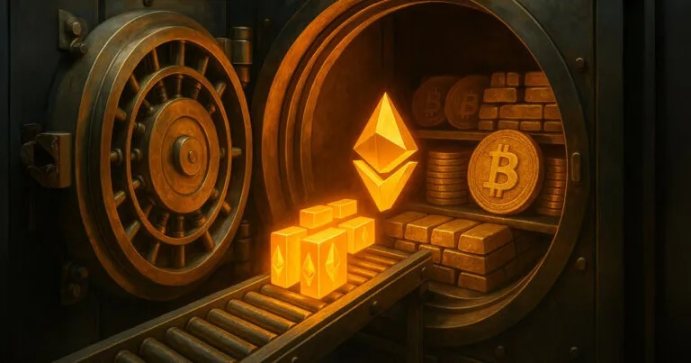
The driving force behind this shift is the growing popularity of digital asset treasuries (DATs), with global businesses increasingly favoring Ethereum and Bitcoin as options for digital asset vaults.

Initially, Bitcoin was the preferred digital asset for treasuries due to its fixed supply and perceived stability, but recent developments have sparked increased interest in Ethereum.

Regulatory changes in the United States have highlighted the need for stablecoins and tokenization, which are core functions of the Ethereum ecosystem.

This has allowed ETH to be used for purposes beyond its original design, with several large brokerages and exchanges already launching tokenized stocks on the Ethereum blockchain.

Furthermore, Ethereum’s increasing flexibility is seen as a significant advantage over Bitcoin.

VanEck analysts pointed out that Ethereum provides more possibilities for complex financial strategies, allowing institutions to increase their holdings of ETH more efficiently than accumulating BTC.

With Ethereum’s staking functionality, the Treasury can earn additional ETH by participating in the network, a source of income that Bitcoin cannot provide in a similar way.
Ethereum’s transition from Proof-of-Work (PoW) to Proof-of-Stake (PoS) has had a significant impact on its inflation rate.

According to VanEck data, this shift caused ETH's supply growth to drop significantly: from approximately 120.6 million ETH in October 2022 to 120.1 million ETH in April 2024, resulting in a negative inflation rate of -0.25%.

In comparison, Bitcoin’s supply grew by 1.1% during the same period, making Ethereum’s inflation policy more attractive to ETH holders.

Bitcoin’s inflation rate decreases by 50% after each halving, making it more predictable. But the problem is that the top cryptocurrency has long relied on inflationary issuance to incentivize miners.

Last year, Bitcoin miners earned huge revenue from inflation rewards, totaling over $14 billion.

Therefore, as Bitcoin's inflation rate continues to decline in subsequent halvings, its security model will face increasing pressure and may need to rely on transaction fees or price increases to maintain it. Without these supports, the security of the blockchain network may be at risk, which may force a major shift in economic structure.

On the other hand, Ethereum’s PoS model gives token holders more control over network governance, ensuring that network upgrades and economic policy decisions are more directly in line with their interests.

This contrasts with Bitcoin’s miner-centric governance model, where miners’ economic incentives often influence decision-making.

Therefore, VanEck analysts believe that as Ethereum continues to develop with a more flexible governance structure, it may become a better long-term store of value than Bitcoin.

Disclaimer: The articles reposted on this site are sourced from public platforms and are provided for informational purposes only. They do not necessarily reflect the views of MEXC. All rights remain with the original authors. If you believe any content infringes on third-party rights, please contact service@support.mexc.com for removal. MEXC makes no guarantees regarding the accuracy, completeness, or timeliness of the content and is not responsible for any actions taken based on the information provided. The content does not constitute financial, legal, or other professional advice, nor should it be considered a recommendation or endorsement by MEXC.

You May Also Like

Which Altcoins Stand to Gain from the SEC’s New ETF Listing Standards?

Which Altcoins Stand to Gain from the SEC’s New ETF Listing Standards?

On Wednesday, the US SEC (Securities and Exchange Commission) took a landmark step in crypto regulation, approving generic listing standards for spot crypto ETFs (exchange-traded funds). This new framework eliminates the case-by-case 19b-4 approval process, streamlining the path for multiple digital asset ETFs to enter the market in the coming weeks. Grayscale’s Multi-Crypto Milestone Grayscale secured a first-mover advantage as its Digital Large Cap Fund (GDLC) received approval under the new listing standards. Products that will be traded under the ticker GDLC include Bitcoin, Ethereum, XRP, Solana, and Cardano. “Grayscale Digital Large Cap Fund $GDLC was just approved for trading along with the Generic Listing Standards. The Grayscale team is working expeditiously to bring the FIRST multi-crypto asset ETP to market with Bitcoin, Ethereum, XRP, Solana, and Cardano,” wrote Grayscale CEO Peter Mintzberg. The approval marks the US’s first diversified, multi-crypto ETP, signaling a shift toward broader portfolio products rather than single-asset ETFs. Bloomberg’s Eric Balchunas explained that around 12–15 cryptocurrencies now qualify for spot ETF consideration. However, this is contingent on the altcoins having established futures trading on Coinbase Derivatives for at least six months. This includes well-known altcoins like Dogecoin (DOGE), Litecoin (LTC), and Chainlink (LINK), alongside the majors already included in Grayscale’s GDLC. Altcoins in the Spotlight Amid New Era of ETF Eligibility Several assets have already met the key condition, regulated futures trading on Coinbase. For example, Solana futures launched in February 2024, making the token eligible as of August 19. “The SEC approved generic ETF listing standards. Assets with a regulated futures contract trading for 6 months qualify for a spot ETF. Solana met this criterion on Aug 19, 6 months after SOL futures launched on Coinbase Derivatives,” SolanaFloor indicated. Crypto investors and communities also identified which tokens stand to gain. Chainlink community liaison Zach Rynes highlighted that LINK could soon see its own ETF. He noted that both Bitwise and Grayscale have already filed applications. Meanwhile, the Litecoin Foundation indicated that the new standards provide the regulatory framework for LTC to be listed on US exchanges. Hedera is also in the spotlight, with digital asset investor Mark anticipating an HBAR ETF. Market observers see the decision as a potential turning point for broader adoption, bringing the much-needed clarity and accessibility for investors. At the same time, it boosts confidence in the market’s maturity. The general sentiment is that with the SEC’s approval, the next phase of crypto ETFs is no longer a question of ‘if,’ but ‘when.’ The shift to generic listing standards could expand the US-listed digital asset ETFs roster beyond Bitcoin and Ethereum. Such a move would usher in new investment vehicles covering a dozen or more altcoins. This represents the clearest path yet toward mainstream, regulated access to diversified crypto exposure. More importantly, it comes without the friction of direct custody. “We’re gonna be off to the races in a matter of weeks,” ETF analyst James Seyffart quipped.
Share
Coinstats2025/09/18 12:57
‘High Risk’ Projects Dominate Crypto Press Releases, Report Finds

‘High Risk’ Projects Dominate Crypto Press Releases, Report Finds

The post ‘High Risk’ Projects Dominate Crypto Press Releases, Report Finds appeared on BitcoinEthereumNews.com. More than six in 10 crypto press releases published
Share
BitcoinEthereumNews2026/02/04 13:09
Why Vitalik Says L2s Aren’t Ethereum Shards Now?

Why Vitalik Says L2s Aren’t Ethereum Shards Now?

The post Why Vitalik Says L2s Aren’t Ethereum Shards Now? appeared on BitcoinEthereumNews.com. Vitalik says Ethereum’s scaling and higher gas limits mean L2s no
Share
BitcoinEthereumNews2026/02/04 13:18