Stablecoins have rapidly become a central pillar of the digital asset economy, now exceeding a combined market capitalization of $230 billion as of mid-2025, according to Morningstar DBRS. The market is led by Tether (USDT) and Circle (USDC), with other players including USDe, DAI, and FDUSD (see Exhibit 1). This growth has been fuelled by their stability — pegged to the U.S. dollar — and their ability to function as digital cash within the blockchain ecosystem. The passage of the first federal stablecoin legislation on July 17 has also accelerated adoption. With regulation in place, U.S. banks are beginning to explore launching their own stablecoins, notes the agency. “Stablecoins offer efficiency and innovation in the financial system, but they also pose both opportunities and risks for banks,” Morningstar DBRS analysts wrote in a report published Tuesday. How Stablecoins Work: Cheaper, Faster, Smarter Money Morningstar explains stablecoins are designed to combine the reliability of fiat currencies with the efficiency of blockchain. Unlike traditional payment rails — credit cards, ACH, or wire transfers — stablecoin transactions settle in seconds. “Stablecoins are programmable money,” Morningstar notes, highlighting their use in smart contracts that automatically execute financial operations. This has made them attractive for cross-border payments, e-commerce, and remittances. Major issuers like Tether, Circle, and PayPal back their coins with reserves of short-term U.S. Treasuries and cash equivalents, ensuring stability and redeemability. The efficiency advantage is stark: where wire transfers can cost up to $50 and take days to settle, stablecoins move instantly with negligible fees. This dynamic is drawing users away from banks’ legacy systems. Risks to U.S. Banks: Deposits and Payments at Stake Morningstar warns that the rise of stablecoins poses real risks to U.S. banks’ core business models. The most immediate concern is deposit flight. If consumers increasingly hold funds in stablecoins for rewards, convenience, or integration with decentralized finance, banks could lose the deposits that underpin their lending operations. According to the Bank for International Settlements, stablecoins still account for just 1.5% of total U.S. deposits, but growth is accelerating. “ A large-scale shift of funds from bank accounts into stablecoins could constrain banks’ ability to fund new loans or extend credit,” Morningstar analysts said. Banks also risk losing lucrative payment fees. Stablecoins bypass networks like ACH and SWIFT, enabling cheaper and faster transfers. As Exhibit 2 shows, the cost advantage is significant, threatening revenue from transaction services. Not All Bad News: A Path Forward for Banks Despite the risks, Morningstar highlights potential opportunities. Banks could leverage their regulatory credibility to serve as custodians of stablecoin reserves, manage U.S. Treasury holdings, and provide settlement and compliance infrastructure. These services could open new fee income streams. The newly passed GENIUS Act (Guiding and Establishing National Innovation for U.S. Stablecoins Act) sets capital and reserve requirements for issuers, creating a more level playing field. Some banks are considering launching their own fully backed stablecoins, integrated into existing compliance systems, to retain deposits and stay competitive. “Whether stablecoins ultimately represent an opportunity or a threat to U.S. banks will depend on regulatory design and market adoption,” Morningstar concludes.Stablecoins have rapidly become a central pillar of the digital asset economy, now exceeding a combined market capitalization of $230 billion as of mid-2025, according to Morningstar DBRS. The market is led by Tether (USDT) and Circle (USDC), with other players including USDe, DAI, and FDUSD (see Exhibit 1). This growth has been fuelled by their stability — pegged to the U.S. dollar — and their ability to function as digital cash within the blockchain ecosystem. The passage of the first federal stablecoin legislation on July 17 has also accelerated adoption. With regulation in place, U.S. banks are beginning to explore launching their own stablecoins, notes the agency. “Stablecoins offer efficiency and innovation in the financial system, but they also pose both opportunities and risks for banks,” Morningstar DBRS analysts wrote in a report published Tuesday. How Stablecoins Work: Cheaper, Faster, Smarter Money Morningstar explains stablecoins are designed to combine the reliability of fiat currencies with the efficiency of blockchain. Unlike traditional payment rails — credit cards, ACH, or wire transfers — stablecoin transactions settle in seconds. “Stablecoins are programmable money,” Morningstar notes, highlighting their use in smart contracts that automatically execute financial operations. This has made them attractive for cross-border payments, e-commerce, and remittances. Major issuers like Tether, Circle, and PayPal back their coins with reserves of short-term U.S. Treasuries and cash equivalents, ensuring stability and redeemability. The efficiency advantage is stark: where wire transfers can cost up to $50 and take days to settle, stablecoins move instantly with negligible fees. This dynamic is drawing users away from banks’ legacy systems. Risks to U.S. Banks: Deposits and Payments at Stake Morningstar warns that the rise of stablecoins poses real risks to U.S. banks’ core business models. The most immediate concern is deposit flight. If consumers increasingly hold funds in stablecoins for rewards, convenience, or integration with decentralized finance, banks could lose the deposits that underpin their lending operations. According to the Bank for International Settlements, stablecoins still account for just 1.5% of total U.S. deposits, but growth is accelerating. “ A large-scale shift of funds from bank accounts into stablecoins could constrain banks’ ability to fund new loans or extend credit,” Morningstar analysts said. Banks also risk losing lucrative payment fees. Stablecoins bypass networks like ACH and SWIFT, enabling cheaper and faster transfers. As Exhibit 2 shows, the cost advantage is significant, threatening revenue from transaction services. Not All Bad News: A Path Forward for Banks Despite the risks, Morningstar highlights potential opportunities. Banks could leverage their regulatory credibility to serve as custodians of stablecoin reserves, manage U.S. Treasury holdings, and provide settlement and compliance infrastructure. These services could open new fee income streams. The newly passed GENIUS Act (Guiding and Establishing National Innovation for U.S. Stablecoins Act) sets capital and reserve requirements for issuers, creating a more level playing field. Some banks are considering launching their own fully backed stablecoins, integrated into existing compliance systems, to retain deposits and stay competitive. “Whether stablecoins ultimately represent an opportunity or a threat to U.S. banks will depend on regulatory design and market adoption,” Morningstar concludes.

Stablecoins Threaten to Disrupt U.S. Bank Deposits and Payments, Morningstar DBRS Warns

3 min read

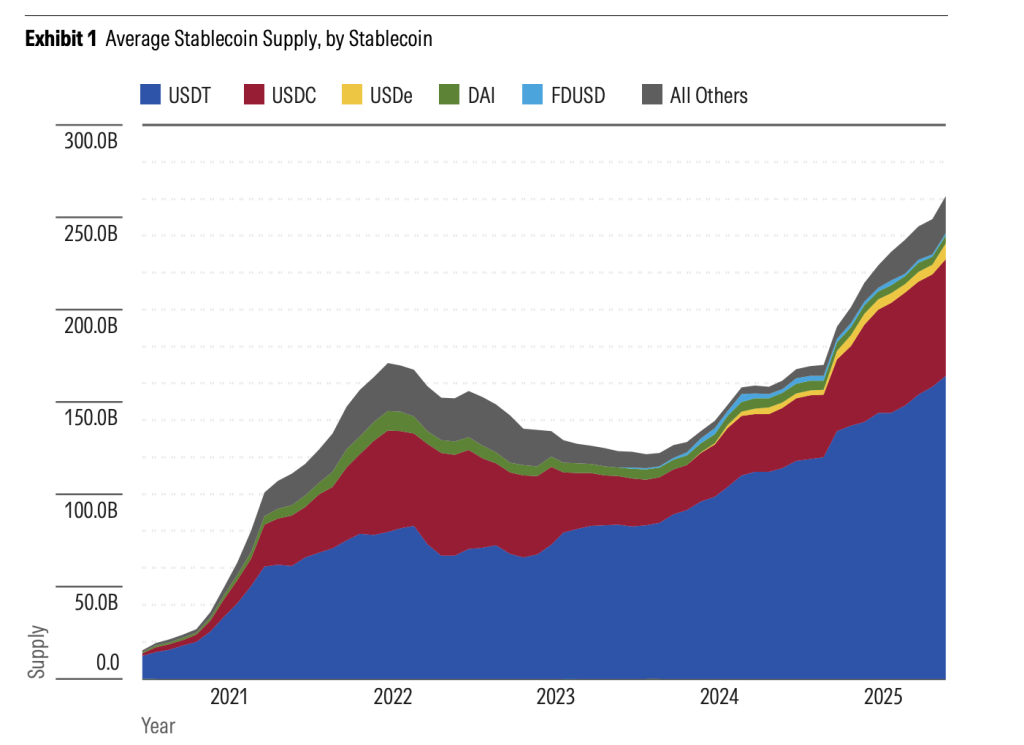
Stablecoins have rapidly become a central pillar of the digital asset economy, now exceeding a combined market capitalization of $230 billion as of mid-2025, according to Morningstar DBRS.

The market is led by Tether (USDT) and Circle (USDC), with other players including USDe, DAI, and FDUSD (see Exhibit 1). This growth has been fuelled by their stability — pegged to the U.S. dollar — and their ability to function as digital cash within the blockchain ecosystem.
The passage of the first federal stablecoin legislation on July 17 has also accelerated adoption. With regulation in place, U.S. banks are beginning to explore launching their own stablecoins, notes the agency.

“Stablecoins offer efficiency and innovation in the financial system, but they also pose both opportunities and risks for banks,” Morningstar DBRS analysts wrote in a report published Tuesday.

How Stablecoins Work: Cheaper, Faster, Smarter Money

Morningstar explains stablecoins are designed to combine the reliability of fiat currencies with the efficiency of blockchain. Unlike traditional payment rails — credit cards, ACH, or wire transfers — stablecoin transactions settle in seconds.

“Stablecoins are programmable money,” Morningstar notes, highlighting their use in smart contracts that automatically execute financial operations.

This has made them attractive for cross-border payments, e-commerce, and remittances. Major issuers like Tether, Circle, and PayPal back their coins with reserves of short-term U.S. Treasuries and cash equivalents, ensuring stability and redeemability.

The efficiency advantage is stark: where wire transfers can cost up to $50 and take days to settle, stablecoins move instantly with negligible fees. This dynamic is drawing users away from banks’ legacy systems.

Risks to U.S. Banks: Deposits and Payments at Stake

Morningstar warns that the rise of stablecoins poses real risks to U.S. banks’ core business models. The most immediate concern is deposit flight.

If consumers increasingly hold funds in stablecoins for rewards, convenience, or integration with decentralized finance, banks could lose the deposits that underpin their lending operations.

According to the Bank for International Settlements, stablecoins still account for just 1.5% of total U.S. deposits, but growth is accelerating. “

A large-scale shift of funds from bank accounts into stablecoins could constrain banks’ ability to fund new loans or extend credit,” Morningstar analysts said.

Banks also risk losing lucrative payment fees. Stablecoins bypass networks like ACH and SWIFT, enabling cheaper and faster transfers. As Exhibit 2 shows, the cost advantage is significant, threatening revenue from transaction services.

Not All Bad News: A Path Forward for Banks

Despite the risks, Morningstar highlights potential opportunities. Banks could leverage their regulatory credibility to serve as custodians of stablecoin reserves, manage U.S. Treasury holdings, and provide settlement and compliance infrastructure. These services could open new fee income streams.

The newly passed GENIUS Act (Guiding and Establishing National Innovation for U.S. Stablecoins Act) sets capital and reserve requirements for issuers, creating a more level playing field. Some banks are considering launching their own fully backed stablecoins, integrated into existing compliance systems, to retain deposits and stay competitive.

“Whether stablecoins ultimately represent an opportunity or a threat to U.S. banks will depend on regulatory design and market adoption,” Morningstar concludes.

Market Opportunity
RealLink Logo
RealLink Price(REAL)
$0,05737
$0,05737$0,05737
-4,63%
USD
RealLink (REAL) Live Price Chart
Disclaimer: The articles reposted on this site are sourced from public platforms and are provided for informational purposes only. They do not necessarily reflect the views of MEXC. All rights remain with the original authors. If you believe any content infringes on third-party rights, please contact service@support.mexc.com for removal. MEXC makes no guarantees regarding the accuracy, completeness, or timeliness of the content and is not responsible for any actions taken based on the information provided. The content does not constitute financial, legal, or other professional advice, nor should it be considered a recommendation or endorsement by MEXC.

You May Also Like

Payward Revenue Hits $2.2 Billion as Kraken Exchange Reports Strong 2025 Growth

Payward Revenue Hits $2.2 Billion as Kraken Exchange Reports Strong 2025 Growth

TLDR Payward, Kraken’s parent company, earned $2.2 billion in 2025, a 33% increase from 2024’s $1.6 billion Trading revenue and asset-based services each contributed
Share
Blockonomi2026/02/04 20:11
BetFury is at SBC Summit Lisbon 2025: Affiliate Growth in Focus

BetFury is at SBC Summit Lisbon 2025: Affiliate Growth in Focus

The post BetFury is at SBC Summit Lisbon 2025: Affiliate Growth in Focus appeared on BitcoinEthereumNews.com. Press Releases are sponsored content and not a part of Finbold’s editorial content. For a full disclaimer, please . Crypto assets/products can be highly risky. Never invest unless you’re prepared to lose all the money you invest. Curacao, Curacao, September 17th, 2025, Chainwire BetFury steps onto the stage of SBC Summit Lisbon 2025 — one of the key gatherings in the iGaming calendar. From 16 to 18 September, the platform showcases its brand strength, deepens affiliate connections, and outlines its plans for global expansion. BetFury continues to play a role in the evolving crypto and iGaming partnership landscape. BetFury’s Participation at SBC Summit The SBC Summit gathers over 25,000 delegates, including 6,000+ affiliates — the largest concentration of affiliate professionals in iGaming. For BetFury, this isn’t just visibility, it’s a strategic chance to present its Affiliate Program to the right audience. Face-to-face meetings, dedicated networking zones, and affiliate-focused sessions make Lisbon the ideal ground to build new partnerships and strengthen existing ones. BetFury Meets Affiliate Leaders at its Massive Stand BetFury arrives at the summit with a massive stand placed right in the center of the Affiliate zone. Designed as a true meeting hub, the stand combines large LED screens, a sleek interior, and the best coffee at the event — but its core mission goes far beyond style. Here, BetFury’s team welcomes partners and affiliates to discuss tailored collaborations, explore growth opportunities across multiple GEOs, and expand its global Affiliate Program. To make the experience even more engaging, the stand also hosts: Affiliate Lottery — a branded drum filled with exclusive offers and personalized deals for affiliates. Merch Kits — premium giveaways to boost brand recognition and leave visitors with a lasting conference memory. Besides, at SBC Summit Lisbon, attendees have a chance to meet the BetFury team along…
Share
BitcoinEthereumNews2025/09/18 01:20
Super Micro Computer (SMCI) Stock: Revenue Soars Past $12B on AI Server Boom

Super Micro Computer (SMCI) Stock: Revenue Soars Past $12B on AI Server Boom

TLDR Revenue hit $12.7 billion, crushing $10.42 billion estimate and up 123.4% year-over-year EPS of $0.69 beat consensus $0.49 by 40.8% in fiscal Q2 Q3 guidance
Share
Blockonomi2026/02/04 20:36