We live in an era of unprecedented digital convenience. With a few clicks, we can collaborate on a spreadsheet with a colleague in Singapore, share a presentationWe live in an era of unprecedented digital convenience. With a few clicks, we can collaborate on a spreadsheet with a colleague in Singapore, share a presentation

The Illusion of Ownership: Why Your Cloud Data Isn’t Actually Yours

2026/02/13 16:39
6 min read

We live in an era of unprecedented digital convenience. With a few clicks, we can collaborate on a spreadsheet with a colleague in Singapore, share a presentation with a client in London, and store terabytes of data from our daily operations. The infrastructure enabling this is the modern cloud—specifically, the dominant suites provided by Google and Microsoft. We have entrusted them with our personal lives, our company secrets, and our deepest intellectual property.

Yet, there is a fundamental paradox at the heart of this digital transformation: the more we rely on these services, the less control we have over our own data. We operate under the comfortable illusion that because we created a file, it belongs to us. But in the eyes of law enforcement, regulatory bodies, and the cloud providers themselves, that data is often just a commodity housed on someone else’s property.

The Illusion of Ownership: Why Your Cloud Data Isn’t Actually Yours

To truly secure our digital future and ensure business continuity, we must confront a difficult truth: the current model of centralized cloud storage is fundamentally flawed regarding user privacy. It is time to move beyond the illusion and reclaim true data sovereignty.

For most users and businesses, the thought of law enforcement accessing their private documents feels like a distant scenario. The reality, however, is far more mundane and pervasive.

Cloud providers are bound by the laws of the jurisdictions in which they operate. When a government agency—be it local police, federal investigators, or national security agencies—serves a warrant or subpoena, providers like Google and Microsoft are legally obligated to comply. Furthermore, under laws such as the US CLOUD Act, American authorities can compel US-based tech companies to provide data stored on servers anywhere in the world.

The problem lies not just in the legal requirement to comply, but in the technical capacity to do so. In many conventional cloud setups, data is encrypted while it is being transferred and while it is sitting on the server (“at rest”). However, the cloud provider holds the encryption keys. This means that if a court order demands access to your files, the provider can—and will—decrypt your data and hand it over.

This vulnerability extends far beyond official warrants. In the age of social media, data requests have become a standard procedure. Platforms often comply with requests for metadata—information about who you contacted, when, from where, and for how long—without ever notifying you. This metadata, when aggregated, can reveal intimate details about your business strategies, personal relationships, and physical movements. You may own the device you are typing on, but the moment that data hits the cloud, you are at the mercy of the provider’s policy and the government’s reach.

Digital Feudalism and The Cost of Convenience

This brings us to a profound technological and ethical question that defines our digital existence: Do we actually own our data?

We are currently living in a state of digital feudalism. Much like medieval serfs worked the land owned by a lord in exchange for protection, we produce digital assets—emails, documents, images—on platforms owned by tech giants in exchange for convenience. We are not truly owners; we are digital tenants.

This reality is baked into the terms of service that almost nobody reads. By using these services, we grant providers expansive licenses to host, analyze, and often even use our data to improve their services or target advertising. Your data is not just stored; it is leveraged. It is the product being sold, refined, and analyzed to build profiles that are worth billions to advertisers and data brokers.

Once we realize that our digital presence is managed by a third party with conflicting interests—a party that prioritizes legal compliance and monetization over user privacy—the urgency for change becomes clear.

The Need for a Truly Secure Collaboration

Recognizing this threat, the tech industry has seen a massive boom in End-to-End Encryption (E2EE) applications. Messaging apps like Signal, Wire, or Threema have popularized the concept that only the sender and the recipient should be able to read a message.

This is a massive step forward for individual privacy. However, E2EE is not a silver bullet for the enterprise or for complex personal workflows. While excellent for quick communication, messaging apps lack the functionality required for document collaboration, file management, and project tracking.

To truly solve the privacy crisis, we need to move toward secure collaboration platforms that fundamentally re-engineer how we work. These platforms must handle live chat, task management, internal notes, and file sharing, all within a strictly encrypted environment.

Key requirements for these platforms include: 

  • User-held keys: The service provider has no technical ability to decrypt user data. 
  • Zero-trust architecture: Every interaction is verified and encrypted by default. 
  • Comprehensive functionality: Seamlessly integrating communication and productivity tools without sacrificing security.

As businesses look to move away from the limitations and privacy risks of conventional suites, comprehensive solutions are emerging. Qaxa is an end-to-end encrypted workspace for teams — built for sovereign collaboration. Instead of a fragmented SaaS stack that expands your attack surface, Qaxa keeps chat, tasks, notes, and file sharing in one unified interface where every action stays cryptographically protected. 

Chat in real time, assign tasks, write notes, and share files — all encrypted on your device. Your encryption keys stay with you, so Qaxa can’t read your content. No trackers. No logs. No AI training. Qaxa helps teams reclaim digital autonomy and reduce risk from institutional surveillance, third-party access, and data mining. It’s built for industries and professionals who need uncompromising confidentiality — a hardened, operationally fluid and secure workspace where privacy isn’t a feature, it’s the foundation. As a direct alternative to platforms like Google Workspace and Microsoft 365, it ensures that true data sovereignty remains with the user, not the provider.

Taking Back Control

The digital frontier is expanding, and with it, the risks to our privacy are growing exponentially. Relying on centralized, third-party cloud services for sensitive information is no longer a sustainable strategy for businesses or privacy-conscious individuals. We must stop settling for convenience at the cost of security. Reclaiming our digital ownership requires proactive steps: evaluating where our data lives, understanding who holds the keys, and adopting technologies that align with our need for privacy. True digital ownership starts with choosing the right tools.

Comments
Market Opportunity
Cloud Logo
Cloud Price(CLOUD)
$0.04022
$0.04022$0.04022
+1.18%
USD
Cloud (CLOUD) Live Price Chart
Disclaimer: The articles reposted on this site are sourced from public platforms and are provided for informational purposes only. They do not necessarily reflect the views of MEXC. All rights remain with the original authors. If you believe any content infringes on third-party rights, please contact service@support.mexc.com for removal. MEXC makes no guarantees regarding the accuracy, completeness, or timeliness of the content and is not responsible for any actions taken based on the information provided. The content does not constitute financial, legal, or other professional advice, nor should it be considered a recommendation or endorsement by MEXC.

You May Also Like

Yunfeng Financial appoints Jiang Guofei as Chairman of Web3 Development Committee

Yunfeng Financial appoints Jiang Guofei as Chairman of Web3 Development Committee

PANews reported on September 19th that the South China Morning Post reported that Jack Ma-backed Yunfeng Financial Group has appointed former Ant Group executive Geoff Jiang Guofei as Chairman of its Web3 Development Committee, further clarifying its strategic layout in the Web3 space. Jiang Guofei previously led Ant Group's blockchain project, Trusple , and served as Director of the DAMO Academy's Fintech Lab. Yunfeng recently completed its first real-world asset ( RWA ) tokenization project and purchased 10,000 Ethereum (ETH) for $ 44 million as a strategic reserve, with plans to promote tokenized solutions across multiple asset classes.
Share
PANews2025/09/19 18:01
Crucial ETH Unstaking Period: Vitalik Buterin’s Unwavering Defense for Network Security

Crucial ETH Unstaking Period: Vitalik Buterin’s Unwavering Defense for Network Security

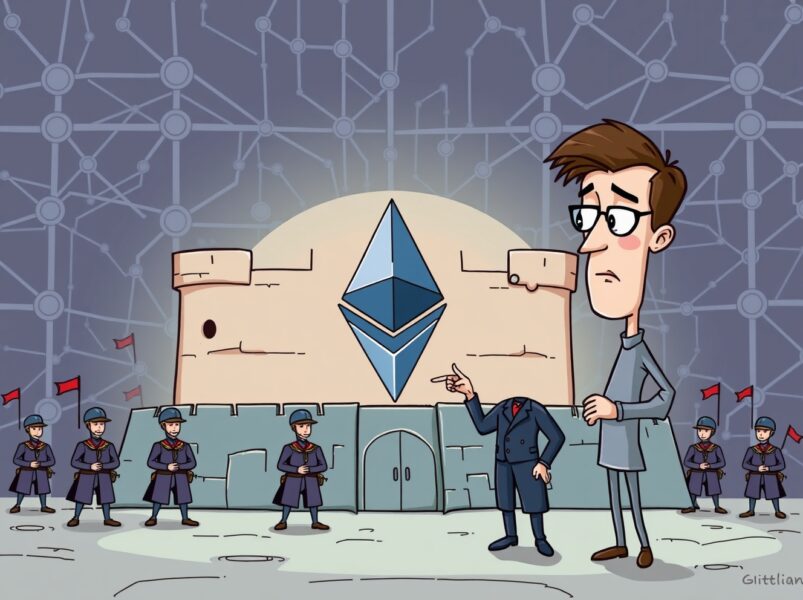
BitcoinWorld Crucial ETH Unstaking Period: Vitalik Buterin’s Unwavering Defense for Network Security Ever wondered why withdrawing your staked Ethereum (ETH) isn’t an instant process? It’s a question that often sparks debate within the crypto community. Ethereum founder Vitalik Buterin recently stepped forward to defend the network’s approximately 45-day ETH unstaking period, asserting its crucial role in safeguarding the network’s integrity. This lengthy waiting time, while sometimes seen as an inconvenience, is a deliberate design choice with profound implications for security. Why is the ETH Unstaking Period a Vital Security Measure? Vitalik Buterin’s defense comes amidst comparisons to other networks, like Solana, which boast significantly shorter unstaking times. He drew a compelling parallel to military operations, explaining that an army cannot function effectively if its soldiers can simply abandon their posts at a moment’s notice. Similarly, a blockchain network requires a stable and committed validator set to maintain its security. The current ETH unstaking period isn’t merely an arbitrary delay. It acts as a critical buffer, providing the network with sufficient time to detect and respond to potential malicious activities. If validators could instantly exit, it would open doors for sophisticated attacks, jeopardizing the entire system. Currently, Ethereum boasts over one million active validators, collectively staking approximately 35.6 million ETH, representing about 30% of the total supply. This massive commitment underpins the network’s robust security model, and the unstaking period helps preserve this stability. Network Security: Ethereum’s Paramount Concern A shorter ETH unstaking period might seem appealing for liquidity, but it introduces significant risks. Imagine a scenario where a large number of validators, potentially colluding, could quickly withdraw their stake after committing a malicious act. Without a substantial delay, the network would have limited time to penalize them or mitigate the damage. This “exit queue” mechanism is designed to prevent sudden validator exodus, which could lead to: Reduced decentralization: A rapid drop in active validators could concentrate power among fewer participants. Increased vulnerability to attacks: A smaller, less stable validator set is easier to compromise. Network instability: Frequent and unpredictable changes in validator numbers can lead to performance issues and consensus failures. Therefore, the extended period is not a bug; it’s a feature. It’s a calculated trade-off between immediate liquidity for stakers and the foundational security of the entire Ethereum ecosystem. Ethereum vs. Solana: Different Approaches to Unstaking When discussing the ETH unstaking period, many point to networks like Solana, which offers a much quicker two-day unstaking process. While this might seem like an advantage for stakers seeking rapid access to their funds, it reflects fundamental differences in network architecture and security philosophies. Solana’s design prioritizes speed and immediate liquidity, often relying on different consensus mechanisms and validator economics to manage security risks. Ethereum, on the other hand, with its proof-of-stake evolution from proof-of-work, has adopted a more cautious approach to ensure its transition and long-term stability are uncompromised. Each network makes design choices based on its unique goals and threat models. Ethereum’s substantial value and its role as a foundational layer for countless dApps necessitate an extremely robust security posture, making the current unstaking duration a deliberate and necessary component. What Does the ETH Unstaking Period Mean for Stakers? For individuals and institutions staking ETH, understanding the ETH unstaking period is crucial for managing expectations and investment strategies. It means that while staking offers attractive rewards, it also comes with a commitment to the network’s long-term health. Here are key considerations for stakers: Liquidity Planning: Stakers should view their staked ETH as a longer-term commitment, not immediately liquid capital. Risk Management: The delay inherently reduces the ability to react quickly to market volatility with staked assets. Network Contribution: By participating, stakers contribute directly to the security and decentralization of Ethereum, reinforcing its value proposition. While the current waiting period may not be “optimal” in every sense, as Buterin acknowledged, simply shortening it without addressing the underlying security implications would be a dangerous gamble for the network’s reliability. In conclusion, Vitalik Buterin’s defense of the lengthy ETH unstaking period underscores a fundamental principle: network security cannot be compromised for the sake of convenience. It is a vital mechanism that protects Ethereum’s integrity, ensuring its stability and trustworthiness as a leading blockchain platform. This deliberate design choice, while requiring patience from stakers, ultimately fortifies the entire ecosystem against potential threats, paving the way for a more secure and reliable decentralized future. Frequently Asked Questions (FAQs) Q1: What is the main reason for Ethereum’s long unstaking period? A1: The primary reason is network security. A lengthy ETH unstaking period prevents malicious actors from quickly withdrawing their stake after an attack, giving the network time to detect and penalize them, thus maintaining stability and integrity. Q2: How long is the current ETH unstaking period? A2: The current ETH unstaking period is approximately 45 days. This duration can fluctuate based on network conditions and the number of validators in the exit queue. Q3: How does Ethereum’s unstaking period compare to other blockchains? A3: Ethereum’s unstaking period is notably longer than some other networks, such as Solana, which has a two-day period. This difference reflects varying network architectures and security priorities. Q4: Does the unstaking period affect ETH stakers? A4: Yes, it means stakers need to plan their liquidity carefully, as their staked ETH is not immediately accessible. It encourages a longer-term commitment to the network, aligning staker interests with Ethereum’s stability. Q5: Could the ETH unstaking period be shortened in the future? A5: While Vitalik Buterin acknowledged the current period might not be “optimal,” any significant shortening would likely require extensive research and network upgrades to ensure security isn’t compromised. For now, the focus remains on maintaining robust network defenses. Found this article insightful? Share it with your friends and fellow crypto enthusiasts on social media to spread awareness about the critical role of the ETH unstaking period in Ethereum’s security! To learn more about the latest Ethereum trends, explore our article on key developments shaping Ethereum’s institutional adoption. This post Crucial ETH Unstaking Period: Vitalik Buterin’s Unwavering Defense for Network Security first appeared on BitcoinWorld.
Share
Coinstats2025/09/18 15:30
XRP holders hit new high, but THIS keeps pressure on price

XRP holders hit new high, but THIS keeps pressure on price

The post XRP holders hit new high, but THIS keeps pressure on price appeared on BitcoinEthereumNews.com. Ripple [XRP] remains one of the top five cryptocurrencies
Share
BitcoinEthereumNews2026/02/17 08:49