The U.S. is about to get its first Dogecoin ETF — and with it, the crypto industry is forced to ask a very uncomfortable question: are we legitimizing a cultural phenomenon, or just dressing up speculation in Wall Street clothes?The U.S. is about to get its first Dogecoin ETF — and with it, the crypto industry is forced to ask a very uncomfortable question: are we legitimizing a cultural phenomenon, or just dressing up speculation in Wall Street clothes?

Dogecoin ETF: A Joke Gone Institutional

2025/09/12 03:01
3 min read
The U.S. is about to get its first Dogecoin ETF — and with it, the crypto industry is forced to ask a very uncomfortable question: are we legitimizing a cultural phenomenon, or just dressing up speculation in Wall Street clothes?

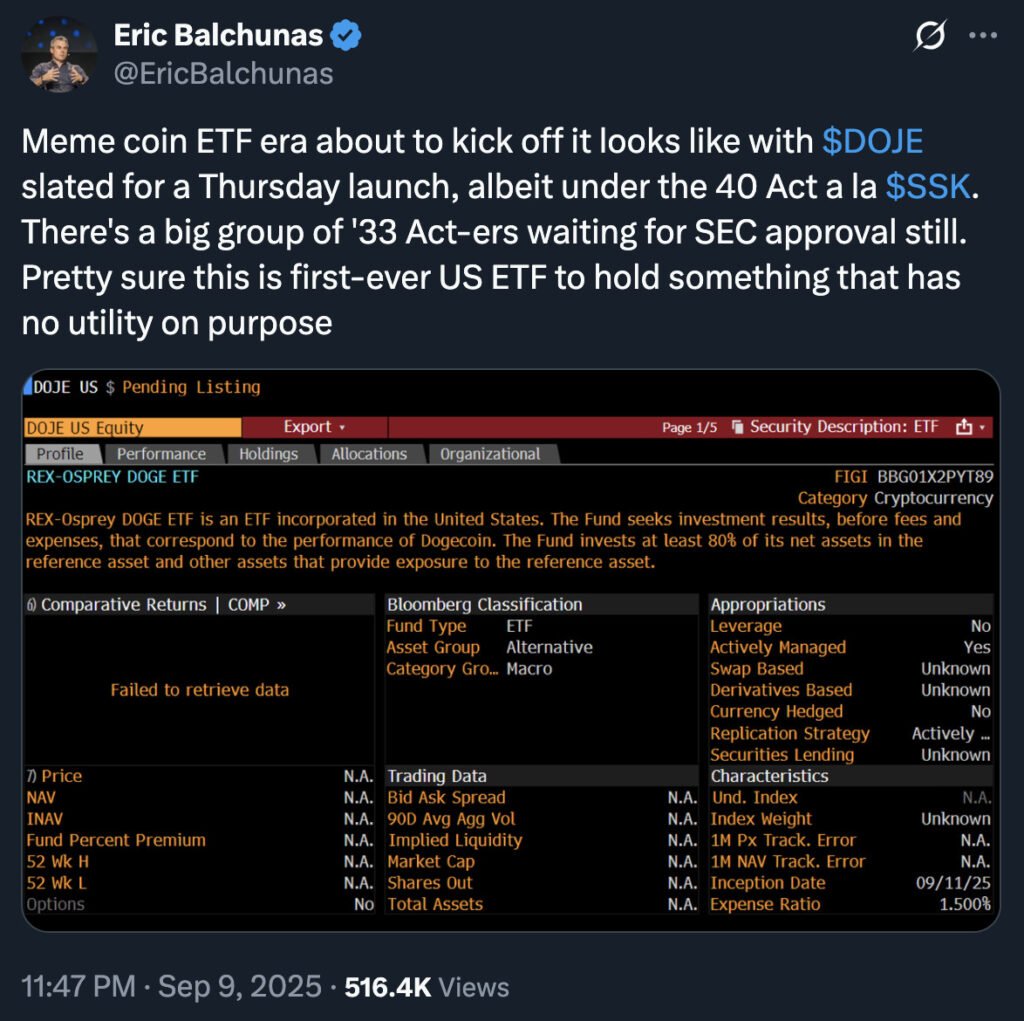
On Thursday, the Rex-Osprey Dogecoin ETF (ticker: DOJE) goes live. Unlike Bitcoin spot ETFs, which are approved under the Securities Act of 1933 and simply hold BTC in custody (BlackRock’s version keeps coins parked with Coinbase), this Dogecoin fund had to squirm its way through a very different legal loophole: the Investment Company Act of 1940. That framework was designed for diversified mutual funds — not single-asset gambles — which is why DOJE had to route exposure through a Cayman Islands subsidiary and use derivatives. Translation: Wall Street lawyers earned their retainers.
The U.S. is about to get its first Dogecoin ETF — and with it, the crypto industry is forced to ask a very uncomfortable question: are we legitimizing a cultural phenomenon, or just dressing up speculation in Wall Street clothes?

Meme coin ETF begins, source: X

Speculation With a Smile

Crypto loves to celebrate new ETFs as milestones, but this one feels different. Critics argue DOJE institutionalizes pure casino energy. Why pay fund fees when you could just buy Dogecoin directly on Coinbase in five minutes, as Brian Huang of Glider points out? He calls the ETF a “ridiculous” way to wrap a single asset — like packaging Tesla stock into a “diversified fund” with a hefty expense ratio.

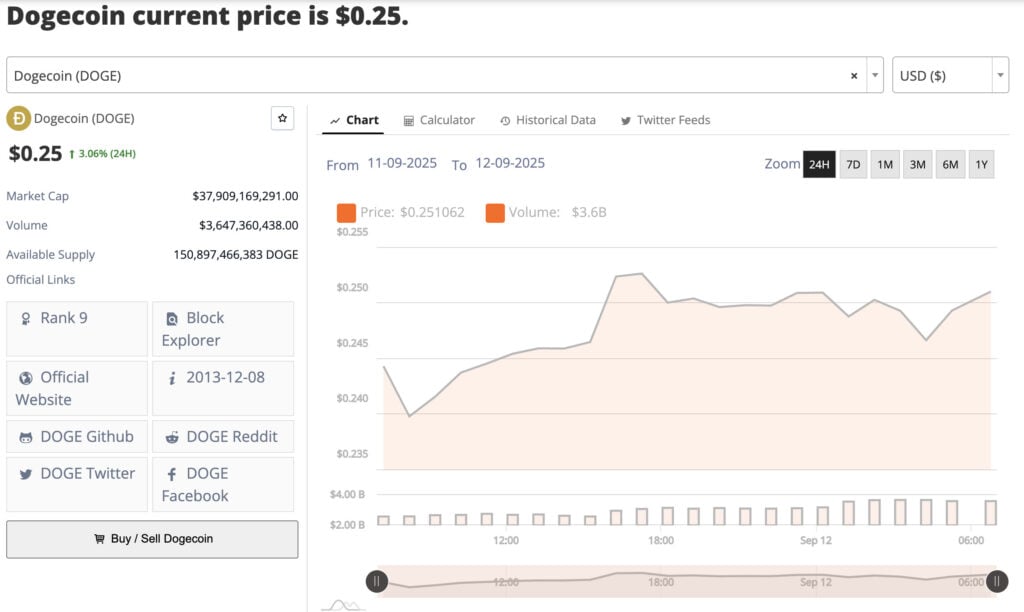
And yet, that’s Dogecoin’s magic trick. Born in 2013 as a joke fork of a fork of a fork (Bitcoin → Litecoin → Luckycoin → Dogecoin), it somehow clawed its way into the top 10 by market cap. It spawned the entire memecoin category, a subculture often dismissed as a distraction from “serious” blockchain projects. Its tokenomics mock Bitcoin’s scarcity fetish — instead of a 21M cap, DOGE has unlimited supply, with 10,000 new coins minted every minute (that’s 5 billion a year). Scarcity maxis hate it; Doge holders don’t care.
The U.S. is about to get its first Dogecoin ETF — and with it, the crypto industry is forced to ask a very uncomfortable question: are we legitimizing a cultural phenomenon, or just dressing up speculation in Wall Street clothes?

Dogecoin is sitting at 0.25c, Source: BNC

The Bigger Picture

Here’s where it gets interesting. By late August, 92 crypto ETP applications were sitting with the SEC — everything from serious altcoins to joke tokens like Pengu (tied to Pudgy Penguins NFTs). The fact that Dogecoin is cutting the line ahead of more “serious” projects says something brutal about crypto’s reality: cultural capital moves faster than technical capital.

Meme vs. Market

So, do we need a Dogecoin ETF? From a functionality standpoint, no. From a narrative standpoint, maybe. For skeptics, this is Wall Street legitimizing a meme while fleecing investors with fees. For optimists, it’s another bridge between retail culture and institutional money.

Here’s the uncomfortable truth: Dogecoin doesn’t need a use case beyond existing as a mirror to the absurdity of modern markets. In that sense, it’s the most honest token of all. A Dogecoin ETF doesn’t blur the line between meme and market — it obliterates it.

If a memecoin can become a regulated ETF, then anything is on the table. And maybe that’s the point.


Market Opportunity
Union Logo
Union Price(U)
$0.001534
$0.001534$0.001534
+3.50%
USD
Union (U) Live Price Chart
Disclaimer: The articles reposted on this site are sourced from public platforms and are provided for informational purposes only. They do not necessarily reflect the views of MEXC. All rights remain with the original authors. If you believe any content infringes on third-party rights, please contact service@support.mexc.com for removal. MEXC makes no guarantees regarding the accuracy, completeness, or timeliness of the content and is not responsible for any actions taken based on the information provided. The content does not constitute financial, legal, or other professional advice, nor should it be considered a recommendation or endorsement by MEXC.

You May Also Like

Vàng Cán Mốc Lịch Sử 5.000 USD: Khi Dự Báo Của CEO Bitget Gracy Chen Trở Thành Hiện Thực Và Tầm Nhìn Về Đích Đến 5.400 USD

Vàng Cán Mốc Lịch Sử 5.000 USD: Khi Dự Báo Của CEO Bitget Gracy Chen Trở Thành Hiện Thực Và Tầm Nhìn Về Đích Đến 5.400 USD

Thị trường tài chính toàn cầu vừa chứng kiến một khoảnh khắc lịch sử chấn động: Giá Vàng thế giới [...] The post Vàng Cán Mốc Lịch Sử 5.000 USD: Khi Dự Báo Của
Share
Vneconomics2026/02/10 16:26
Why the Bitcoin Boom Is Not Another Tulip Mania

Why the Bitcoin Boom Is Not Another Tulip Mania

Bitcoin is an amazing success story. It was only invented in January of 2009 and was only worth a tiny fraction of a cent for each token. Over just a few years
Share
Medium2026/02/10 15:44
Non-Opioid Painkillers Have Struggled–Cannabis Drugs Might Be The Solution

Non-Opioid Painkillers Have Struggled–Cannabis Drugs Might Be The Solution

The post Non-Opioid Painkillers Have Struggled–Cannabis Drugs Might Be The Solution appeared on BitcoinEthereumNews.com. In this week’s edition of InnovationRx, we look at possible pain treatments from cannabis, risks of new vaccine restrictions, virtual clinical trials at the Mayo Clinic, GSK’s $30 billion U.S. manufacturing commitment, and more. To get it in your inbox, subscribe here. Despite their addictive nature, opioids continue to be a major treatment for pain due to a lack of effective alternatives. In an effort to boost new drugs, the FDA released new guidelines for non-opioid painkillers last week. But making these drugs hasn’t been easy. Vertex Pharmaceuticals received FDA approval for its non-opioid Journavx in January, then abandoned a next generation drug after a failed clinical trial earlier this summer. Acadia similarly abandoned a promising candidate after a failed trial in 2022. One possible basis for non-opioids might be cannabis. Earlier this year, researchers at Washington University at St. Louis and Stanford published a study showing that a cannabis-derived compound successfully eased pain in mice with minimal side effects. Munich-based pharmaceutical company Vertanical is perhaps the furthest along in this quest. It is developing a cannabinoid-based extract to treat chronic pain it hopes will soon become an approved medicine, first in the European Union and eventually in the United States. The drug, currently called Ver-01, packs enough low levels of cannabinoids (including THC) to relieve pain, but not so much that patients get high. Founder Clemens Fischer, a 50-year-old medical doctor and serial pharmaceutical and supplement entrepreneur, hopes it will become the first cannabis-based painkiller prescribed by physicians and covered by insurance. Fischer founded Vertanical, with his business partner Madlena Hohlefelder, in 2017, and has invested more than $250 million of his own money in it. With a cannabis cultivation site and drug manufacturing plant in Denmark, Vertanical has successfully passed phase III clinical trials in Germany and expects…
Share
BitcoinEthereumNews2025/09/18 05:26