Zcash price fell over 18% from its weekly high to $232, a level that aligns with a key trendline support that could determine whether the current pullback stabilizesZcash price fell over 18% from its weekly high to $232, a level that aligns with a key trendline support that could determine whether the current pullback stabilizes

Zcash price pulls back to key trendline support, is a bounce still likely?

2026/03/20 21:56
3 min read
For feedback or concerns regarding this content, please contact us at crypto.news@mexc.com

Zcash price fell over 18% from its weekly high to $232, a level that aligns with a key trendline support that could determine whether the current pullback stabilizes or extends further.

Summary
  • Zcash pulled back over 18% from a recent high to $232, now testing key trendline support after a broader market-driven selloff.
  • Technical indicators, including a green Supertrend and bullish RSI divergence, suggest weakening selling pressure and potential for a rebound toward $265 and $300.
  • Rising shielded pool usage and upcoming network upgrades provide fundamental support, though a break below $230 could expose downside toward $200.

According to data from crypto.news, Zcash (ZEC) price shot up to a monthly high of $284 on Tuesday before falling back to $232 at the time of writing.

Zcash price dipped along with the entire crypto market amid a confluence of geopolitical and macroeconomic uncertainty arising from the U.S.-Iran war and the Federal Reserve’s hawkish tone for interest rate cuts for this year, as it points to persistent inflation as a major concern.

Following the recent drop, the second-largest privacy coin by market cap has consolidated near a descending trendline that it had turned into support following its breakout above it this week. If the token manages to hold the line, it could bounce back to test earlier highs. However, failure to hold above the dynamic support could lead to a deeper correction.
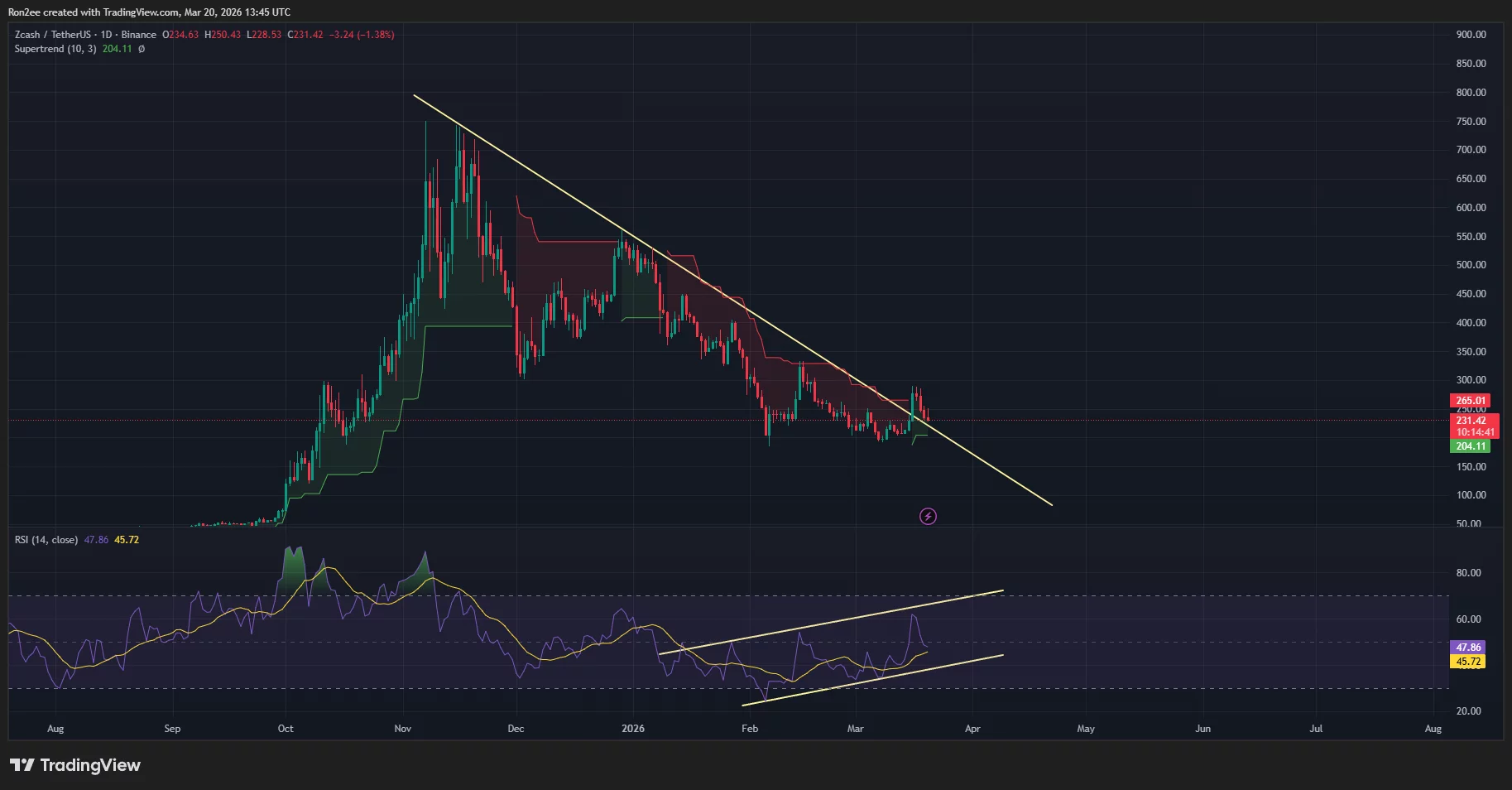
Zcash price is testing a descending trendline support on the daily chart.

Looking at additional technical indicators gives a more grounded view of the possible outlook for the privacy-focused asset. The Supertrend indicator, which helps traders identify prevailing trend directions, has flipped green since Tuesday, a sign that the underlying momentum is shifting in favor of the bulls.

On top of this, the RSI line has formed a bullish divergence with Zcash price since early January this year. A bullish divergence occurs when the price makes lower lows while the indicator makes higher lows. It means that the downward selling pressure is losing its grip despite the falling prices.

Hence, Zcash will likely bounce from the $230 support to $265, the current position of the super trendline, and then to the psychological resistance at $300 if bullish momentum remains strong.

However, if the bearish sentiment prevailing in the broader market latches on to the token’s price action and it loses the $230 support, a drop to $200 becomes a very real possibility.

Bullish catalysts for Zcash price

Zcash price has a few fundamental catalysts lined up that could support the technical recovery.

First, the total amount of Zcash held in shielded pools currently accounts for over 30% of the total circulating supply. A surge in this metric means that a greater number of traders are now engaging with the core functionality of the network. This could attract more institutional interest as privacy becomes a more sought-after feature in the digital asset space.

Additionally, the 2026 roadmap for Zcash includes the Crosslink project, which is a move towards a hybrid Proof of Stake model. This transition is expected to lower sell-side pressure from miners and align the network with institutional ESG standards, potentially opening the door for new capital inflows.

Disclosure: This article does not represent investment advice. The content and materials featured on this page are for educational purposes only.

Market Opportunity
Zcash Logo
Zcash Price(ZEC)
$233.96
$233.96$233.96
-0.44%
USD
Zcash (ZEC) Live Price Chart
Disclaimer: The articles reposted on this site are sourced from public platforms and are provided for informational purposes only. They do not necessarily reflect the views of MEXC. All rights remain with the original authors. If you believe any content infringes on third-party rights, please contact crypto.news@mexc.com for removal. MEXC makes no guarantees regarding the accuracy, completeness, or timeliness of the content and is not responsible for any actions taken based on the information provided. The content does not constitute financial, legal, or other professional advice, nor should it be considered a recommendation or endorsement by MEXC.

You May Also Like

The Channel Factories We’ve Been Waiting For

The Channel Factories We’ve Been Waiting For

The post The Channel Factories We’ve Been Waiting For appeared on BitcoinEthereumNews.com. Visions of future technology are often prescient about the broad strokes while flubbing the details. The tablets in “2001: A Space Odyssey” do indeed look like iPads, but you never see the astronauts paying for subscriptions or wasting hours on Candy Crush.  Channel factories are one vision that arose early in the history of the Lightning Network to address some challenges that Lightning has faced from the beginning. Despite having grown to become Bitcoin’s most successful layer-2 scaling solution, with instant and low-fee payments, Lightning’s scale is limited by its reliance on payment channels. Although Lightning shifts most transactions off-chain, each payment channel still requires an on-chain transaction to open and (usually) another to close. As adoption grows, pressure on the blockchain grows with it. The need for a more scalable approach to managing channels is clear. Channel factories were supposed to meet this need, but where are they? In 2025, subnetworks are emerging that revive the impetus of channel factories with some new details that vastly increase their potential. They are natively interoperable with Lightning and achieve greater scale by allowing a group of participants to open a shared multisig UTXO and create multiple bilateral channels, which reduces the number of on-chain transactions and improves capital efficiency. Achieving greater scale by reducing complexity, Ark and Spark perform the same function as traditional channel factories with new designs and additional capabilities based on shared UTXOs.  Channel Factories 101 Channel factories have been around since the inception of Lightning. A factory is a multiparty contract where multiple users (not just two, as in a Dryja-Poon channel) cooperatively lock funds in a single multisig UTXO. They can open, close and update channels off-chain without updating the blockchain for each operation. Only when participants leave or the factory dissolves is an on-chain transaction…
Share
BitcoinEthereumNews2025/09/18 00:09
Top 3 Altcoins for the Next Bull Run Ethereum, Solana and Mutuum Finance

Top 3 Altcoins for the Next Bull Run Ethereum, Solana and Mutuum Finance

Ethereum and Solana already sit near the top of most serious altcoin watchlists, and Mutuum Finance is starting to enter that same conversation from a very different
Share
Techbullion2026/03/20 23:07
Trump: We want to negotiate with Iran, but we have no negotiating partner.

Trump: We want to negotiate with Iran, but we have no negotiating partner.

PANews reported on March 20 that US President Trump stated: "We want to negotiate with Iran, but we have no one to negotiate with. Nobody wants to be Iran's leader
Share
PANews2026/03/20 23:04