Bitcoin (BTC) Tests Support at $76,700: Analyzing the Latest Market Downturn
Key Takeaways
- Bitcoin declined to approximately $76,700, marking its lowest level in two weeks amid deteriorating risk sentiment and rising bond yields
- Crypto markets witnessed over $661 million in position liquidations within a 24-hour window, predominantly affecting long positions at 95%
- Net outflows from U.S. spot Bitcoin ETFs reached $290.4 million on May 15, preceded by a larger $630.4 million exodus on May 13
- Ethereum experienced similar outflow patterns while underperforming relative to Bitcoin’s price action
- The Senate Banking Committee moved the CLARITY Act forward with a 15-9 approval, marking progress in cryptocurrency legislation
[[LINK_START_1]]Bitcoin[[LINK_END_1]] retreated to approximately $76,700 last week, marking a two-week low after sliding from levels above $80,000. The decline coincided with rising Treasury yields and diminishing risk appetite among investors, prompting questions about whether this represents temporary consolidation or signals a more substantial downturn ahead.
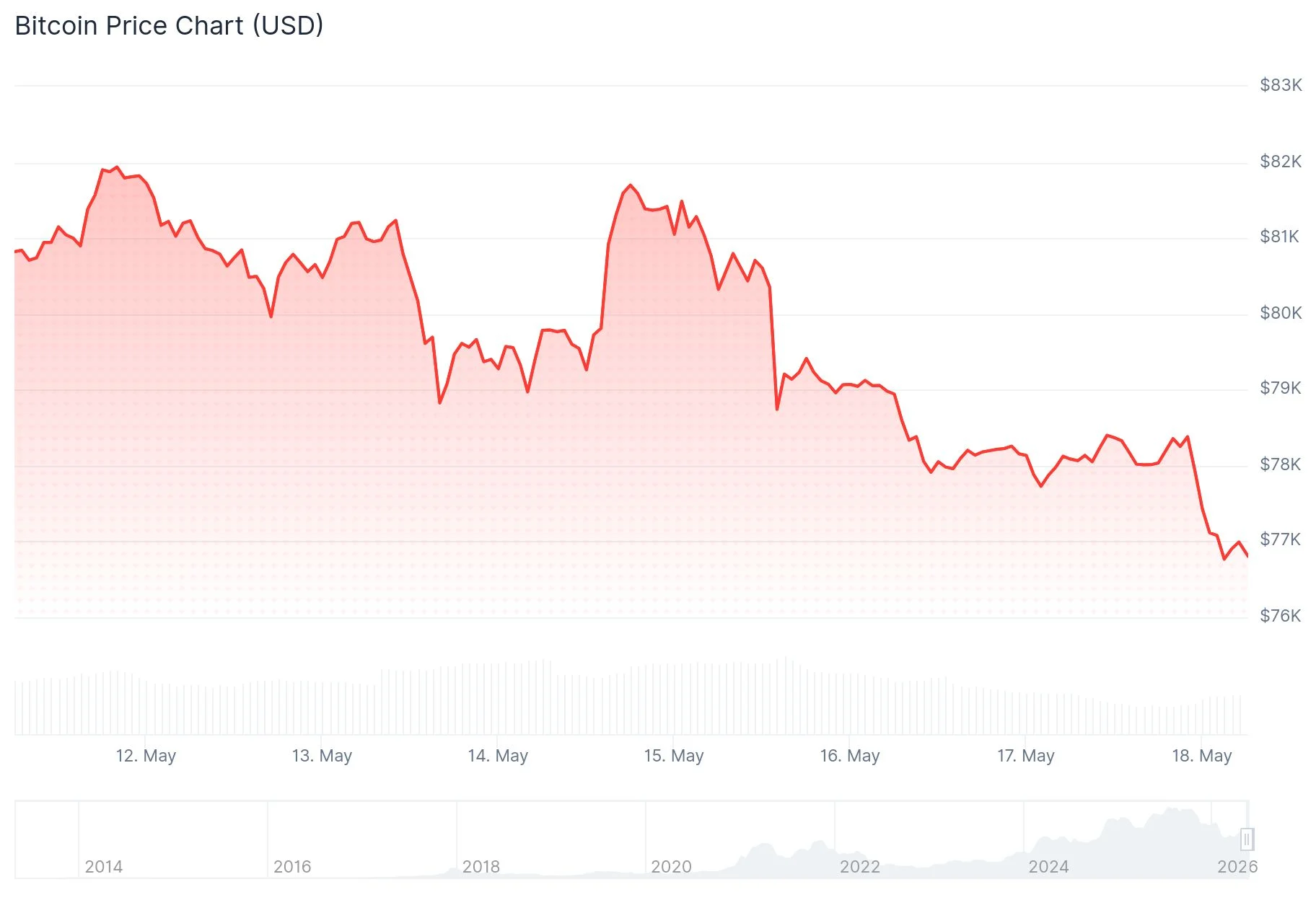 Bitcoin (BTC) Price
The price action triggered significant market deleveraging. Approximately $661 million in cryptocurrency positions faced forced liquidation during a 24-hour stretch. Leveraged long positions accounted for roughly 95% of these liquidations, highlighting how concentrated positioning can amplify downside moves when sentiment shifts.
Institutional Demand Shows Cracks Through ETF Data
Monitoring Bitcoin ETF flows has become essential for gauging institutional participation. Recent data suggests wavering commitment from larger market participants.
On May 13, U.S.-listed spot Bitcoin ETFs experienced $630.4 million in net redemptions. While May 14 brought a brief reprieve with $131.3 million in inflows, the momentum reversed quickly as $290.4 million exited these products on May 15, based on tracking from Farside Investors.
This fluctuating pattern indicates institutional buyers are stepping back rather than accumulating aggressively. The consistent buying pressure observed during earlier months has given way to more cautious, intermittent participation.
[[LINK_START_3]]Ethereum[[LINK_END_3]] mirrored this trend with its own ETF products recording outflows on May 15. ETH’s relative weakness compared to Bitcoin’s performance raises concerns about broader altcoin market recovery prospects.Macroeconomic Headwinds Create Additional Challenges
The yield environment is creating meaningful headwinds. As Treasury yields climb, fixed-income instruments become more competitive, drawing capital away from higher-risk asset classes including cryptocurrencies. Bitcoin’s descent toward $78,000 occurred alongside a widespread selloff in global bond markets.
Market participants are closely monitoring Treasury yield movements, inflation indicators, and Federal Reserve communications. Sustained yield increases could continue pressuring crypto valuations, while any reversal might provide the catalyst for a rebound across Bitcoin and alternative tokens.
Legislative Progress Offers Encouragement
Amid the market turbulence, the Senate Banking Committee provided a constructive development by advancing the CLARITY Act with 15-9 support. The proposed legislation seeks to establish definitive frameworks for classifying digital assets—whether as securities, commodities, or alternative categories—while addressing stablecoin regulations and supervisory structures.
This represents meaningful progress for industry maturation. Nevertheless, significant obstacles remain. Democratic committee members expressed reservations regarding anti-money laundering provisions and potential conflicts of interest. Committee approval doesn’t ensure smooth passage through the full Senate.
Bitcoin continues trading above critical long-term support zones, and the regulatory landscape shows gradual improvement. However, the combination of ETF redemptions, forced liquidations, and ascending yields has left near-term market dynamics vulnerable to additional volatility.
The post Bitcoin (BTC) Tests Support at $76,700: Analyzing the Latest Market Downturn appeared first on Blockonomi.


Ayrıca Şunları da Beğenebilirsiniz

White House Announces Major U.S.–China Trade Deals

Goldman Sachs crypto ETF holdings drop XRP and Solana in Q1 2026 filing