

Solana (SOL) Price Prediction: Why Some Analysts Think SOL Could Be 10x Higher by 2031
TLDR
- Solana currently trades around $85–$95 with a market cap near $49 billion
- Base case forecast for 2031 puts SOL between $350 and $500
- Bull case sees SOL reaching $900–$1,200 if institutional adoption and real usage grow
- Bear case places SOL at $70–$120 if competitors take market share or demand weakens
- Probability-weighted target is around $485 by 2031
Solana has become one of the more widely used blockchain networks in crypto. Known for fast transaction speeds and low fees, it sits alongside Ethereum as one of the most active smart contract platforms in the space.
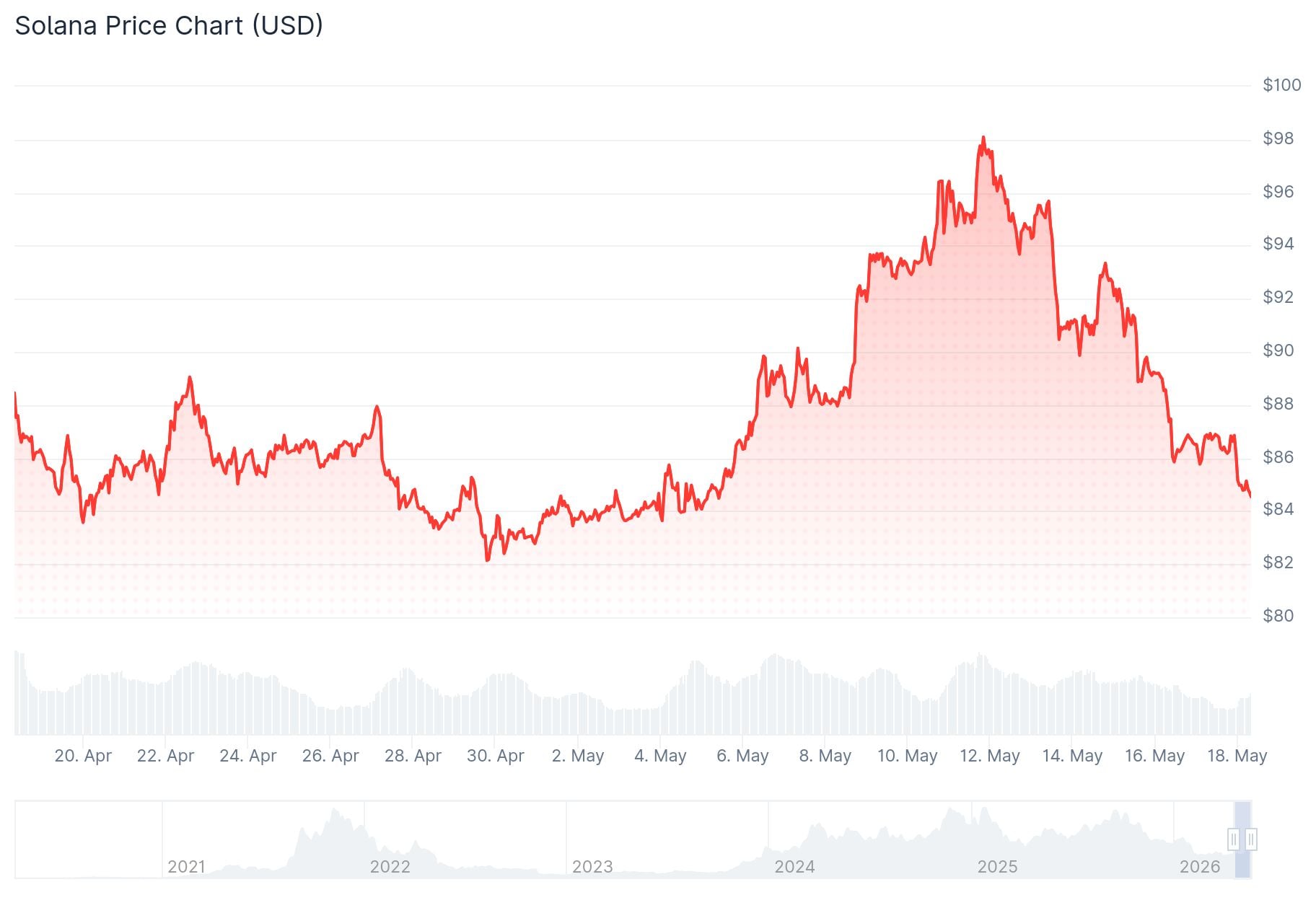 Solana (SOL) Price
SOL currently trades around $85–$95. Its circulating supply is near 578 million tokens, giving it a market cap close to $49 billion.
The central question for the next five years is whether Solana can grow from a leading Layer 1 chain into one of the main settlement layers of the global crypto economy.
Analysts have laid out three distinct price scenarios for 2031, based on different assumptions about crypto adoption, competition, and network reliability.
Base Case: $350 to $500 by 2031
The base case assumes steady growth across the crypto market over the next five years.
In this scenario, Bitcoin remains the primary store-of-value asset, Ethereum stays the dominant smart contract ecosystem, and Solana carves out its position as the top high-speed chain for consumer apps, payments, and trading.
If Solana achieves a market cap of roughly $250 billion to $350 billion, with supply growing toward 700 million SOL, that points to a price range of $350 to $500.
Solana’s advantage here is usability. Transactions settle quickly, fees stay low, and the chain already has an established base of retail users and developers.
Unlike Ethereum, which is increasingly focused on settlement and Layer 2 infrastructure, Solana is more consumer-facing. That positions it differently in the market.
Solana’s inflation model also plays a role. SOL does not have a hard supply cap like Bitcoin. Its inflation rate declines over time toward a long-term level near 1.5%, while a portion of transaction fees are burned.
Bull Case: $900 to $1,200 by 2031
The bull case puts Solana between $900 and $1,200 by 2031, which would require a market cap of around $650 billion to $850 billion.
Several conditions would need to come together for this outcome.
First, real usage on the network would need to keep growing — more stablecoin payments, tokenized assets, trading volume, and consumer apps.
Second, institutional demand would need to expand. A spot Solana ETF, if approved, could create a meaningful new demand channel.
Third, Solana would need to demonstrate consistent network reliability at high volumes.
In this scenario, Solana does not need to displace Ethereum. It simply needs to become the dominant high-throughput chain for users and applications.
Crypto.com has noted that Solana’s inflation rate remains higher than Ethereum’s, even as it is designed to fall over time — a point that matters for long-term valuation.
The probability-weighted price target across all three scenarios comes to around $485 by 2031.
The post Solana (SOL) Price Prediction: Why Some Analysts Think SOL Could Be 10x Higher by 2031 appeared first on CoinCentral.


Ayrıca Şunları da Beğenebilirsiniz

VanEck and Grayscale Advance BNB ETF Filings as SEC Review Continues

Q2 Market Insights: Bitcoin regains dominance in risk-averse environment, ETFs remain critical to market structure




