Arthur Hayes Crypto Portfolio: Revealing the Controversial Investor's Holdings
One crypto wallet can tell you a lot, if the owner is Arthur Hayes. His holdings often point to a bigger market call, not a random shopping list of coins.
That is why people want more than names. They want the logic.
I think the easiest way to read his portfolio is to split it into:
- On-chain holdings
- Private bets through Maelstrom
- Public views he keeps repeating about liquidity, rates, and money printing
Let’s get into it!
Key highlights:
- Arthur Hayes’ portfolio is built around macro, liquidity, and money printing
- Bitcoin and Ethereum are the core holdings, with BTC as the macro hedge and ETH as the infrastructure bet
- Smaller bets like Ethena, Ether.fi, Pendle, HYPE, and privacy coins reflect specific crypto narratives
- Hayes rotates fast, often selling or de-risking when the market setup changes
Who Arthur Hayes is and why people care
Arthur Hayes is still one of crypto's most watched traders because he mixes three things people can't ignore:
- History
- Conviction
- Controversy
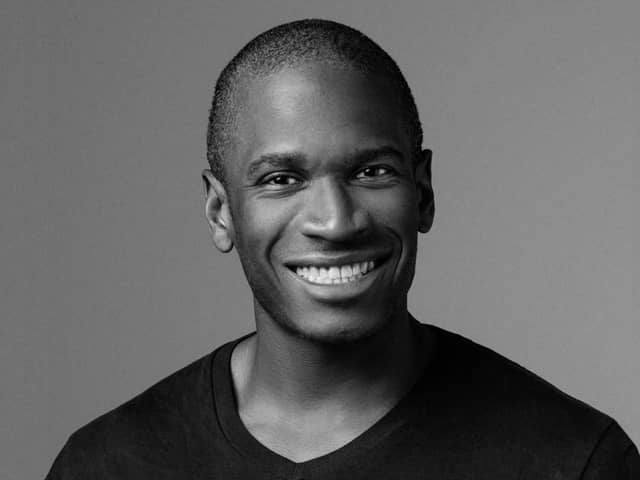
He co-founded BitMEX, built a name as a hard-charging derivatives operator, and then turned into one of crypto's loudest macro commentators.
He talks about global liquidity, central bank balance sheets, oil, rates, and fiat money creation. I can’t even count how many of his Medium pieces I’ve read.
When he buys something, people assume there is a thesis behind it.
His calls are rarely small. He briefly promoted a $500,000 Bitcoin target in 2026, but later revised it down to $125,000 by year-end.
He also argued that fiat creation, not politics, is the main driver of Bitcoin's long-term move. Agree or disagree, that kind of framing gets attention
The other reason his holdings matter is Maelstrom, his family office and venture arm. Some exposure sits in visible wallets, some doesn’t. Maelstrom has been tied to projects such as Ethena, Zcash, River, and Bio Protocol, so wallet and crypto portfolio trackers only show part of the picture.
Hayes also makes the portfolio easier to read by what he leaves out. In a February 2026 snapshot shared publicly, he was clear about owning BTC, ETH, ZEC, HYPE, physical gold, and mining-related stocks. He did not list Solana, meme coins, or AI tokens.
Arthur Hayes crypto portfolio: the main holdings known in 2026
The latest visible picture is tighter than some older portfolio snapshots. Past wallet roundups included a wider set of tokens, but the 2026 mix looks far more focused.
Here is the clearest current snapshot I could find:
| Asset | Status (as of July 2026) | Last known detail | Source basis |
| Bitcoin (BTC) | Core holding | Held throughout, described as his monetary-hedge anchor | His own disclosures |
| Ethereum (ETH) | Core holding, actively adding | +3,000 ETH (~$5.42M) June 15, +1,400 ETH (~$2.51M) June 17 | On-chain (Lookonchain) |
| Zcash (ZEC) | Reportedly exited | Sold in early June "Reality Test" de-risking, had targeted $10K | His June 8 essay |
| HYPE (Hyperliquid) | Reportedly sold, re-entry disputed | Sold above $72, a ~$2.09M June 8 buy was flagged but he denied it | Mixed / disputed |
| NEAR Protocol | Reportedly exited | Sold in early June de-risking | His June 8 essay |
| Worldcoin (WLD) | Reportedly exited | Sold in early June de-risking | His June 8 essay |
| ENA (Ethena) | Unclear / possibly still held | ~$1.97M bought around New Year, early backer, some holdings may be unverified | On-chain + Arkham |
| ETHFI (Ether.fi) | Unclear | ~$735K bought around New Year | On-chain |
| PENDLE | Unclear | ~$515K (Jan) plus ~$973K (Dec 26) | On-chain |
| LDO (Lido) | Unclear | ~$260K plus 1,855,000 LDO (~$1.03M) on Dec 26 | On-chain |
| USDC | Held as dry powder | Reportedly his largest single position at one point (~$14M) | On-chain |
His book is concentrated, Bitcoin+Ethereum-heavy, and theme-driven.
Ethereum is the core of his liquid portfolio
If you strip out stablecoins, Ethereum looks like the center of Hayes' liquid book. He kept ETH as a core position even while cutting risk across the rest of his portfolio in June 2026, and the on-chain flow backs that up.
A wallet linked to him took in roughly 3,000 ETH, around $5.4 million, through a Flowdesk OTC desk on June 15, then added about 1,400 ETH, near $2.5 million, two days later.
Why ETH? I’d assume because Ethereum is where a lot of crypto's actual activity lives. Stablecoins settle there. DeFi products launch there. Institutions keep circling it because it is still the biggest smart contract chain by depth and history.
If Bitcoin is the reserve asset, Ethereum is the finance layer people build on top.
Hayes has spent years thinking in systems. ETH fits that habit. It gives him exposure to the chain itself, the apps on top, and the money flows moving through both.
Ether.fi and restaking exposure show his yield-focused side
During my research, on-chain data shows a staked-ETH holding through Ether.fi, in eETH and weETH, large enough that trackers have flagged him as a whale in it.
Liquid restaking sounds technical, but the idea is actually easy enough. You lock into Ethereum-linked yield systems, then hold a token you can still move or trade. So you keep exposure and pick up yield without freezing your capital.
That fits Hayes well. He likes optionality. He also likes financial tools that turn passive holdings into productive ones. Restaking is still young, but his size here says he thinks this corner of Ethereum has legs.
Ethena is both an investment and a belief in new DeFi models
Ethena matters in his portfolio for two reasons:
- There’s the visible ENA exposure, built up through on-chain buys in late 2025 that ran to a few million dollars
- There is the likely private exposure through Maelstrom, which backed the project and has been publicly supportive of its model.
I see this as a bet on crypto-native dollars.
Ethena's pitch sits at the intersection of stablecoin demand, derivatives funding, and on-chain capital efficiency. Hayes likes that kind of design because it ties DeFi to real market flows, not empty branding.
If more traders want dollar-like exposure without leaving crypto rails, products in this category can grow fast.
You don't have to love the model to see why it appeals to him. It plugs straight into his macro brain.
Zcash was his privacy bet, and it shows how he thinks
Zcash is where the portfolio gets more controversial. Hayes talked up ZEC as a privacy play, describing it as "Bitcoin with complete privacy" and floating a target as high as $10,000. But he reportedly exited the position in early June 2026 as part of a broader de-risking move, so this reads as a bet he made and then stepped back from, not a live holding.
The thesis is still worth understanding. If more financial life moves into trackable digital systems, private money gets more valuable. That idea gets stronger when central banks talk more about digital currencies and governments push for tighter surveillance.
This was a different bet from ETH or BTC. Privacy coins carry more political and regulatory risk. They also have smaller, thinner markets. That means the trade can move hard in both directions.
Which is why it fit him. He likes asymmetry. He also likes themes that most of the market ignores until they stop being ignorable.
Stablecoins and smaller positions keep Arthur Hayes portfolio flexible
Hayes has reportedly held around $14 million in USDC, plus roughly $1.19 million in sUSDe. That cash-like exposure matters. It gives him room to buy dips, rotate fast, or sit still when the setup looks bad.
I should mention his smaller positions, too. A PENDLE stake, worth somewhere in the high six figures depending on the date, gives him exposure to future-yield markets without turning the whole book into a single narrative.
His HYPE trade did something similar, though it also shows his style. He built a public position, set a loud target, then sold above $72 in June and stepped back.
That’s pattern. Strong views, expressed in size, but rarely with every chip pushed to the middle.
How Arthur Hayes builds a portfolio around macro
Hayes doesn’t read the market coin first. He reads liquidity first.
That means his portfolio makes more sense when you zoom out. He links crypto to money supply growth, rate policy, oil, credit conditions, and the availability of risk capital.
In 2026, he also talked about AI sucking up capital through huge debt issuance, which he said could drain liquidity away from Bitcoin and other risk assets.
Why he rotates between Bitcoin, Ethereum, and privacy coins
His rotation logic is actually cleaner than it looks at first.
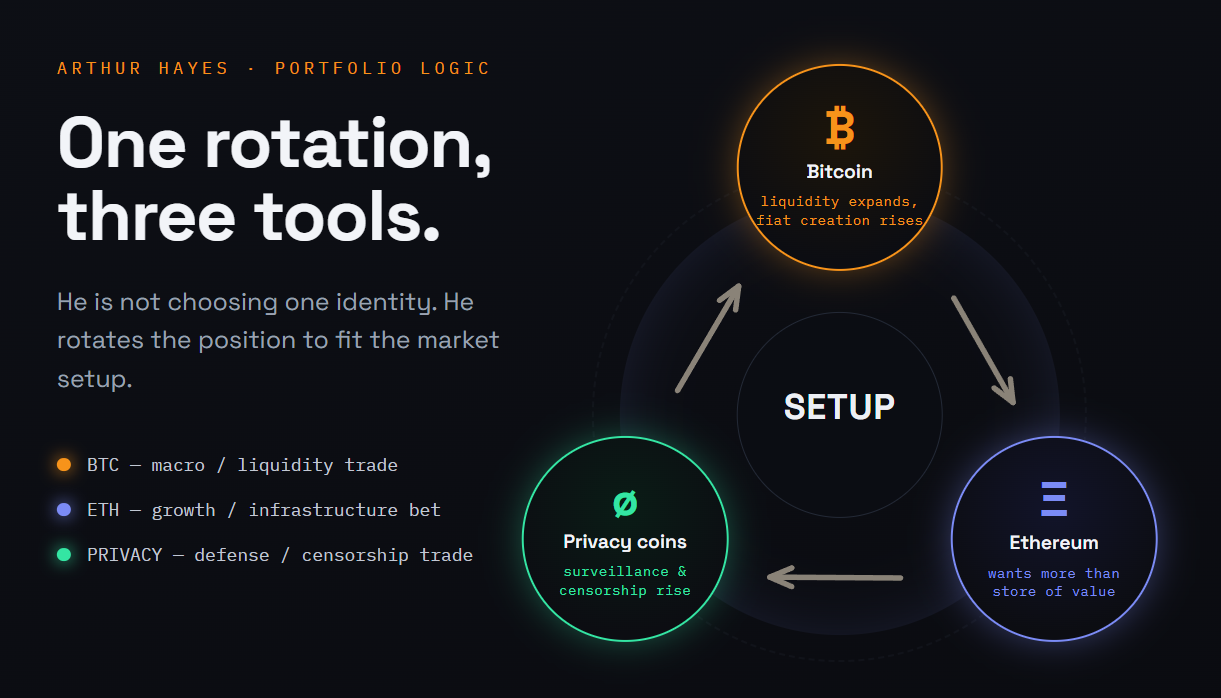
Bitcoin is the purest macro trade in his framework. When liquidity expands and fiat creation rises, BTC is the cleanest way to express that view.
Ethereum comes in when he wants more than a store-of-value trade. ETH gives him exposure to infrastructure, staking, stablecoins, and on-chain finance. It is a wider bet.
Privacy coins come into focus when censorship resistance and surveillance start to matter more. In other words, he is not choosing one identity. He is switching tools based on the setup.
Why he likes DeFi tokens when growth and liquidity improve
The smaller token bets are not random. They usually cluster around real usage, fresh yield mechanics, or heavy trader activity.
That is why yield markets, liquid staking, synthetic dollars, and exchange-linked tokens keep showing up around his public views. These ideas tend to work best when capital is flowing and traders are willing to take risk. When the tape gets ugly, he’s willing to cut.
The November 2025 sales were a good example. Reports showed more than $5 million in altcoin sales in a single day. Hayes isn’t a man married to his investments.
The bottom line
Arthur Hayes' crypto portfolio is not a messy pile of coins. It’s a concentrated mix of:
- Bitcoin
- Ethereum
- Major restaking exposure
- Smaller DeFi and altcoin trades around strong narratives
The cleanest way to read it is as a macro thesis with a wallet attached. The asset list matters, but the bigger story is how he ties each position to liquidity, rates, and market structure.
That picture can change fast. With Hayes, a portfolio snapshot is less a permanent identity and more a live read on what he thinks the market is paying for right now.
To learn about what cryptocurrencies look like good investments now, read our guide on:
12 Best Crypto to Buy Now
FAQ
What is Arthur Hayes’ net worth?
Arthur Hayes’ net worth is estimated to be roughly $200 million to $350 million. The exact number isn’t available, and it can change quickly because a large part of his wealth is tied to crypto, private investments, and market-sensitive assets.
What is Arthur Hayes’ crypto wallet?
Arthur Hayes doesn’t use one single publicly named crypto wallet. Instead, blockchain analytics platforms often track multiple on-chain addresses linked to him.
You can use tools such as Arkham Intel Explorer to track the active holdings and on-chain movements connected to Arthur Hayes.
How much crypto does Arthur Hayes have?
The exact amount of crypto Arthur Hayes holds is not fully public. His visible wallets only show part of the picture, while some exposure may sit through private investments, Maelstrom, custody accounts, or addresses not publicly linked to him.
Based on public wallet tracking and his own disclosures, his known crypto exposure has included Bitcoin, Ethereum, stablecoins, DeFi tokens, and privacy coin positions. But the exact holdings can change over time.


Ayrıca Şunları da Beğenebilirsiniz

Crypto Hack: Drift Protocol Drained Over $200M in Private Key Breach
Justice Department has 'gone off the rails' for Trump's 'pretzel logic': analysis