

Crude Oil Holds Near $72 as U.S.-Iran Diplomacy Advances and Hormuz Traffic Resumes
TLDR
- Crude markets showed minimal movement Friday before the Independence Day long weekend
- Brent crude hovered around $71.96 per barrel; WTI remained below the $70 mark
- Crude is heading toward a fourth consecutive weekly decline amid Strait of Hormuz traffic normalization
- Tehran has turned down a Washington proposal requesting formal renunciation of Strait of Hormuz claims
- Brent’s futures curve shows contango structure, indicating expectations of near-term surplus
Crude markets displayed little volatility on Friday as market participants weighed diplomatic developments between Washington and Tehran against mounting indicators of supply abundance.
Brent crude edged up 0.2% to reach $71.96 per barrel in early Friday trading. West Texas Intermediate hovered just beneath the $70 threshold. Both major benchmarks remained positioned for their fourth straight weekly decline.
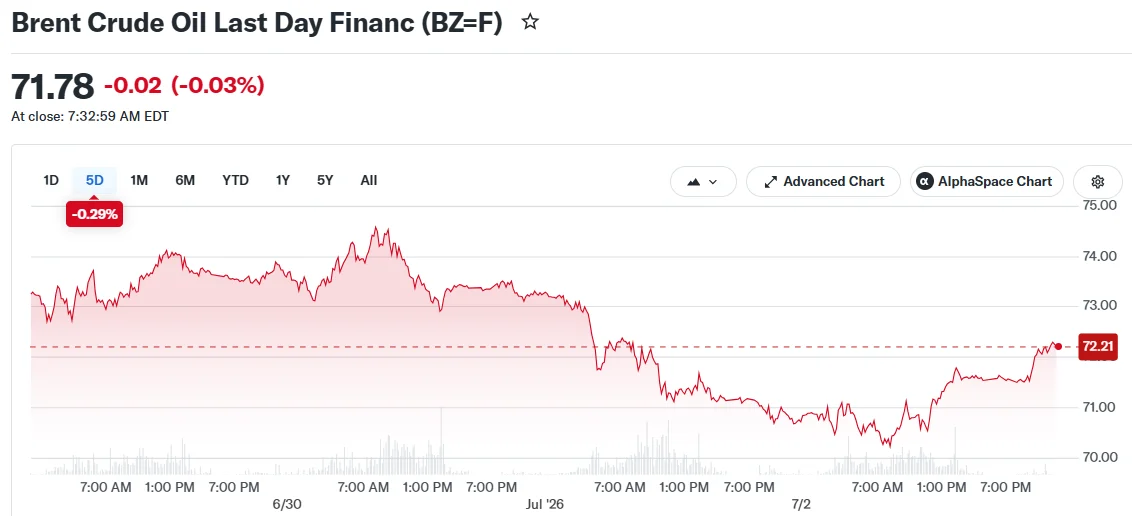 Brent Crude Oil Last Day Financ (BZ=F)
Crude values have retreated to levels comparable to pre-conflict pricing throughout the last three weeks. The normalization of traffic through the Strait of Hormuz has served as a primary catalyst for this downward pressure.
Washington and Tehran finalized a memorandum of understanding aimed at negotiating a comprehensive agreement. This development alone altered market psychology, with participants factoring in the likelihood of increased physical supply availability in coming weeks.
President Donald Trump expressed confidence that Iran had “agreed to just about everything we need.” His statements suggested meaningful advancement in negotiations, despite several critical obstacles remaining unresolved.
According to reporting from The Wall Street Journal, Tehran has declined a Washington proposal that would have required formal abandonment of its claims over the Strait of Hormuz. The U.S. administration had proposed releasing billions in frozen Iranian assets as part of the exchange. Iran has thus far rejected the offer.
Authority over the strategic waterway emerged as a pivotal concern after Tehran effectively blockaded it following coordinated U.S.-Israeli military actions in late February. Maritime activity through the passage is now demonstrating signs of restoration.
Gulf Producers Rush to Export as Window Narrows
Riyadh has moved more than 10 million barrels of crude through the Strait of Hormuz over recent days. Massive tankers are being loaded at the Saudi facility of Ras Tanura, with the kingdom accelerating shipments to Asian markets. Saudi export volumes have rebounded to approximately 90% of pre-conflict levels.
Persian Gulf exporters, including Iran, are accelerating crude shipments while the diplomatic opportunity remains available. This window is scheduled to close in August, creating uncertainty regarding subsequent developments.
The Brent futures curve has deepened its contango position. This means shorter-term contracts trade at discounts to longer-dated positions — a configuration indicating market anticipation of abundant near-term availability.
ING commodities strategists Warren Patterson and Ewa Manthey indicated that the increase in oil flows is exerting intensifying pressure on the front-month Brent contracts.
ANZ highlighted that accumulation of short positions has additionally pressured crude valuations. Some pessimistic positions were reduced before the holiday weekend.
Iran remains challenged in marketing its crude output. Approximately 58 million barrels remain stored on vessels at sea, with more than 90% still seeking buyers, based on data from shipping analytics firm Vortexa.
Reduced crude prices have attracted purchasing interest from China’s independent refineries, supported by more accommodating pricing strategies from Saudi Arabia and Kuwait.
Certain market observers suggest crude has entered oversold conditions, though the near-term supply outlook continues to strengthen.
The post Crude Oil Holds Near $72 as U.S.-Iran Diplomacy Advances and Hormuz Traffic Resumes appeared first on Blockonomi.


Ayrıca Şunları da Beğenebilirsiniz
How Cloudflare Is Positioning for the AI Era

Alibaba Restricts Claude Code Over Security Concerns


