

SEC clears Luno, Koinkoin and 5 other crypto exchanges to operate in Nigeria as total approvals hit 9
The Securities and Exchange Commission (SEC) has cleared seven more crypto platforms for its Accelerated Regulatory Incubation Programme (ARIP), marking the regulator’s most significant expansion of its digital asset sandbox since the programme’s pioneer cohort in August 2024.
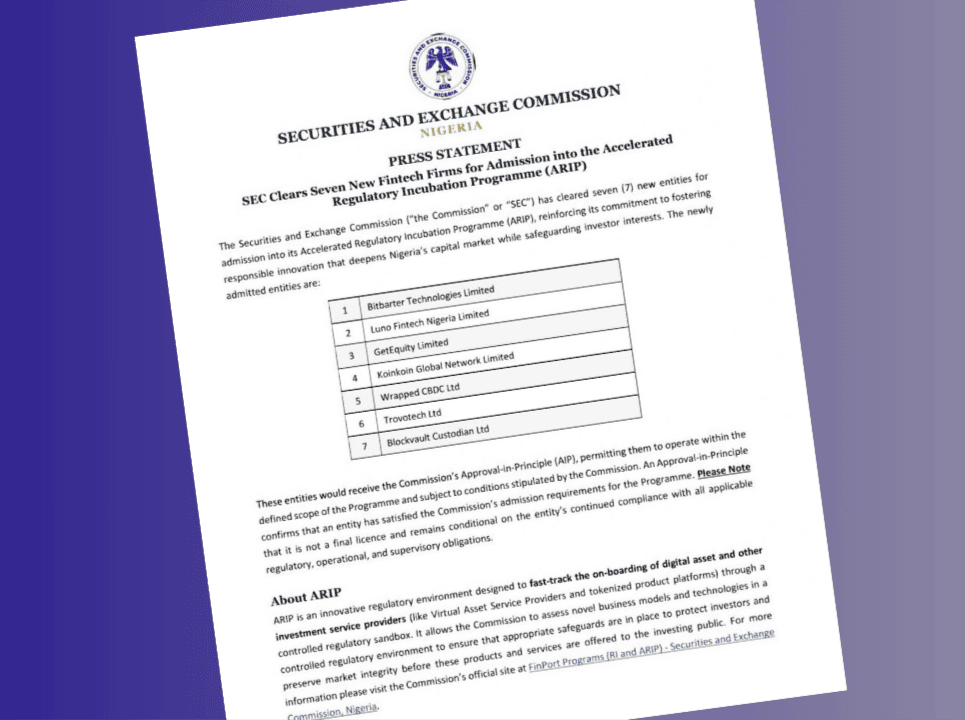
The new entrants, Bitbarter Technologies Limited, Luno Fintech Nigeria Limited, GetEquity Limited, Koinkoin Global Network Limited, Wrapped CBDC Ltd, Trovotech Ltd, and Blockvault Custodian Ltd, will each receive an Approval-in-Principle (AIP), granting conditional permission to operate within ARIP’s defined parameters while remaining under the SEC’s supervision.
How firms get here
ARIP admission runs through two structured phases. An applicant first files an initial assessment form on the SEC’s ePortal, alongside a non-refundable fee, after which the Commission determines whether the business model qualifies for the programme.
 Dr. Emomotimi Agama, DG of Nigeria SEC
Eligible entities then proceed to a full application: a sworn undertaking, an operational plan, evidence of registration with the Nigerian Financial Intelligence Unit, letters of no objection from any other sectoral regulator, proof of shareholders’ funds, a fidelity bond, and documentation for at least four principal officers, including a compliance lead.
Only after the commission is satisfied does it issue an AIP, not a full licence, but conditional clearance to operate under the Investments and Securities Act while working toward formal registration.
Under the SEC’s tightened digital asset rules, an AIP is typically valid for up to 12 months, after which qualifying entities are expected to transition to full registration as a digital asset exchange, offering platform, or custodian.
SEC’s ARIP cohort with familiar names
What distinguishes this round from the 2024 debut is the overlap between new and returning names. Three of the seven, Trovotech, Wrapped CBDC, and Blockvault Custodian, were among the five firms first admitted into the SEC’s parallel Regulatory Incubation (RI) programme in August 2024, alongside HousingExchange. NG and Dream City Capital. Their reappearance here, now bearing AIPs rather than RI status, suggests a maturing pipeline in which entities that spent roughly two years testing models under SEC supervision are being escalated toward the sandbox’s more formal track.
The remaining four are newer to public SEC recognition. Luno and Koinkoin have been visible fixtures in Nigeria’s crypto policy conversations; both companies’ local executives appeared before the House of Representatives’ ad hoc committee on cryptocurrency adoption in November, alongside Quidax and Busha.
Luno had publicly disclosed, as recently as September, that it had applied for SEC incubation and was awaiting a decision. GetEquity, an equity crowdfunding and tokenised investment platform, and Bitbarter, a peer-to-peer trading platform, round out the cohort.
Piecing together the SEC’s public disclosures since ARIP’s 2024 launch, the current cohort brings the number of entities that have held an Approval-in-Principle under the programme to at least nine: Busha and Quidax, the pioneer digital asset exchanges cleared in 2024, plus these seven. Including entities still sitting in the RI track without an upgraded AIP, at least eleven distinct firms have now passed through one stage or another of the SEC’s digital asset incubation architecture.
Why it matters
The timing is notable. This expansion follows the enactment of the Investments and Securities Act (ISA) 2025, which for the first time formally classifies virtual assets and investment contracts as securities and gives the SEC explicit statutory authority to register and regulate digital asset exchanges as market infrastructure, not merely as technology platforms operating at the regulator’s discretion.

For an ecosystem that ranks among the highest in the world for grassroots crypto adoption and where firms have historically operated in a grey zone between central bank restrictions and unclear securities status, a widening AIP list signals two things simultaneously: growing regulatory confidence in vetted local operators and a narrowing runway for platforms that have not applied.
The commission has repeatedly warned that ARIP and RI remain the only legitimate channels through which digital asset businesses can lawfully serve Nigerian investors and has urged the public to verify any platform’s status through its official portals before engaging.
An AIP is not a finish line. Conditions attach, supervision continues, and full registration under the Digital Assets Rules still awaits every name on this list. But for Nigeria’s crypto industry, each new cohort narrows the gap between the country’s outsized adoption numbers and a regulatory framework built to match them.
Also read: Understanding CBN’s crypto pilot with Obinna Iwuno, former president of SiBAN


Ayrıca Şunları da Beğenebilirsiniz

Galaxy Digital: Strategy’s Capital Plan Is a Stopgap, Not a Solution

PH victories needed to prevent domination by one party, says Loke


