

- Hızlı Al/SatKart ve mobil ödeme ile alım satım yapın
- P2PEn iyi fiyatlardan yerel ödeme ile alım satım yapın
- İtibari Para YatırmaBRL, COP, EUR ve daha fazlasını yatırın
- Uluslararası Banka TransferiYerel bankalar aracılığıyla alım satım yapın
- MEXC CardKripto varlıklarınızı dünya çapında harcayın
- SpotKolaylıkla kripto alım satımı yapın
- DönüştürPopüler tokenleri anında, 0 işlem ücretiyle dönüştürün
- Piyasa ÖncesiResmi listelemelerden önce erken satın alın
- MX BölgesiMX ile özel avantajların kilidini açın
- Spot DCAİnişler ve çıkışlar arasında istikrarlı büyüme
- Meme+Zincir üstü fırsatları erkenden keşfedin
- On-ChainYour unified hub for discovering, trading, and managing on-chain assets
- USDT-MUSDT ile uzlaştırılan Sürekli Vadeli İşlemler
- USDC-MUSDC ile uzlaştırılan Sürekli Vadeli İşlemler
- USD1-MPerpetual Futures settled in USD1
- Coin-MDiğer kriptolar ile uzlaştırılan Sürekli Vadeli İşlemler
- Vadeli KazançBakiyenizle kazanın ve yüksek APR'nin tadını çıkarın
- AI StratejisiFikirlerinizi Stratejik Eylemlere Dönüştürün
- Grid Alım SatımOtomatik alım satım ile volatiliteyi yakalayın
- YZ İşlem KopyalamaYeni ve geliştirilmiş YZ Ustaları ile hassas stil eşleştirme
- Demo Alım SatımRisksiz Vadeli İşlem alım satımını simüle edin
- Vadeli İşlem BilgileriVadeli İşlem araçları, ürünleri ve özelliklerini keşfedin
- OIL Futures24/7 access to top liquidity & leveraged trading
- BTC 500XBTC Vadeli İşlemlerinde 500 kata kadar kaldıraç
- ETH 500XETH Vadeli İşlemlerinde 500 kata kadar kaldıraç
- ZEC Vadelisıfır komisyon · 150x
- MEXC KazançKripto paranızla yüksek APR kazanın
- Tut ve KazanVarlıklarınızı tutarak günlük faiz kazanın
- Vadeli KazançBakiyenizle kazanın ve yüksek APR'nin tadını çıkarın
- Zincir Üstü KazançKolay stake, fiili zincir üstü getiri
- MEXC BorçRekabetçi oranlarla anında borç alın
- Ödül Merkezi10.000$ bonusla hemen başlayın
- Event CenterHigher rewards, 0 fees
- Davet Edin ve KazanınArkadaşlarınızı davet edin ve her davette 140 USDT kazanın
- $500K BTC CarnivalWin up to 1 BTC & more!
- LaunchpadAccess top tokens early or at a discount
- Airdrop+Yeni airdroplar almak için yatırma ve alım satım yapın
- KickstarterYeni tokenler kazanmak için MX tutun
- 0 FeesTrade hot futures, enjoy limited 0 fees
- Vadeli M-DayVadeli İşlem yapın ve günlük ödüller kazanın
- Futures Loss Coverage PlanGet triple protection and win $5,000 in XAUT
- Davet ProgramıDavet ederek %40'tan başlayan komisyonlar kazanın
- Ajanslık Programı%70'e varan üst düzey ajans komisyonları
- MEXC VVIPM-Score into Wealth, 10+ Elite Benefits Upgrading
- MEXC × TradingViewConnect MEXC to trade directly on TradingView
- Kripto HaberleriEn son kripto haberlerini takip edin
- DuyurularMEXC'deki tüm gelişmeleri takip edin
- LearnYeni başlayan herkes için güçlü kripto temelleri
- MEXC KurumsalKurumsal kullanıcılar için özel çözümler
Digital Asset Tax Certainty Act: Who Gets Tax Relief?
The United States is advancing legislation that could change how cryptocurrency transactions are taxed and how taxpayers correct previously unreported digital-asset activity. On September 16, 2026, the House Ways and Means Committee approved H.R. 10357, the Digital Asset Tax Certainty Act, by a 38–5 vote, sending the amended legislation forward for consideration by the House of Representatives. The bill addresses several areas of cryptocurrency taxation, including transaction reporting, mining and staking income, stablecoin payments, and a proposed voluntary disclosure program for historical compliance failures.
The Digital Asset Tax Certainty Act has not become law, and its voluntary disclosure provisions are not an active Internal Revenue Service program. Under the proposed framework, eligible taxpayers could potentially correct previous digital-asset tax reporting failures while receiving relief from certain penalties and specified enforcement consequences. The proposal does not eliminate unpaid taxes or interest, and eligibility would depend on the circumstances of the taxpayer and the final statutory requirements.
The broader significance extends beyond temporary penalty relief. Cryptocurrency users often face complicated reporting obligations arising from transactions across multiple exchanges, wallets, decentralized protocols, and blockchain networks. By combining a potential route for historical correction with changes to future tax rules, the legislation raises a more consequential policy question: whether the United States can improve digital-asset tax compliance by making accurate reporting more practical rather than relying principally on enforcement after mistakes occur.
Key Takeaways
- H.R. 10357 advanced through the House Ways and Means Committee on September 16, 2026, but has not become law.
- The proposal would direct the Treasury Department to establish a digital-asset voluntary disclosure program.
- Eligible taxpayers could potentially obtain relief from specified penalties while remaining responsible for unpaid taxes and interest.
- The bill also addresses stablecoin transactions, reporting requirements, mining, staking, and other digital-asset tax issues.
- Its long-term importance depends on whether clearer rules reduce compliance burdens without weakening enforcement against deliberate misconduct.
What the Digital Asset Tax Certainty Act Proposes
The Digital Asset Tax Certainty Act represents an attempt to address several tax problems arising from the growing use of cryptocurrencies and blockchain-based financial products. Introduced as H.R. 10357 in September 2026, the legislation received committee consideration after earlier discussions of digital-asset tax reform. On September 16, the House Ways and Means Committee approved an amended version by a recorded vote of 38–5. This was a legislative committee action, not final passage by Congress, and it did not establish an effective date for the proposed tax changes. The distinction is particularly important because taxpayers cannot rely on pending legislation as a substitute for existing reporting requirements. The bill must complete the remaining legislative process before its provisions can become enforceable law.
Its scope is broader than a proposed penalty relief program. According to the committee's official description, the legislation seeks to reduce tax friction associated with certain everyday digital-asset transactions, address the treatment of mining and staking, modernize reporting requirements, and provide closer alignment between qualifying digital assets and comparable traditional financial instruments. It also proposes extending certain established tax principles, including anti-abuse provisions, to digital assets. These measures address different dimensions of the same underlying problem: cryptocurrency activity frequently involves financial arrangements that do not fit neatly into tax rules originally developed around securities, banking accounts, or conventional payment systems. The legislation therefore attempts to clarify both when digital-asset transactions create taxable consequences and how those consequences should be administered.
The proposal's potential impact should not be overstated. A statutory framework can clarify tax treatment without removing the recordkeeping responsibilities involved in calculating income, capital gains, or losses. Moreover, legislative compromises may alter individual provisions before enactment, and implementing regulations could determine how they function in practice. The most useful way to evaluate the bill is to distinguish its confirmed legislative status from the changes it would introduce if ultimately enacted. In particular, the voluntary disclosure program should be understood as a proposed mechanism for correcting historical reporting failures, not an announcement that previously unpaid cryptocurrency taxes have been forgiven.
How the Crypto Voluntary Disclosure Program Would Work
The voluntary disclosure provision is one of the bill's most consequential elements because it attempts to address historical noncompliance directly. Under Section 502 of the committee-approved proposal, the Treasury Department would be directed to establish a program through which qualifying taxpayers could disclose previously unreported digital-asset tax obligations. The framework contemplates a defined implementation period and a subsequent opportunity for eligible participants to amend earlier returns, pay outstanding liabilities, and satisfy specified disclosure conditions. Rather than eliminating the tax obligations associated with cryptocurrency gains or income, the program is designed to create an incentive for taxpayers to correct historical failures under more predictable penalty arrangements. Its practical value would depend on the final law, Treasury implementation rules, taxpayer eligibility, and the amount of information required to establish a complete disclosure.
The proposed structure distinguishes between unpaid tax liabilities and penalties imposed because taxpayers failed to report or pay those liabilities properly. Tax and applicable interest would remain payable, while certain penalties could be reduced under the program's conditions. The committee-approved framework describes a penalty generally calculated at 25% of the relevant unpaid tax, with the possibility of a 0% rate for taxpayers satisfying specified certifications concerning nonfraudulent and nonwillful conduct. Those figures should not be interpreted as universal penalty rates applicable to every cryptocurrency investor. Eligibility, disclosure completeness, legal circumstances, and the nature of the underlying violation would determine whether a taxpayer could qualify. The program also contemplates limitations on additional penalties and certain criminal referrals for appropriately disclosed matters, but these protections are conditional rather than blanket immunity for any historical activity.
Can Investors Avoid Penalties on Past Crypto Taxes?
Potentially, but only if the proposed legislation becomes law and the taxpayer satisfies the resulting program's requirements. The proposed relief would not automatically erase penalties merely because a person previously traded cryptocurrency or failed to include a transaction on a tax return. A qualifying participant would need to provide the required disclosure, correct relevant reporting failures, and pay the tax and interest owed under the applicable rules. Where the proposal allows more favorable treatment for nonwillful conduct, taxpayers would also need to satisfy the relevant certification standards. Deliberate concealment, incomplete disclosures, or other disqualifying circumstances could prevent access to relief. Until legislation is enacted and the Treasury Department establishes the program, taxpayers with existing reporting problems remain subject to current law and should not assume that future provisions will apply retroactively to their circumstances.
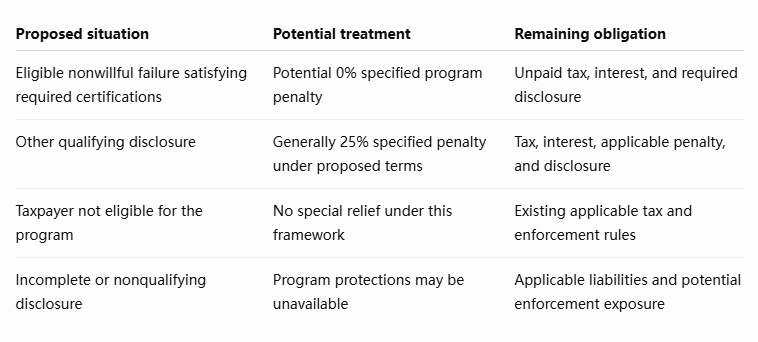
The table summarizes the proposed framework, not current IRS procedures. Final eligibility, penalty calculations, and protections would depend on enacted legislation and implementing guidance.
A voluntary disclosure program can have significant consequences even when it does not reduce the underlying tax owed. Taxpayers who have accumulated reporting failures may face uncertainty over potential penalties, enforcement exposure, and the financial cost of reconstructing historical transactions. A defined correction process could make the consequences of compliance more predictable, thereby encouraging individuals and businesses to resolve outstanding liabilities. However, the incentive may be less effective for taxpayers whose historical records are incomplete or who cannot reliably determine the value and tax basis of their transactions. The success of the proposed program would therefore depend partly on its administrative design, including how the Treasury Department handles incomplete records, valuation questions, and disclosures spanning multiple years.
Why Crypto Tax Compliance Became So Difficult
Cryptocurrency taxation is particularly complex because the number of transactions recorded on a blockchain does not correspond neatly to the number of taxable events. An investor may transfer tokens between personally controlled wallets, exchange one cryptocurrency for another, receive staking rewards, deposit assets into decentralized applications, or move collateral between protocols. These activities can have different tax consequences depending on their economic substance and the applicable legal framework. Under current U.S. federal tax principles, selling or exchanging cryptocurrency generally requires an assessment of gain or loss, while receiving certain types of rewards can create income recognition questions. By contrast, simply transferring the same asset between wallets controlled by the same owner ordinarily does not represent a taxable disposal. Accurate reporting therefore requires more than downloading a list of blockchain transfers and adding their dollar values together.
The difficulty becomes greater when activity spans multiple exchanges and decentralized services. Cost basis information may be stored with a different provider from the one through which an asset is eventually sold, and the taxpayer may need to reconstruct earlier acquisitions, transaction dates, fees, and asset valuations. Wallet addresses do not necessarily identify beneficial ownership, while movements through bridges or smart contracts may require additional analysis to determine whether ownership has changed. Even when exchanges provide reporting documents, those records may not capture every transaction relevant to an individual's tax position. MEXC's guide to U.S. crypto tax reporting requirements provides background on taxable events, capital gains, and broker reporting, although the requirements discussed there should be distinguished from the proposed changes in H.R. 10357.
These operational difficulties can create a gap between taxpayers' willingness to comply and their ability to produce complete records. A person who has made thousands of small transactions may face substantial costs reconstructing activity even when the aggregate tax liability is modest. The growth of broker reporting and transaction information supplied to tax authorities can improve oversight, but it does not automatically resolve discrepancies between reported proceeds and a taxpayer's complete historical cost basis. Policymakers must therefore consider whether more detailed information reporting produces proportionate improvements in compliance or creates administrative burdens that are difficult for ordinary taxpayers to manage. The proposed legislation attempts to address parts of this problem through simplified treatment for selected activities, clearer tax rules, and a mechanism for historical correction.
What Else Would H.R. 10357 Change?
Although the voluntary disclosure program attracts attention because of its potential effect on existing tax liabilities, other provisions may have greater long-term consequences for digital-asset usage. One area concerns small transactions and the treatment of certain qualifying payment activities. Under existing U.S. rules, disposing of cryptocurrency to purchase goods or services can trigger a gain or loss calculation, even when the transaction is economically similar to an ordinary payment. This creates friction when digital assets are used for routine settlement rather than held primarily as investments. The proposed framework seeks to reduce some of these administrative burdens for qualifying transactions, including specified stablecoin-related activity and network fees. However, the exact scope of any exclusion or simplified treatment would depend on the enacted statutory definitions and limitations, making it inappropriate to describe every stablecoin payment as automatically tax-free.
Another important area concerns mining and staking. These activities can produce income through the validation of blockchain transactions, but the timing and character of recognition have generated substantial debate. The legislation proposes changes intended to provide clearer treatment for certain digital assets produced through mining or staking arrangements. Such clarification could affect how participants calculate income, record basis, and subsequently recognize gains or losses when acquired tokens are disposed of. The bill also addresses the treatment of qualifying digital assets under rules more commonly associated with traditional financial markets, including provisions concerning dealers, traders, and selected anti-abuse requirements. These changes could influence how both individual participants and professional digital-asset businesses structure their compliance processes.
The interaction among these provisions is more important than their individual headlines. Simplifying selected payment transactions could reduce future recordkeeping burdens, while clearer treatment of mining, staking, and financial activities could limit uncertainty over when a taxable event occurs. Meanwhile, the voluntary disclosure program would provide a potential route for resolving historical failures under defined conditions. Together, these approaches suggest a shift toward combining more administrable forward-looking rules with an incentive to correct earlier reporting problems. Yet the legislative process remains incomplete, and taxpayers cannot assume that every proposed rule will survive unchanged or apply to earlier transactions.
MEXC View: Tax Certainty Requires a Path to Correction
The deeper policy question raised by the Digital Asset Tax Certainty Act is whether a tax system can achieve durable compliance when its underlying transaction rules and reporting infrastructure are difficult for taxpayers to reconcile. Enforcement and third-party reporting can increase the visibility of taxable transactions, but accurate compliance also depends on reliable cost basis information, clear definitions, and processes through which taxpayers can correct mistakes. Digital assets make these requirements unusually important because ownership and transaction records are distributed across multiple platforms and public blockchains. A system that expands transaction reporting without addressing uncertainty over tax treatment may produce more information while leaving substantial disputes over the correct tax liability.
The proposed combination of a voluntary correction mechanism and prospective rule changes offers a different approach. Historical disclosure relief could encourage taxpayers to address prior failures, while clearer rules may reduce the number of mistakes occurring in subsequent years. Neither measure is sufficient on its own: a one-time correction program would have limited value if future reporting remained excessively difficult, while simplified future rules would not automatically resolve existing unpaid liabilities. The effectiveness of the legislation will therefore depend on how well these components work together, whether eligibility conditions can be applied consistently, and whether Treasury guidance gives taxpayers a practical route to calculating and documenting their obligations.
Crypto Tax Relief Is Not Tax Forgiveness
The Digital Asset Tax Certainty Act could become an important development in U.S. cryptocurrency taxation, but its central significance should not be reduced to the possibility of lower penalties for historical reporting failures. The legislation attempts to address a wider administrative problem: digital-asset transactions have expanded into trading, payments, mining, staking, and decentralized financial activities faster than many existing tax procedures were designed to accommodate. This has created uncertainty for taxpayers attempting to identify taxable events, calculate cost basis, and reconcile transaction records across different platforms. A statutory framework that clarifies selected rules while providing a structured route for historical correction could improve compliance more effectively than relying on enforcement alone.
Nevertheless, the Digital Asset Tax Certainty Act remains proposed legislation. The September 16 committee vote demonstrates legislative progress but does not establish a functioning voluntary disclosure program or alter current tax liabilities. The potential availability of reduced penalties must also be separated from the obligation to pay outstanding taxes and interest. A taxpayer who qualifies for future relief would still need to satisfy the program's disclosure and payment requirements, while those outside its scope would remain subject to the applicable legal framework.
The next meaningful developments will be further action in the House of Representatives, the treatment of the bill in the Senate, any changes to the committee-approved text, and ultimately the Treasury Department's implementation if legislation is enacted. Particular attention should be given to the final eligibility criteria for voluntary disclosure, the treatment of small digital-asset transactions, and the practical recordkeeping requirements associated with mining, staking, and other activities.
The legislation's lasting value would come from making accurate cryptocurrency tax compliance more achievable, not from eliminating the consequences of past taxable activity. A credible tax framework must distinguish between taxpayers seeking to correct complex reporting failures and those engaged in deliberate misconduct, while providing clearer rules that reduce uncertainty before new problems accumulate.
Sources
U.S. House Committee on Ways and Means — Historic Digital Asset Tax Legislation Advances, September 16, 2026:
https://waysandmeans.house.gov/2026/09/16/historic-digital-asset-tax-legislation-advances-to-keep-america-the-crypto-capital-of-the-world/
U.S. House Committee on Ways and Means — Official Markup Record for H.R. 10357:
https://waysandmeans.house.gov/event/markup-of-h-r-10357-h-r-10334-h-r-6130-h-r-5439-h-r-4093-h-r-10346-and-h-r-10356/
Joint Committee on Taxation — Description of the Chairman's Amendment to H.R. 10357, JCX-50-26:
https://www.jct.gov/publications/2026/jcx-50-26/
U.S. House Committee Repository — H.R. 10357 Legislative Text and Amendments:
https://docs.house.gov/Committee/Calendar/ByEvent.aspx?EventID=119574
Risk Disclaimer: This article is for reference only and does not constitute investment advice. The cryptocurrency market is highly volatile. Please make decisions cautiously based on your individual circumstances.
REAL ile İlgili Haberler

Stablecoins as Cash Equivalents: What FASB Could Change

FTIXX Lynq: Goldman's $100B Fund Connects to Crypto Rails

Yorumlar
Yalnızca önceden ayarlanmış yorumlar ve emojiler seçilebilir