Overview
The most consequential structural change in stablecoins over the past decade is not market cap growth. It is that issuers are being pulled inside bank regulation. Circle completed two steps in three weeks: final approval from the Office of the Comptroller of the Currency on July 10 to establish a national trust bank, followed by a New York Department of Financial Services limited purpose trust charter on July 31. According to
Circle's announcement of the final OCC approval, the entity is legally named First National Digital Currency Bank, N.A. and operates as Circle National Trust.
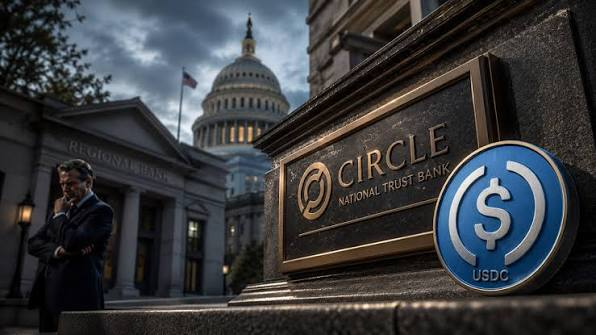
What makes this worth attention is not that Circle added a licence. It is that the connection between a stablecoin issuer and the US financial system has changed shape. USDC's reserve management and custody previously depended on third parties and a patchwork of state licences. Those functions can now sit inside an entity supervised directly by a federal banking regulator. That path stands in clear contrast to the route Tether chose, which left its flagship product outside the US framework and built a separate compliant product line instead.
One boundary should be established first. A trust bank charter is not a commercial bank charter. It carries no deposit insurance and permits neither deposit-taking nor lending. Understanding that limit is a precondition for judging what this actually means.
Key Takeaways
Circle applied on June 30, 2025, received conditional approval in December 2025, and secured final approval on July 10, 2026, authorising the bank to open on or after that date.
Once open, the bank will provide fiduciary digital asset custody for Circle and its affiliates. Under its OCC-approved business plan, it may eventually offer custody directly to a limited number of institutional customers, focused on banks and regulated derivatives organizations.
Management of the USDC Reserve is described as a future capability and has not begun. Circle's announcement states this explicitly.
On July 31, 2026, NYDFS granted a limited purpose trust charter to Circle Internet Trust Company LLC, operating as Circle New York Trust, giving Circle a dual state and federal supervisory structure.
The OCC issued similar conditional approvals in December 2025 to firms including Ripple, Paxos, BitGo and Fidelity Digital Assets, with BitGo subsequently upgraded to unconditional.
Circle's second-quarter results show USDC in circulation of $73.3 billion at quarter end, up 19% year on year, but a 66 basis point decline in the reserve return rate, with total revenue and reserve income of $701 million growing 7% against 20% the prior quarter.
Tether took a different route, launching USAT on January 27, 2026 through Anchorage Digital Bank rather than migrating USDT into the US framework.
Two Regulatory Tracks Landing at Once
What the Federal Approval Actually Delivers
Circle's announcement states that the charter places Circle National Trust under direct federal oversight by the OCC, the primary regulator for national banks and national trust banks. It frames the outcome as strengthening USDC infrastructure through federally regulated custody, with reserve management planned as a future capability.
The timeline itself signals how substantive the process was.
Circle's conditional approval announcement shows the application was submitted on June 30, 2025, with conditional approval that December and final approval in July 2026, spanning more than a year.
American Banker reported, citing a Circle spokesperson, that the bank is authorised to open on or after July 10 and the company expects to open shortly thereafter, with the OCC setting no deadline.
The layering of permitted activity matters. Circle and its affiliates come first, a limited set of institutional customers second, reserve management last. This is a staged expansion rather than a single leap in capability.
The New York Charter Fills a Different Gap
The state charter that landed three weeks later is different in kind but comparable in weight.
Circle's New York announcement confirms that NYDFS granted the limited purpose trust charter to Circle Internet Trust Company LLC, doing business as Circle New York Trust.
CoinDesk reported that a trust charter is an official state banking authorization permitting the holder to provide fiduciary, custody and asset management services under New York Banking Law.
Circle's relationship with the regulator dates to 2015, when it became the first company to receive a BitLicense. The trust charter adds fiduciary powers, which the virtual currency licence did not cover.
A status distinction is warranted here. Some outlets have reported that USDC issuance is expected to migrate to the New York entity over time. Circle's official announcement contains no corresponding statement, so this belongs in the reported-but-not-company-confirmed category.
Why This Is Not an Ordinary Bank
The Limits of a Trust Charter
This is the part most easily overstated.
PYMNTS reported, citing the NYDFS website, that a limited purpose trust company is chartered under the bank and trust company provisions of New York banking law but without general power to take deposits or make loans, and that trust charters are not automatically equivalent to being an FDIC-insured commercial bank.
The same applies federally.
Cryptopolitan's coverage of the approval states plainly that the charter grants no deposit insurance and that reserve management under the bank remains a future plan. What Circle obtained is fiduciary and custody authority, not credit creation authority.
The distinction has practical consequences. Describing stablecoin issuers as becoming banks invites the reading that they can take public deposits. What actually happened is that one obtained the standing to safeguard client assets under federal supervision. The first concerns money creation, the second concerns asset safekeeping, and their risk properties are not comparable.
Traditional Banking Is Pushing Back
The path is contested. Cryptopolitan reported that the Bank Policy Institute is considering legal action against the OCC, arguing that crypto trust banks could offer bank-like products without carrying the same obligations as full-service lenders, and that other banking groups have asked the regulator to narrow the policy on financial stability and consumer protection grounds. The same report cited Comptroller Jonathan Gould's view that new entrants benefit consumers by providing access to new products, services and sources of credit.
The dispute is unresolved. For investors it represents a category of regulatory tail risk worth tracking: the charter is granted, but the framework underneath it could still be reshaped by litigation or policy revision.
The Business Logic Visible in Q2 Results
A Falling Reserve Return Rate Exposes the Model
The commercial rationale for the charter shows up more clearly in the earnings release than in the announcement. According to
Circle's second-quarter 2026 results, USDC in circulation reached $73.3 billion at quarter end, up 19% year on year, with quarterly onchain transaction volume of $14.8 trillion, up 151%. Total revenue and reserve income was $701 million, up 7%.
The problem sits in the composition. Reserve income of $668 million grew 5%, driven by 25% growth in average USDC in circulation but partially offset by a 66 basis point decline in the reserve return rate. Scale grew by a quarter; revenue grew by a twentieth. Rates absorbed most of the increment.
Other lines deserve attention too. Net income from continuing operations was $48 million, a $530 million year-on-year improvement, but the release attributes this primarily to lower stock-based compensation following the prior-year IPO rather than to operating leverage. Adjusted EBITDA was $143 million, up 8%.
BeInCrypto's analysis noted that against the prior quarter's $694 million of revenue and $151 million of adjusted EBITDA, the sequential picture is flat to lower, and that CRCL is down 20.2% in 2026 while the S&P 500 has gained 13%.
Custody and Infrastructure Are the Diversification Route
Put those two datasets together and the charter's logic resolves. When revenue depends heavily on reserve interest, the rate cycle becomes the company's dominant risk exposure and one management cannot influence. Fiduciary custody generates fee income with far lower rate sensitivity.
Circle simultaneously raised full-year guidance for other revenue to a range of $310 million to $330 million from $150 million to $170 million, including recognised revenue from the Arc token presale, and lifted its post-distribution margin guidance to a range of 41.7% to 43.7%. The release also notes Arc's public mainnet launch scheduled for September 16, with founding validators including BlackRock, DTCC, Galaxy, ICE, Mastercard, Standard Chartered and Visa.
The direction is unambiguous: away from a single reserve-yield model and toward a mix of custody, network and infrastructure revenue. The charter is the entry condition for that shift rather than the shift itself. For investors following the stablecoin sector, watching how pair depth for USDC shifts against competing stablecoins on venues such as
MEXC often signals institutional preference earlier than any announcement does.
Circle and Tether Chose Opposite Routes
Dual Structure Versus Ring Fence
The two largest dollar stablecoin issuers responded to the same statute differently. The GENIUS Act, signed into law on July 18, 2025, sets rules for dollar-pegged tokens including full reserve backing in liquid assets and Bank Secrecy Act anti-money-laundering obligations for licensed issuers.
Circle's approach was to place itself inside the framework, taking a federal trust bank charter and then a state trust charter to build a two-tier supervisory structure. Tether built a separate product line instead.
CoinDesk's coverage of the USAT launch reported that Tether introduced USAT on January 27, 2026, issued by federally chartered Anchorage Digital Bank with Cantor Fitzgerald as reserve custodian and primary dealer, led by former White House Crypto Council executive director Bo Hines as CEO of Tether USAT. USDT was not migrated into the US framework, and the two products maintain separate reserves, issuance and redemption rails.
The scale comparison is stark. USDC ended the quarter at $73.3 billion in circulation while USDT sits above $180 billion. The larger issuer chose to stay outside the perimeter; the smaller one chose to move inside. These are different strategic bets rather than a ranking.
2028 Is Where the Two Paths Meet
The timeline provides the coordinate system.
CoinDesk's July analysis noted that GENIUS included a three-year grace period with two years remaining, after which non-compliant stablecoins cannot be used by US institutions. The piece cited Anchorage Digital policy head Kevin Wysocki's expectation that institutional users will move toward compliant, bank-issued digital dollars well ahead of that deadline.
Whether USDT can continue circulating in the US runs through qualification as a compliant foreign issuer, which requires a reciprocity determination from the US Treasury. Per
Value The Markets' analysis, that determination remained pending as of mid-2026. This is reported without an official conclusion, so predictions about the outcome rest on nothing verifiable.
What This Means for the Market and for Investors
For institutional capital, the regulatory status of a custodian is a hard requirement in due diligence. A custody entity supervised directly by a federal banking regulator lowers friction in the internal compliance reviews that asset managers, banks and corporate treasuries run. That kind of change never registers in a single day's price, but it registers in the slope of the adoption curve.
For stablecoin holders, near-term substance is limited. Reserve management has not moved into the new bank, and custody initially serves Circle and its affiliates. The meaningful change arrives only once reserve management actually migrates, and no timetable has been published.
For the sector, the clearest signal is that the entry bar is rising. The OCC granted conditional approvals in December 2025 to Ripple, Paxos, BitGo and Fidelity Digital Assets, with Nomura's Laser Digital and Sony Bank's Connectia Trust securing conditional approvals subsequently.
Coinpaprika reported that Coinbase, MoonPay, BitGo and Paxos already held New York limited purpose trust charters. Licensing is becoming table stakes rather than differentiation, which pushes competition back toward cost, distribution and product capability.
Risks and Scenarios
The first risk is legal. Banking groups are weighing litigation against the OCC, and if such a case advances the operating boundaries for crypto trust banks could be redrawn. The matter is at the consideration stage with no public record of a filing.
The second is rates. A 66 basis point year-on-year decline in the reserve return rate has already compressed revenue growth. If rates fall further, custody and infrastructure revenue must grow fast enough to fill the gap, and the roughly flat sequential quarter indicates that substitution is not yet complete.
The third is competitive structure. Once charters are widespread, regulated custody stops functioning as a moat. Share will then be determined by distribution networks and integration depth, and the leaders on those dimensions need not be the leaders on licensing.
On scenarios, the base case is that Circle gradually expands custody and eventually migrates reserve management into the new bank, with revenue mix diversifying slowly. A second is that litigation or policy revision narrows what trust banks may do, reducing the charter's strategic value. A third is that Tether obtains a Treasury reciprocity determination allowing USDT to keep circulating in the US, materially eroding the relative advantage Circle built through compliance. None of the three has decisive evidence behind it today.
Exclusive View from James Mitchell
What actually matters here is not that a stablecoin issuer became a bank. It is the single line reporting a 66 basis point year-on-year decline in the reserve return rate. That number exposes something scale growth had been masking: Circle's core revenue model is more sensitive to interest rates than to USDC adoption. Average circulation grew 25%; reserve income grew 5%. The difference is the rate cycle, arriving undiluted. The trust bank charter should be read against that backdrop. It is not an honour. It is an attempt to restructure revenue, moving the company from price-taker on rates to collector of fees.
Three misreadings look likely. The first is equating a trust charter with a commercial bank charter. No deposit insurance, no deposit-taking, no lending, with capability concentrated in fiduciary custody. Reading it as permission to run a lending book fundamentally misstates the risk profile. The second is treating the charter as an immediate earnings event. Reserve management remains a future capability and custody initially serves Circle and its affiliates, so the contribution needs time to materialise. The third is reading Tether's choice as falling behind. USDT retains several times USDC's circulation from outside the framework, and Tether traded a compliant subset for the freedom to keep its flagship running globally. That is a different allocation of risk, not passivity.
Three verifiable markers deserve tracking. Whether Circle publishes a timetable for migrating USDC reserve management into the new bank is the core proof point for the charter. Whether other revenue rises as a share of the total will show how far diversification has actually progressed, with full-year guidance now at $310 million to $330 million. And the Treasury's reciprocity determination for foreign issuers would rewrite competitive conditions for both companies at once. On-chain, one further metric is worth watching: address concentration and transfer size distribution for institutional-scale USDC movements, which would register a behavioural shift earlier than quarterly reporting does.
The cross-asset lesson is that compliance standing is converting from a cost line into a revenue line. For years the market treated licensing as operating expense and barrier to entry. Once custody, fiduciary services and settlement become billable, regulatory standing becomes the product itself. Traditional finance crossed this threshold long ago, and custody banking is built on precisely that foundation. Crypto has now reached the same junction. From a risk management standpoint, valuing companies like this requires separating two income types: float income tightly coupled to interest rates, and fee income coupled to assets under custody. They deserve different multiples, and merging them into a single growth narrative reliably produces cycle-timing errors.
This analysis rests on official announcements, reported financials and credible coverage available now. The regulatory environment, the rate path and the competitive landscape could each change the conclusion, and no single scenario should be treated as a fixed expectation.
FAQ
Did Circle receive a banking licence?
It received a national trust bank charter, not a commercial bank charter. The core difference is authority: a trust bank may safeguard client assets under fiduciary standards but cannot take public deposits or make loans, and it carries no federal deposit insurance. The entity is legally named First National Digital Currency Bank, N.A., operates as Circle National Trust, and sits under direct OCC supervision. Reading it as a federally regulated custodian is more accurate than reading it as a bank.
What does this change for USDC holders?
Substantively, little in the near term. Circle's announcement states that once open the bank will provide fiduciary digital asset custody for Circle and its affiliates, while management of the USDC Reserve is explicitly framed as a future capability that has not begun. The structural change arrives only when reserve management actually moves into a federally supervised entity, and no timetable has been published. Until then, USDC's reserve arrangements remain as they were.
How does the New York charter differ from the federal one?
They operate at different levels. The federal charter, granted by the OCC, places Circle National Trust under federal banking supervision with a focus on custody powers and eventual reserve management. The New York charter, granted by NYDFS on July 31, 2026 to Circle Internet Trust Company LLC, is a state banking authorization permitting fiduciary, custody and asset management services under New York Banking Law. Together they create a dual state and federal structure, which is uncommon among stablecoin issuers.
How do Circle's and Tether's regulatory paths differ?
Circle moved itself inside the US framework, securing federal and state trust charters in sequence. Tether built a parallel product line, launching USAT on January 27, 2026 through Anchorage Digital Bank with Cantor Fitzgerald as reserve custodian, while USDT stayed outside the US framework with separate reserves, issuance and redemption rails. USDT remains substantially larger than USDC, so this reads better as two different risk allocations than as a ranking of sophistication.
Why does this charter matter for Circle's business model?
Because of revenue composition. Second-quarter reserve income grew only 5% even as average USDC in circulation rose 25%, with the gap driven by a 66 basis point decline in the reserve return rate. That shows how heavily core revenue depends on the rate environment. Fiduciary custody generates fee income with far lower rate sensitivity. The charter is the entry condition for that business, and its value depends on how much fee income can substitute for rate-sensitive reserve yield.
Why is traditional banking opposed?
The objection centres on competitive fairness and financial stability. Reporting indicates the Bank Policy Institute is considering legal action against the OCC on the grounds that crypto trust banks could offer bank-like products without carrying full-service lenders' obligations, with other banking groups urging the regulator to narrow the policy. The OCC's position, per Comptroller Jonathan Gould, is that new entrants bring consumers new products, services and sources of credit. The dispute remains unresolved and constitutes a live regulatory risk.
Have other crypto firms obtained similar charters?
Yes, and the path is becoming crowded. The OCC issued conditional approvals in December 2025 to Ripple, Paxos, BitGo and Fidelity Digital Assets, with BitGo later upgraded to unconditional, and Nomura's Laser Digital plus Sony Bank's Connectia Trust securing conditional approvals afterward. At the state level, Coinbase, MoonPay, BitGo and Paxos already held New York limited purpose trust charters. Licensing is shifting from differentiator to baseline requirement.
What should be watched next?
Three verifiable markers. First, whether Circle publishes a timetable for moving USDC reserve management into the new bank, which is the core proof that the charter delivers value. Second, whether other revenue rises as a share of total revenue in line with raised full-year guidance of $310 million to $330 million. Third, the progress of the Treasury's reciprocity determination for foreign issuers, which would affect both USDT's US availability and the sector's competitive balance.
Disclaimer
This article is provided for informational and research purposes only and does not constitute investment advice, financial advice, legal advice, tax advice or any recommendation to transact. The charter approvals, regulatory frameworks and financial figures described here come from official announcements and credible reporting; application and subsequent developments should be verified against the most recent formal documents from the relevant regulators and companies, and some information has been reported without official confirmation, which the text notes where applicable. Prices of crypto assets, equities and other related financial instruments can move sharply over short periods, and investors may lose their entire principal. Although stablecoins are designed to maintain a stable value, they carry issuer risk, reserve risk, redemption risk and regulatory risk, should not be treated as equivalent to bank deposits, and are not protected by deposit insurance. Historical performance, technical indicators and on-chain data cannot guarantee future outcomes and should not be read as a promise or forecast regarding any asset. Readers should conduct their own independent research, verify official information directly, and evaluate any decision against their own financial circumstances, investment objectives, experience and risk tolerance, consulting a qualified professional adviser where appropriate. The MEXC Crypto Pulse team accepts no liability for any direct or indirect loss arising from use of or reliance on the information in this article.
About the Author
James Mitchell specializes in technical analysis, market trends, and trading strategies for both Bitcoin and altcoins. Based in London, he has over 10 years of experience in financial markets. Before joining MEXC Learn, James worked as a senior analyst at a leading European investment firm, where he developed expertise in risk management and quantitative trading. His transition to cryptocurrency markets began in 2017, and he has since become recognized for his data-driven approach. He holds a Master's degree in Financial Economics from the London School of Economics. His analytical approach combines traditional technical analysis with on-chain metrics to provide readers with actionable insights.
Areas of Expertise:
Research References