Lending

Lending protocols form the backbone of the decentralized money market, allowing users to lend or borrow digital assets without intermediaries. Using smart contracts, platforms like Aave and Morpho automate interest rates based on supply and demand while requiring over-collateralization for security. The 2026 lending landscape features advanced permissionless vaults and institutional-grade credit lines. This tag covers the evolution of capital efficiency, liquidations, and the integration of diverse collateral types, including LSTs and tokenized RWAs.

14595 Articles
Created: 2026/02/02 18:52
Updated: 2026/02/02 18:52
ReserveOne Seeks Nasdaq Listing in $1B Merger with M3-Brigade

ReserveOne Seeks Nasdaq Listing in $1B Merger with M3-Brigade

TLDR ReserveOne targets $1B IPO with M3-Brigade merger to lead in crypto asset management. ReserveOne’s merger aims for $1B, bringing diversified digital asset portfolio to Nasdaq. ReserveOne merges with M3-Brigade to offer institutional digital asset exposure. Former Hut 8 CEO leads ReserveOne’s $1B crypto-focused merger with M3-Brigade. ReserveOne plans Nasdaq debut, offering institutional crypto investments [...] The post ReserveOne Seeks Nasdaq Listing in $1B Merger with M3-Brigade appeared first on CoinCentral.

Author: Coincentral
Top 3 Altcoins Whales Are Buying Amid This Crypto Market Crash

Top 3 Altcoins Whales Are Buying Amid This Crypto Market Crash

The post Top 3 Altcoins Whales Are Buying Amid This Crypto Market Crash appeared first on Coinpedia Fintech News The cryptocurrency market faced a sharp sell-off over the past three days, wiping out weeks of gains and causing panic among traders. While some analysts call this a “sell the news” reaction following the Federal Reserve’s latest meeting, historical seasonal trends suggest this dip could create the perfect setup for a strong fourth-quarter crypto rally. …

Author: CoinPedia
Exploring zkTLS As A Way To Build A Verifiable and Private Web3

Exploring zkTLS As A Way To Build A Verifiable and Private Web3

Today the world has become heavily digital-first even as AI and AI-adjacent integrations impact all our interactions and experiences. Privacy and security concerns have become more pressing now than ever before. Among the emerging technologies that address and try to deal with all this, Zero-Knowledge Transport Layer Security or zkTLS has caught the attention. Let’s take a deep dive. What is zkTLS? As the name suggests this is a hybrid protocol combining two components: zk: Refers to one of the most popular and highly effective privacy-preserving technique in use in blockchain technology — zero-knowledge proofs (ZKPs). It is a cryptographic method involving two parties, where the prover convinces the verifier that a piece of information is known without having to reveal it. TLS: Refers to a critical part of HTTPS (Hypertext Transfer Protocol Secure) providing encryption and authentication mechanisms to secure data transmission between client and server. Fun fact: Not all implementations of TLS attestations use ZKPs as focus is on verifiability rather than mere privacy, but still the name zkTLS has etched its name as one of crypto’s newest privacy primitives. Bottomline: In tandem with confidential computing, zkTLS enables data provenance and encryption, even tapping into previously unusable data. Oasis, with a focused privacy-first approach and production-ready confidential EVM, Sapphire, has been working with leading zkTLS projects, including PoCs, e.g. onboarding Reclaim Protocol with its ecosystem. How zkTLS works? In simple terms, it allows a user or a server to demonstrate that data fetched via a TLS-secured connection, like an API call to a bank’s server, is authentic, and no extra information is exposed in the process. So, zkTLS will generate a proof like zk-SNARK confirming that data was fetched from a specific server (identified by its public key and domain) via a legitimate TLS session, without exposing the session key or plaintext data. The process flow is something like this: The client and the server connect over TLS (“TLS handshake”), establishing a secure session with encryption and server authentication. zkTLS captures session details (e.g., encrypted data and server certificate) and processes them in a zk-SNARK circuit tailored to TLS constraints. The circuit output will produce the proof verifying the data’s authenticity and source, keeping sensitive details hidden. This proof is recorded on a blockchain for decentralized verification. Let’s now take a quick look at the models. MPC-based Here, zkTLS modifies the standard TLS handshake by introducing a network of nodes that collaborate to produce a multi-party key replacing the browser-generated key. With browser consulting these nodes to generate a shared key through an MPC protocol, it is ensured no single party knows the entire key. The shared key is used for encrypting and decrypting requests and responses as the browser and all nodes cooperate on every instances of operation. This model enhances security but the the trade-off is networking complexity and overhead due to persistent node coordination. TEE-based Here, zkTLS leverages Trusted Execution Environments — tamper-proof secure enclaves within CPUs that act like a black box and can securely handle HTTPS requests. All sensitive data such as authentication tokens are encrypted and sent to the service provider’s TEE, where decryption happens internally without any exposure to the provider or external systems. The TEE logs in on behalf of the user and securely processes the response, providing cryptographic guarantees about the integrity of the request and response. This model is very efficient but the trade-off is dependency on TEE hardware and trust reliance on manufacturer security, e.g. Intel SGX or TDX. Proxy-based Here, zkTLS uses HTTPS proxies as intermediaries which forward encrypted traffic between the browser and the website, and then observe the data exchange. It is the proxy that provides attestations about the encrypted requests and responses, confirming they originated from the browser or the website. Finally, the browser generates a ZKP allowing decryption of the received data, and since the shared key is not revealed, privacy is ensured. This model eliminates the trade-offs of the other two models but has its own challenge — having to trust that the proxy is not malicious. Key takeaways of zkTLS zkTLS is a game-changer for web3 and its implications are best understood when we understand the two-pronged problem is solves. For a web2 user, HTTPS means there is end-to-end encryption. However, this isn’t provable. Also, TLS itself is unverifiable. And, no privacy is guaranteed. zkTLS brings verifiability to the table as the proof it generates validates the data or its origin and verifies the transfer. Another benefit of this technology is data privacy. To those who are thinking this is just like pulling API data and putting it on-chain, the distinction is tangible. APIs can be easily disabled, but with an ongoing HTTPS connection, zkTLS ensures continuous data access. Simply stated, this enables any web2 data to be used on a blockchain in a verifiable and permissionless way. Key use cases of zkTLS in crypto DeFi Lending Real world example: 3Jane Identity Verification Real world example: Nosh Privacy-Preserving Oracles Real world example: TLS Notary Verifiable Airdrops Real world example: ZKON Final word on zkTLS is that its design space is vast and full of potential as it evolves by solving current challenges like scalability, compatibility with varied web systems, and dependence on existing oracle networks. But the promise is real as indicated by the various real world examples, already in production with many more being explored. And the result we have been seeing and, as the space grows and evolves, look forward to gives hope that web2 — web3 interactions between the internet and the blockchain would also drive mass adoption. Resources: Oasis blog Reclaim blog Oasis x Reclaim Originally published at https://dev.to on September 23, 2025. Exploring zkTLS As A Way To Build A Verifiable and Private Web3 was originally published in Coinmonks on Medium, where people are continuing the conversation by highlighting and responding to this story

Author: Medium
Why Is XRP Price Down, And Which Top Crypto Are Investors Accumulating Today?

Why Is XRP Price Down, And Which Top Crypto Are Investors Accumulating Today?

$XRP dips under $3 as selling pressure rises, while investors pivot to Mutuum Finance ($MUTM), a $16.2M presale at $0.035 with utility and growth momentum.

Author: Blockchainreporter
Sats Terminal Building the Credit Layer of Bitcoin

Sats Terminal Building the Credit Layer of Bitcoin

The post Sats Terminal Building the Credit Layer of Bitcoin appeared on BitcoinEthereumNews.com. In recent years, the global financial landscape has witnessed a major shift as Bitcoin, the world’s largest decentralized digital asset, often called ‘digital gold’, has grown from a niche experiment into a mainstream financial network with a market cap rivaling major global assets. As adoption accelerates, the next wave of innovation will come not just from trading, but from building the credit infrastructure that transforms Bitcoin into a productive asset.  At the forefront of this shift is Rishabh Java, a technologist and entrepreneur whose career has been defined by solving hard problems. As a teenager, Java built one of the world’s most affordable mind-controlled prosthetic arms and later a multilingual humanoid robot — innovations that won global recognition and reflected a consistent theme: turning complex technology into something practical and accessible. That same ethos drives Sats Terminal, the Silicon Valley company he co-founded and scaled with backing from Coinbase Ventures and Draper Associates. The platform first solved a critical problem in Bitcoin trading by aggregating decentralized exchanges and cross-chain bridges, giving users the best execution across fragmented markets. A $1.7 million pre-seed round validated both the vision and the team’s ability to deliver. With this, Sats Terminal is moving into what it sees as the next major opportunity: Bitcoin Backed Loans. For long-term holders, selling Bitcoin often means missing out on future upside. Lending provides an alternative, the ability to borrow against Bitcoin holdings, unlocking liquidity while preserving exposure. Just as gold gave rise to vast credit markets as its role in the global economy expanded, Bitcoin’s maturation will almost inevitably create a parallel market for Bitcoin-backed loans. Industry forecasts already point to tens of billions of dollars in potential volume over the coming decade. “The future of Bitcoin isn’t just about holding,” says Rishabh Java, Co-founder of Sats Terminal.…

Author: BitcoinEthereumNews
CleanSpark’s Bitcoin Strategy Pays Off with $100M Credit Boost

CleanSpark’s Bitcoin Strategy Pays Off with $100M Credit Boost

The post CleanSpark’s Bitcoin Strategy Pays Off with $100M Credit Boost appeared on BitcoinEthereumNews.com. CleanSpark secures $100M via Bitcoin-backed loan on Coinbase Prime, boosting after-hours stock 5%. Firm expands Bitcoin mining, AI, and HPC with record $198.6M revenue and August’s 657 BTC output. Bitcoin mining company CleanSpark saw its after-hours trading increase by 5% on Monday after it announced it had raised an extra $100 million in funding. The company used a part of its massive 13,000 Bitcoin holdings as collateral on the institutional lending platform of Coinbase Prime. The stock prices rose to $14.44 during the extended trading hours on Monday, as compared to the previous price of $13.74, indicating that investors have confidence in the expansion plan. The most recent funding facility takes CleanSpark’s total Bitcoin-secured credit facilities with Coinbase Prime to about 300 million. Chief Business Officer Harry Sudock highlighted that the company would focus on maximizing shareholder value by using Bitcoin strategically. The capital will finance the aggressive growth of CleanSpark in its Bitcoin mining activities, high-performance computing, and development of energy infrastructure. Strategic Diversification Beyond Traditional Mining CleanSpark is not the only company in the Bitcoin mining sector that is shifting to artificial intelligence and high-performance computing services to diversify its revenue streams. Sudock described the overall asset optimization strategy of the company, examining each power contract and energy relationship to optimize it. Instead of concentrating on particular portfolio ratios, CleanSpark concentrates on versatility to seize new opportunities in various sectors. The company plans to find power pipeline segments that would be more appropriate for high-performance computing than the traditional Bitcoin mining activity. This flexibility will enable CleanSpark to seek greater opportunities to grow its power portfolio without compromising its competitive advantages in various markets. Sudock emphasized that versatility generates opportunity maximization that allows the company to manage the evolving market conditions. The financing announcement comes after CleanSpark achieved…

Author: BitcoinEthereumNews
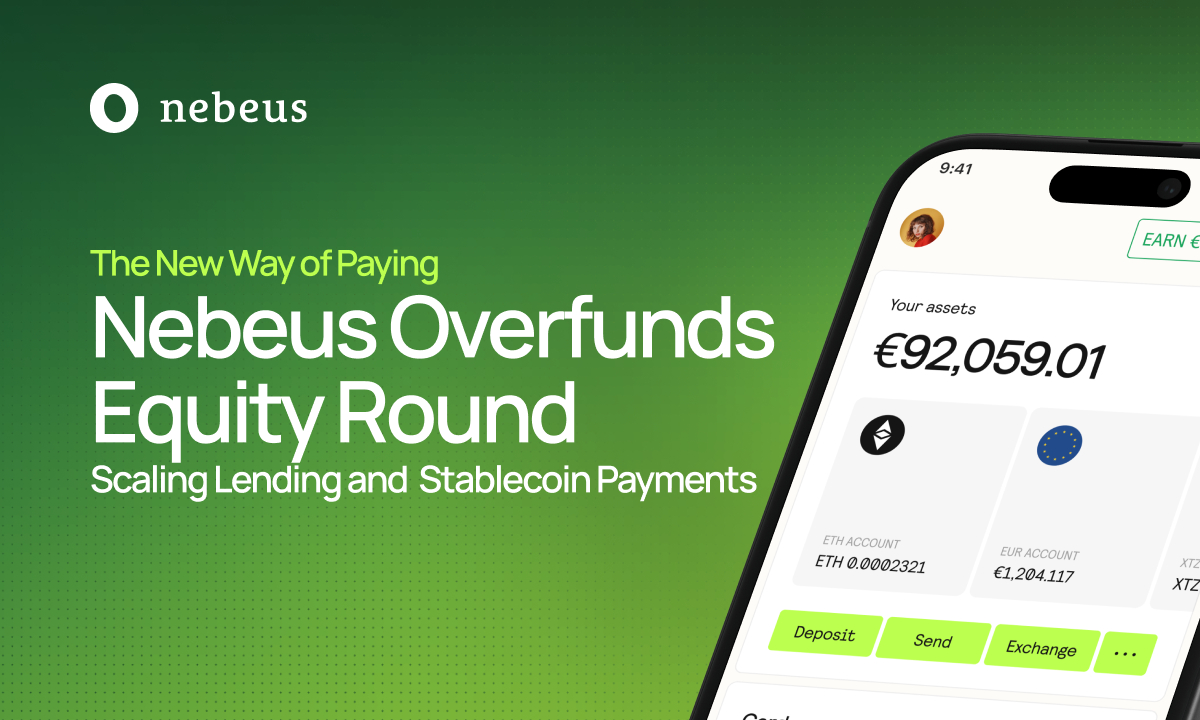
Nebeus Overfunds Equity Crowdfunding Campaign with €3.6M Raised, Reflecting Growing Demand for Regulated Crypto–Finance Solutions

Nebeus Overfunds Equity Crowdfunding Campaign with €3.6M Raised, Reflecting Growing Demand for Regulated Crypto–Finance Solutions

Nebeus Overfunds Equity Crowdfunding Campaign with €3.6M Raised, Reflecting Growing Demand for Regulated Crypto–Finance Solutions

Author: Cryptodaily
Native USDC & CCTP V2 Land on Plume to Supercharge Institutional RWA Adoption

Native USDC & CCTP V2 Land on Plume to Supercharge Institutional RWA Adoption

Plume has launched native USDC and CCTP V2, enabling seamless cross-chain transfers and regulated stablecoin settlement for institutions.

Author: Blockchainreporter
$167 Million in Solana Bagged By Major Tech Giant, What’s Coming?

$167 Million in Solana Bagged By Major Tech Giant, What’s Coming?

The post $167 Million in Solana Bagged By Major Tech Giant, What’s Coming? appeared on BitcoinEthereumNews.com. A few days after Pantera-backed Helius Medical announced plans to adopt a digital asset treasury strategy focused on accumulating SOL, the company has made its first major purchase, according to a CoinMarketCap report today. For the first time, the medical device company has purchased over 760,000 Solana, worth about $167 million, at an average price of $231 per SOL. The move marks its first step toward building the previously announced $500 million Solana treasury. Following the firm’s decision to heavily bet on the sixth-largest cryptocurrency by market capitalization, investors have expressed optimism about Solana’s price potential amid growing institutional adoption. Helius Medical further revealed that the vision behind the treasury launch is not only to hold Solana long-term, but also to explore opportunities in staking and decentralized finance (DeFi) to put its tokens to work. With its sights set on further SOL accumulation in the near future, Helius Medical reports holding over $335 million in cash reserves allocated to the execution of its digital asset strategy. Solana retrieves $220 mark Amid the broader crypto market downturn, Solana’s price fell sharply, recording an intraday low of $212.80 on Tuesday, September 23rd. While Solana experienced a heavier decline the previous day, with its price dropping over 6%, it has shown steadier price action today, flashing signals of a potential recovery after reclaiming the $220 level. Market watchers remain largely unfazed by the ongoing downturn, anticipating a major rally in the near term, particularly for Solana. Solana continues to attract institutional interest thanks to its robust infrastructure for large-scale business use. Its momentum is not solely driven by speculation but also by real-world adoption and expanding use cases. In recent weeks, Solana has made significant strides in the DeFi ecosystem as users increasingly stake funds within its network amid surging engagement. Boasting speed,…

Author: BitcoinEthereumNews
Ripple Focuses on Tokenization and Stablecoins in XRP Ledger’s Institutional DeFi Strategy

Ripple Focuses on Tokenization and Stablecoins in XRP Ledger’s Institutional DeFi Strategy

Ripple’s XRPL roadmap targets tokenization, stablecoins, and privacy tools to boost institutional adoption in DeFi and finance. Ripple is positioning the XRP Ledger (XRPL) at the forefront of institutional decentralized finance (DeFi) by prioritizing tokenization and stablecoins.  The company’s roadmap is set to transform the XRPL into a platform that allows banks, asset managers, and […] The post Ripple Focuses on Tokenization and Stablecoins in XRP Ledger’s Institutional DeFi Strategy appeared first on Live Bitcoin News.

Author: LiveBitcoinNews