NFT

NFTs are unique digital identifiers recorded on a blockchain that certify ownership and authenticity of a specific asset. Moving past the "PFP" craze, 2026 NFTs emphasize utility, representing everything from IP rights and digital fashion to RWA titles and event ticketing. This tag explores the technical standards of digital ownership, the growth of NFT marketplaces, and the integration of non-fungible tech into the broader Creator Economy and enterprise solutions.

13249 Articles
Created: 2026/02/02 18:52
Updated: 2026/02/02 18:52
Bitcoin Hyper Boosts as Texas Is First US State to Buy Bitcoin

Bitcoin Hyper Boosts as Texas Is First US State to Buy Bitcoin

The post Bitcoin Hyper Boosts as Texas Is First US State to Buy Bitcoin appeared on BitcoinEthereumNews.com. What to Know: Texas buying bitcoin via an ETF signals growing state-level comfort with regulated BTC exposure, but it primarily benefits long-term, low-beta allocators. As institutions choose ETFs, crypto-native investors may look one layer deeper, into Bitcoin Layer 2 infrastructure, for higher potential upside. Bitcoin still struggles with low throughput, variable fees, and limited programmability, keeping most complex DeFi and gaming activity on alternative smart contract chains. Bitcoin Hyper aims to solve this by bringing SVM-based, high-throughput smart contracts to a Bitcoin-secured Layer 2, targeting payments, DeFi, NFTs, and gaming. Texas just became the first US state to buy bitcoin, doing it not through a cold wallet but via BlackRock’s spot $BTC ETF. For institutions and treasuries, that’s a historic green light: clean regulatory rails, audited custody, and Bitcoin exposure that fits neatly into a traditional portfolio. For you as a retail investor, though, ETFs cap the upside. You get price tracking, not yield, leverage, or early-stage asymmetry. When a sovereign-scale buyer like Texas enters through an ETF, it reinforces Bitcoin as a macro asset, but it also pushes smaller investors to ask where the next outsized growth might actually come from. That’s why early-stage Bitcoin infrastructure plays are suddenly back in focus. Instead of just holding ‘paper BTC’ via an ETF, some are rotating into projects trying to fix Bitcoin’s biggest pain points: slow confirmation times, rising on-chain fees, and a scripting model that makes complex DeFi almost impossible. That’s the gap Bitcoin Hyper ($HYPER) is aiming to fill. As more headlines frame Texas’s move as the start of state-level Bitcoin adoption and another win for institutional adoption, a parallel conversation is happening in crypto-native circles. If institutions are content with ETF exposure, can agile investors position one layer closer to the innovation stack, into Bitcoin Layer 2s like…

Author: BitcoinEthereumNews
Inside Milk Mocha: 60% APY, NFT Utility, and Heartfelt Branding Making It 2025’s Top Meme Coin

Inside Milk Mocha: 60% APY, NFT Utility, and Heartfelt Branding Making It 2025’s Top Meme Coin

Back in 2013, $DOGE began as a joke that few took seriously, yet those early memes turned into million-dollar stories. […] The post Inside Milk Mocha: 60% APY, NFT Utility, and Heartfelt Branding Making It 2025’s Top Meme Coin appeared first on Coindoo.

Author: Coindoo
Top Picks for 100x? Analysts Weight In on Sui (SUI), GeeFi (GEE), Tron (TRX) for 2026’s Cycle

Top Picks for 100x? Analysts Weight In on Sui (SUI), GeeFi (GEE), Tron (TRX) for 2026’s Cycle

While Sui (SUI) celebrates a major ecosystem milestone and Tron (TRX) shows signs of a technical rebound, both networks still face underlying volatility and market uncertainty. Sui’s recent 11% daily surge is promising, but its long-term stability is yet to be proven. Meanwhile, Tron is battling to recover from oversold conditions.  As investors weigh these […] The post Top Picks for 100x? Analysts Weight In on Sui (SUI), GeeFi (GEE), Tron (TRX) for 2026’s Cycle appeared first on TechBullion.

Author: Techbullion
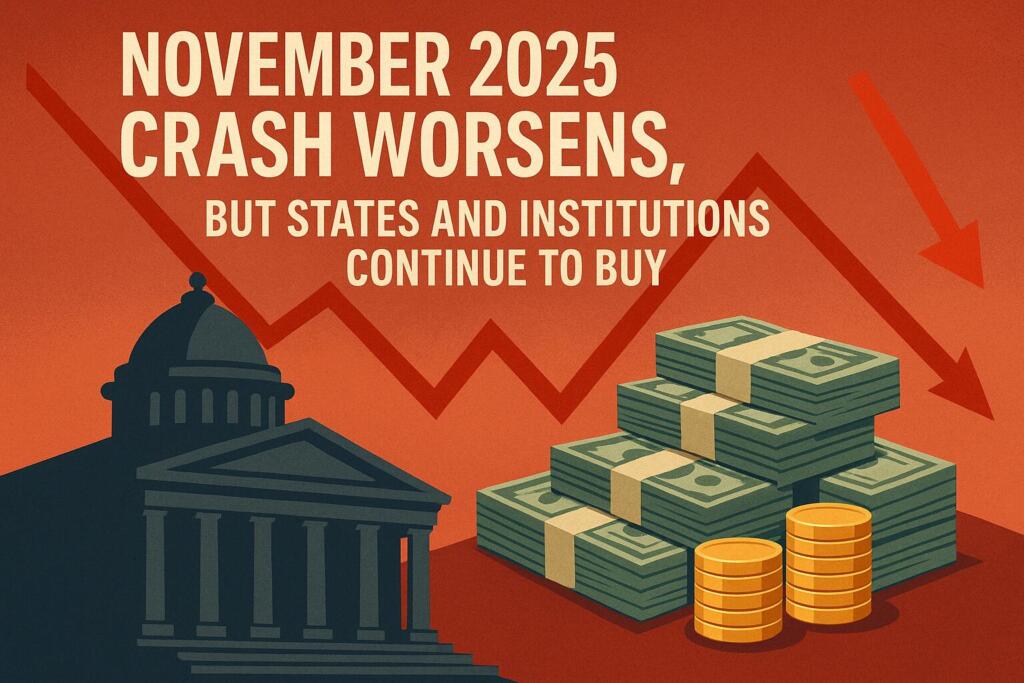
November 2025 Crash Worsens, But States and Institutions Continues to Buy

November 2025 Crash Worsens, But States and Institutions Continues to Buy

As of November 26, 2025, Bitcoin is trading around $87,011, 31.12% below its October peak of $126,198, according to on-chain data from CoinMarketCap.

Author: Crypto Breaking News
2025 Price Projection: Why Traders Expect Ozak AI to Surge Past the $3 Mark by 2026

2025 Price Projection: Why Traders Expect Ozak AI to Surge Past the $3 Mark by 2026

The Ozak AI’s presale momentum demonstrates to investors and traders that the token has significant growth potential. The coin has crossed $4.53 million as presale funding during a bear market continues. Many investors are entering the presale phase, drawn not only by the token’s low presale price but also by the strong technology that underpins […] The post 2025 Price Projection: Why Traders Expect Ozak AI to Surge Past the $3 Mark by 2026 appeared first on Live Bitcoin News.

Author: LiveBitcoinNews
Ethereum Price Prediction: Hedge Funds Are Shorting the Dollar – Here’s Why ETH Holders Should Pay Attention

Ethereum Price Prediction: Hedge Funds Are Shorting the Dollar – Here’s Why ETH Holders Should Pay Attention

Crypto analysts have warned that the future path of the US dollar could shape the next major phase of the crypto market.  The post Ethereum Price Prediction: Hedge Funds Are Shorting the Dollar – Here’s Why ETH Holders Should Pay Attention appeared first on Coinspeaker.

Author: Coinspeaker
Revolutionary Avail Nexus Mainnet Launches: Unifying 11 Blockchains for Seamless Crypto Experience

Revolutionary Avail Nexus Mainnet Launches: Unifying 11 Blockchains for Seamless Crypto Experience

BitcoinWorld Revolutionary Avail Nexus Mainnet Launches: Unifying 11 Blockchains for Seamless Crypto Experience The cryptocurrency world just witnessed a groundbreaking development with the Avail Nexus mainnet launch. This revolutionary cross-chain system is set to transform how we interact with blockchain networks by creating a unified operating environment that connects rollups, appchains, and decentralized applications. Imagine being able to move your assets, liquidity, and user experience seamlessly between different […] This post Revolutionary Avail Nexus Mainnet Launches: Unifying 11 Blockchains for Seamless Crypto Experience first appeared on BitcoinWorld.

Author: bitcoinworld
MEXC Launches Year-End Golden Era Showdown with 2,000g Gold Bar and BTC from 10 Million USDT Prize Pool

MEXC Launches Year-End Golden Era Showdown with 2,000g Gold Bar and BTC from 10 Million USDT Prize Pool

  Victoria, Seychelles, November 26, 2025 – MEXC, a leading global cryptocurrency exchange, has announced its Year-End Golden Era Showdown will officially begin on November 26, 2025, 16:00 (UTC), a trading competition with a total prize pool of up to 10 million USDT. Prizes include a 2,000g gold bar and 6 BTC.   In June […] The post MEXC Launches Year-End Golden Era Showdown with 2,000g Gold Bar and BTC from 10 Million USDT Prize Pool appeared first on TechBullion.

Author: Techbullion
NFTs in 2025 – More Than Digital Art

NFTs in 2025 – More Than Digital Art

By the end of 2025, the NFT industry will hardly be the same exaggerated world of 2021 and the deep correction of 2022–2023. The market’s focus, which was mainly on avatar collections and speculative flips, has expanded to a more diversified ecosystem where utility, interoperability, and models of digital ownership are valued more than quick profit. The change has been slow, but 2025 is shaping up to be a landmark year in the evolution of non-fungible tokens. In general, the NFT market in 2025 is a good example of cautious optimism: the extreme fluctuations are hardly present, there are more genuine use cases, and the distinction between strong and weak projects is much ​‍​‌‍​‍‌​‍​‌‍​‍‌clearer. NFTs​‍​‌‍​‍‌​‍​‌‍​‍‌ in Gaming – The Real Growth Engine The concept of digital ownership of game assets, which was just a small niche side idea, has become the central theme of numerous blockchain-powered games. Consumers purchasing skins or items that are locked behind a centralized platform are indeed the last ones to say; instead, players are described as desiring absolute ownership, the right to trade, sell, or even reuse assets across various games. In addition, gaming tokens also pave the way for a variety of other blockchain-based experiences. For instance, in a competitive strategy game, developers can instill the concept of digital economies so players can use cryptocurrencies to purchase assets and participate in a skill-based tournament.  This is precisely the point at which crypto poker, as an activity, seamlessly fits into the discussion. Both gaming and NFTs are based on verified digital ownership, trustless rules, and community-governed economies. These intersections reveal how blockchain gaming is leading the NFT space not only toward a radical but also a more human future of co-creation. Future Market Insights estimates that the NFT-powered gaming applications market will be worth $3.1 billion by the end of 2025, and long-term projections reach nearly ten times that amount by 2035. Such figures are among the most solid evidence that NFTs are transitioning to real use cases rather than being speculative collectibles. Game studios have become less naive along the way. A majority of the unsustainable “play-to-earn” schemes that littered the space have been cleaned up and replaced by play-and-own models that reward users for their long-term rather than short-term engagement. In particular, developers working on Base, Solana, and Layer-3 environments are conducting interoperability experiments that allow users to share drops from one game across multiple MDR titles and even borrow assets from other users. Indeed, with millions of gamers actively trying out blockchain-based games this year, gaming is not only the largest source of NFT adoption but also the most consistent engine of market ​‍​‌‍​‍‌​‍​‌‍​‍‌expansion. Institutional​‍​‌‍​‍‌​‍​‌‍​‍‌ Adoption and the Quiet Maturation of the Market One of the less-discussed aspects of the institutional presence of 2025 is how it has evolved. The Venetian Research shows that institutional investors account for roughly 15% of the total NFT market revenue. This is a significant change from that environment, where the first years were dominated by retail. However, the institutions are not loading up the market with animal cartoons. They are investing in: Tokenized real-world assets (RWAs) Blockchain-based intellectual property rights Fractional ownership models for digital goods Platform infrastructure rather than individual collections Even if collectors who depended on the hype have already left, this still indicates that institutions have deeper trust in the tech. Regulators have stepped up their game as well. Around the middle of 2025, U.S. courts changed their approach to NFT-related insider trading cases, according to Reuters. This, in turn, is creating new legal benchmarks for the marketplaces. The end environment is a market operating with greater transparency, less of a mess, and viable for long-term investment. The​‍​‌‍​‍‌​‍​‌‍​‍‌ Market’s Challenges Are Still Real The Business Research Company data shows that the worldwide NFT market was forecast to increase from a little over $43 billion in 2024 to almost $60.8 billion in 2025, a very significant move reflecting not only the industry’s maturation but also growing institutional interest.  On the other hand, Vancelian Research reported that more than 85 million NFTs were created in the first half of this year, while active NFT wallets grew approximately 9% year-over-year. These figures imply that the speculative frenzy that used to be there is now completely gone, whereas the usage and adoption are still increasing at a steady pace. The NFT market is still facing challenges it cannot solve on its own, despite impressive growth figures. One of these challenges is value concentration: a few percent of wallets still hold a disproportionate share of the volume. Trading volume is very low across most collections, which is why liquidity is unstable. The carbon footprint issue has been less of a problem due to most projects moving to proof-of-stake chains, but the intellectual property rights, wash-trading, and long-term viability being debated is still a regular thing. Also, the sales volumes have been stable, but the way to mainstream acceptance is still very far. Also, the market remains exposed to the risk of volatility. For instance, Base and Solana are on an upward trend, but other ecosystems are not growing at a similar rate. The difference between high-utility and low-utility projects getting larger is what’s ​‍​‌‍​‍‌​‍​‌‍​‍‌happening. The post NFTs in 2025 – More Than Digital Art appeared first on NFT Plazas.

Author: Coinstats
Charles Hoskinson Blames Institutional Manipulation for Crypto Slump

Charles Hoskinson Blames Institutional Manipulation for Crypto Slump

TLDR Charles Hoskinson accuses large institutions of causing the recent crypto market crash by manipulating prices. Hoskinson claims institutions like Citadel inflated prices and profited by shorting the market during its decline. The Cardano founder believes that institutional dominance and leverage left the market vulnerable when the bubble burst. Hoskinson reflects on the 2021 bull [...] The post Charles Hoskinson Blames Institutional Manipulation for Crypto Slump appeared first on CoinCentral.

Author: Coincentral