Lending

Lending protocols form the backbone of the decentralized money market, allowing users to lend or borrow digital assets without intermediaries. Using smart contracts, platforms like Aave and Morpho automate interest rates based on supply and demand while requiring over-collateralization for security. The 2026 lending landscape features advanced permissionless vaults and institutional-grade credit lines. This tag covers the evolution of capital efficiency, liquidations, and the integration of diverse collateral types, including LSTs and tokenized RWAs.

15865 Articles
Created: 2026/02/02 18:52
Updated: 2026/02/02 18:52
Circle Launces USDC on Monad as Curve, Coinbase Join 13 Launch Apps

Circle Launces USDC on Monad as Curve, Coinbase Join 13 Launch Apps

TLDR: Circle deployed USDC natively on Monad as the 29th blockchain supporting the regulated stablecoin CCTP enables cross-chain transfers between Monad and 17 other networks without liquidity locks Thirteen DeFi applications launched day-one including Curve Finance, Coinbase, and Wormhole Circle bundled Wallets and Contracts developer tools alongside stablecoin infrastructure Circle has deployed USDC and its [...] The post Circle Launces USDC on Monad as Curve, Coinbase Join 13 Launch Apps appeared first on Blockonomi.

Author: Blockonomi
Japan's FSA requires exchanges to hold liability reserves to cover hacks and fraud

Japan's FSA requires exchanges to hold liability reserves to cover hacks and fraud

Japan's FSA requires exchanges to hold liability reserves to cover hacks and fraud.

Author: Cryptopolitan
Bold $49.3M Accumulation Despite $13.9M Loss

Bold $49.3M Accumulation Despite $13.9M Loss

The post Bold $49.3M Accumulation Despite $13.9M Loss appeared on BitcoinEthereumNews.com. In a surprising move that’s captured the crypto world’s attention, Multicoin Capital has made a massive Multicoin Capital AAVE investment worth $49.3 million. This bold accumulation comes despite the firm currently facing significant unrealized losses. What does this tell us about their confidence in AAVE’s future? Why Is Multicoin Capital Doubling Down on AAVE? Over the past month and a half, Multicoin Capital purchased 278,000 AAVE tokens through Galaxy Digital at an average price of $228 per token. This substantial Multicoin Capital AAVE investment represents a major vote of confidence in the DeFi protocol. However, the timing raises important questions about their investment strategy. The firm currently faces an unrealized loss of $13.9 million on this position. This situation demonstrates that even experienced investors can experience short-term setbacks in the volatile cryptocurrency market. What Does This Investment Reveal About AAVE’s Potential? Despite the current paper losses, this massive Multicoin Capital AAVE investment suggests the firm sees long-term value in the protocol. Several factors might explain their confidence: AAVE’s strong position in the DeFi lending space The protocol’s consistent innovation and updates Growing institutional interest in DeFi protocols Potential for recovery in the broader crypto market This strategic move shows that Multicoin Capital is playing the long game rather than focusing on short-term price movements. How Do Professional Investors Approach Crypto Volatility? The current $13.9 million unrealized loss on this Multicoin Capital AAVE investment highlights several key aspects of professional crypto investing: Professional investors often accumulate positions over time They focus on fundamental value rather than daily price swings Large positions require patience and conviction Dollar-cost averaging helps manage volatility risk This approach differs significantly from retail trading strategies and demonstrates why institutional investors often succeed where others struggle. What Can We Learn From This Investment Strategy? The substantial Multicoin Capital…

Author: BitcoinEthereumNews
PBOC sets USD/CNY reference rate at 7.0826 vs. 7.0847 previous

PBOC sets USD/CNY reference rate at 7.0826 vs. 7.0847 previous

The post PBOC sets USD/CNY reference rate at 7.0826 vs. 7.0847 previous appeared on BitcoinEthereumNews.com. The People’s Bank of China (PBOC) sets the USD/CNY central rate for the trading session ahead on Tuesday at 7.0826 compared to the previous day’s fix of 7.0847 and 7.1056 Reuters estimate. PBOC FAQs The primary monetary policy objectives of the People’s Bank of China (PBoC) are to safeguard price stability, including exchange rate stability, and promote economic growth. China’s central bank also aims to implement financial reforms, such as opening and developing the financial market. The PBoC is owned by the state of the People’s Republic of China (PRC), so it is not considered an autonomous institution. The Chinese Communist Party (CCP) Committee Secretary, nominated by the Chairman of the State Council, has a key influence on the PBoC’s management and direction, not the governor. However, Mr. Pan Gongsheng currently holds both of these posts. Unlike the Western economies, the PBoC uses a broader set of monetary policy instruments to achieve its objectives. The primary tools include a seven-day Reverse Repo Rate (RRR), Medium-term Lending Facility (MLF), foreign exchange interventions and Reserve Requirement Ratio (RRR). However, The Loan Prime Rate (LPR) is China’s benchmark interest rate. Changes to the LPR directly influence the rates that need to be paid in the market for loans and mortgages and the interest paid on savings. By changing the LPR, China’s central bank can also influence the exchange rates of the Chinese Renminbi. Yes, China has 19 private banks – a small fraction of the financial system. The largest private banks are digital lenders WeBank and MYbank, which are backed by tech giants Tencent and Ant Group, per The Straits Times. In 2014, China allowed domestic lenders fully capitalized by private funds to operate in the state-dominated financial sector. Source: https://www.fxstreet.com/news/pboc-sets-usd-cny-reference-rate-at-70826-vs-70847-previous-202511250117

Author: BitcoinEthereumNews
Hougan Explains Why Only the Best Will Survive

Hougan Explains Why Only the Best Will Survive

The post Hougan Explains Why Only the Best Will Survive appeared on BitcoinEthereumNews.com. Bitwise CIO Matt Hougan said that structural drag ensures most DATs will trade at a discount. Only a few exceptional DATs can sustainably increase crypto-per-share and earn a premium. DATs that scale and operate efficiently will evolve into fully operational companies, Hougan said. Bitwise Chief Investment Officer Matt Hougan believes that the next evolution of digital asset treasuries (DATs) is already taking shape and many of these firms will eventually transition into fully operational companies rather than passive crypto-holding entities.  Speaking in a series of posts on X on Sunday, Hougan argued that the structural forces shaping DAT valuations leave little room for long-term premiums. This will eventually push most firms toward building real business models to survive. Hougan said that most DATs currently rely on a narrow and uncertain set of tools to increase their “crypto-per-share,” while facing heavy and unavoidable downward pressures such as illiquidity, operating expenses, and execution risk.  “Most will trade at a discount, and only a few exceptional firms will trade at a premium,” he noted and added that the sector faces a “high hurdle” by design. 22/ For the past six months, DATs have risen and fallen together. Going forward, I think there will be more differentiation. A few will execute well and trade at a premium, and many will execute poorly and trade at a discount. This model is one way to think about which is which. — Matt Hougan (@Matt_Hougan) November 23, 2025 A Structural Discount That DATs Cannot Ignore Hougan’s model begins by treating a DAT as if it had a fixed lifespan, i.e., what would the company be worth if its assets were liquidated today, in a year, or over a longer horizon?  He pointed out that investors will not pay full market price today for crypto they would only…

Author: BitcoinEthereumNews
Misalignment: Ethereum is bleeding, Hyperliquid is stalling.

Misalignment: Ethereum is bleeding, Hyperliquid is stalling.

Binance's Aster attack on Hyperliquid's open interest and trading volume, along with the subsequent attacks on HLP by $JELLYJELLY and $POPCAT, are merely minor ailments. Amidst the booming HIP-3 growth mode, the rumored BLP (lending protocol), and the positive news of $USDH actively staking 1 million $HYPE tokens to become aligned quote assets, Hyperliquid has revealed its own cracks—the HyperEVM ecosystem and $HYPE are not yet aligned. Alignment is not complicated. Under normal circumstances, the HyperEVM ecosystem consumes $HYPE, and $HYPE will also support the development of the HyperEVM ecosystem. This is an abnormal situation. The Hyperliquid Foundation's focus remains on the use of $HYPE in the spot, contract, and HIP-3 markets of HyperCore, while the development of the HyperEVM ecosystem remains a second-class citizen. Earlier, a third party proposed the HIP-5 proposal, hoping to allocate some funds from the $HYPE buyback fund to support ecosystem project tokens. However, this proposal was met with overall rejection and skepticism from the community. This points to a harsh reality: the current price of $HYPE is entirely supported by HyperCore market buybacks and has no spare capacity to support the HyperEVM ecosystem. Lessons from Others: Ethereum's Successes and Failures in Scaling L2 switching to Rollup does not satisfy ETH, and third-party sorters are almost absurd. The development of a blockchain involves three main entities: the main token (BTC/ETH/HYPE), the foundation (DAO, spiritual leader, company), and ecosystem project teams. The future of the blockchain hinges on the interaction model between the main token and ecosystem projects. Main token ⇔ Ecosystem: Two-way interaction is the healthiest approach. Ecosystem development requires the main token, and the main token empowers ecosystem projects. SOL is currently doing the best in this regard. Main token -> ecosystem; the main token empowers the ecosystem in one direction; after the main token TGE, everyone disperses, as is typical of Monad or Story. Ecosystem -> Main Token, the main token drains ecosystem projects, and the ecosystem is in a state of competition and cooperation with the main token. The evolution of the relationship between Ethereum, its DeFi projects, and L2 is the most direct and can reflect the current state of HyperEVM and its potential for future breakthroughs. According to 1kx research, the top 20 DeFi protocols account for about 70% of on-chain revenue, but their valuations are far lower than those of underlying public chains. The theory of fat protocols still holds sway, and people trust Uniswap and stablecoins on Ethereum more than Hyperliquid and USDe alone. Not to mention that Vitalik has long "hated" DeFi but can't live without it, and eventually awkwardly came up with the theory of low-risk DeFi. Many DeFi protocols have tried to build their own portals, from dYdX V4 to MakerDAO's EndGame plan in 2023, with technology choices spanning AltVM systems such as Cosmos and Solana. Then came Vitalik's public sale of $MKR. Beyond the interaction between the main token and the ecosystem, people have long underestimated the "official" legitimacy of public chains, especially the role of spiritual leaders. Vitalik's Ethereum Foundation (EF) has long been laissez-faire towards DeFi, focusing instead on metaphysical philosophical concepts. This approach, where the two sides fight like the snipe and the clam, allows the fisherman to profit, and the rise of the Solana DeFi ecosystem is not unrelated to this. Ultimately, Hyperliquid, with its exchange + public chain model, has entered a new phase of competition among public chains. Solana's impact on Ethereum has drawn criticism of Vitalik and EF, but beyond DeFi, the gains and losses of L2 Scaling are more intriguing. The L2/Rollup route has not failed technically, but the diversion of L1 revenue has put ETH into a downward cycle. Image caption: ETH Dream: L2 Scaling -> L1 Scaling Image source: @zuoyeweb3 When Ethereum L1 encountered scaling demands following the DeFi boom, Vitalik Buterin designated a scaling route centered on Rollups and went all in on the long-term application value of ZK, guiding the industry, capital, and talent toward ZK Rollups with FOMO, creating countless wealth effects or tragedies from 2020 to 2024. However, one thing is certain: DeFi is a real product aimed at end consumers. The continuous launch of L2 is essentially consuming Ethereum's L1 infrastructure resources, which means dividing ETH's value capture ability. 2024 will mark the end of L2/Rollup, and 2025 will see a return to the L1 Scaling route. After a four-year absence, he has returned, still primarily focusing on L1. Image caption: Speeding up and reducing fees hurts its own revenue. Image source: @1kxnetwork On the technical level, ZK and L2/Rollup have indeed significantly reduced the burden of L1, and the speed increase and fee reduction have indeed benefited participants, including ordinary users. However, in addition to the competitive and cooperative relationship between public chains and DeFi (applications), on the economic level, a complex triangular relationship between public chains and L2 applications has been added out of thin air, ultimately creating a lose-lose-lose situation. Ethereum's revenue is declining due to L2 caches, the wealth effect is being dispersed due to excessive L2 caches, and L2 caches are being diverted as applications continue to expand. Ultimately, Hyperliquid ended the dispute with a unified stance of "public chain as application, application as transaction," and Vitalik also lowered his arrogant head, reorganized EF (Ethereum Foundation), and embraced user experience again. During the transition from L2 to L1, the technological choices made at certain points in time, such as Scroll's emphasis on four ZK EVMs and Espresso's bet on decentralized L2 sorters, were ultimately proven false. Brevis's recent attention stems from Vitalik's renewed emphasis on the importance of ZK for privacy, and has little to do with Rollup. The fate of a project depends on both its own efforts and the course of history. Amidst a dazzling array of victories, Hyperliquid, having achieved one triumph after another, is once again facing Ethereum's dilemma: how should it manage the relationship between its main token and its ecosystem? To spark discussion: Alignment selection in HyperEVM BSC is an affiliate of Binance, and the HyperEVM team hasn't figured out exactly what Hyperliquid is. In the article "Building HyperEVM", I introduced Hyperliquid's unique development path: first, we created the controllable HyperCore, and then the open HyperEVM, connecting the two with $HYPE. In recent developments, the Hyperliquid Foundation has adhered to a token economics centered on empowering $HYPE, with HyperCore as the core and multiple HyperEVM ecosystems developing together. This leads to the core concern of this article: How should HyperEVM forge a distinctive development path? The BSC ecosystem is an appendage of Binance's main site and $BNB. PancakeSwap and ListaDAO on it also fluctuate with Binance's will, so there is no competitive relationship between BNB and BNB Chain. Even a powerful platform like Ethereum cannot maintain a long-term balance between ETH and the free and prosperous ecosystem. In comparison, Hyperliquid's existing problems can be broken down as follows: Without establishing a collaborative relationship between HyperEVM and HyperCore, HyperEVM's position is awkward. $HYPE itself is the only concern of the Hyperliquid Foundation, leaving HyperEVM ecosystem projects somewhat at a loss. Before answering the question, let's look at the current state of HyperEVM. It's very clear that the HyperEVM ecosystem projects are not keeping up with the Hyperliquid team's thinking. Image caption: HyperEVM stablecoin market share Image source: @AIC_Hugo The USDH team election triggered FOMO among many stablecoin teams, but HyperEVM does not have a significant advantage over existing stablecoin projects. BLP also has potential conflicts of interest with existing lending protocols, and the most obvious issue is the HIP-5 proposal incident, which has resulted in virtually no support for HYPE tokens to empower ecosystem projects. $ATOM represents the Cosmos team's bitter pill to swallow, while $HYPE is a mirage for ecosystem projects—no matter how much they do, it's all just consumables. A classic question arises for HyperEVM ecosystem projects: what if Hyperliquid does the same thing? Image caption: Hyperliquid flywheel Image source: @zuoyeweb3 Looking at the Hyperliquid team's consistent approach, they are very good at making moves during industry crises, thereby building their own antifragility. During industry downturns, not only is the cost of recruiting new members low, but they also use this to promote their own robustness. Over time, this has fostered a strong community consensus within Hyperliquid. The initial anti-VC narrative emphasized self-funded market making and entrepreneurship. Although it still allied with MM and had VCs purchase tokens, it had excellent public appeal and attracted early seed users. The marketing strategy during the development stage is not to recruit business development (BD) agents to attract KOLs and offer commissions, but to program them (Builder Code/HIP-3 Growth Mode), allowing users to fully customize them. Maximizing transparent data during the stable phase is Hyperliquid's latest contribution to blockchain beyond decentralization (few nodes and centralized governance by corporate will), allowing transparent data to represent the future of the blockchain; In the long term, HyperEVM should be open, not building an on-chain ecosystem based on human trust, but rather driving ecosystem development through permissionless access. The problem lies in the long-term strategy. The interests of the Hyperliquid Foundation and $HYPE are completely aligned, but to some extent, HyperEVM has the ulterior motive of prioritizing the development of its own token and ecosystem. This is understandable, as on-chain ecosystems are inherently a game of exchanging liquidity for growth. Governance mechanisms have failed to keep pace with the real-world demands of technological innovation. From Satoshi Nakamoto's departure to Vitalik's advocacy and rejection of DAOs, and then to the foundation model, public blockchain governance is still in the process of continuous experimentation. In a sense, the Vault Curator is also a manifestation of the contradiction between technology and mechanism, constantly absorbing the real governance system to move onto the chain. Lawyers + executives + business development, the problems of large companies on the chain are more abstract than those in Silicon Valley and Zhongguancun. The Hyperliquid team is at least closer to the technical characteristics of blockchain in terms of "everything is programmable". On-chain trustlessness is natural and there is no need to work hard to build a trust model. However, this approach still requires additional impetus on HyperCore, such as the management of HLP, which may have to be manually operated in times of crisis. At least at this stage, HyperEVM has not truly achieved "no access" in terms of governance mechanisms and liquidity. This does not mean that Hyperliquid still imposes technical restrictions on it, but rather that its legitimacy has not yet been fully opened to the community. We will witness the co-evolution of HyperEVM and $HYPE in the impending bear market, or the degeneration of Hyperliquid into Perp DEX. Conclusion Our ETH, Hyperliquid issue. Ethereum has an incredibly strong foundation. Despite the transitions from PoW to PoS, from L2 scaling to L1 scaling, and the impact of Solana in the DeFi field and Hyperliquid in the DEX field, it still maintains an unshakeable market position. Moreover, $ETH has already emerged from the bull-bear cycle, but $HYPE has not yet experienced a true bear market test. Sentiment is a very valuable consensus, and there is not much time left for $HYPE and HyperEVM to align.

Author: PANews
South Korea may postpone crypto tax regime for yet another year

South Korea may postpone crypto tax regime for yet another year

South Korea may need to postpone the implementation of its crypto tax laws for the fourth time as it continues to face difficulties making a clear tax structure for digital assets due to unclear definitions and a lack of tax standards for much of what cryptocurrency trading entails. South Korea’s plan to begin taxing virtual […]

Author: Cryptopolitan
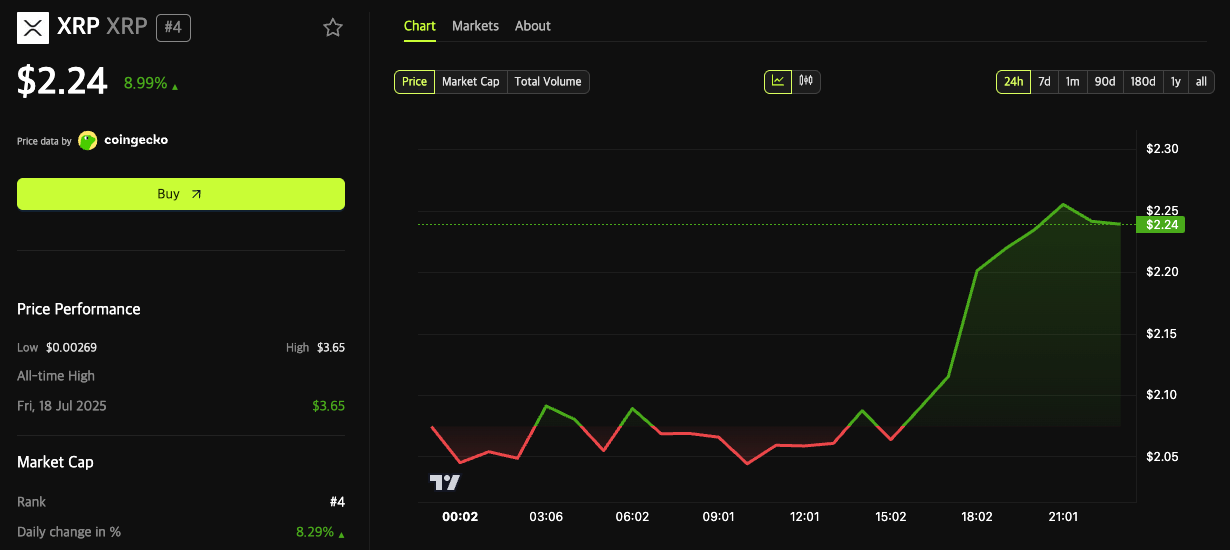
XRP Jumps 9% as Franklin Templeton and Grayscale Launch Spot ETFs

XRP Jumps 9% as Franklin Templeton and Grayscale Launch Spot ETFs

XRP jumped more than 9% to $2.27 after Franklin Templeton and Grayscale launched their spot XRP ETF on Monday. The $1.69 trillion asset manager joined Bitwise, Grayscale, and Canary Capital in offering regulated XRP investment products, calling XRP “foundational” for global settlement infrastructure. This wave of ETF launches marks a turning point for XRP. After regulatory uncertainty faded with Ripple’s SEC settlement earlier in 2025, institutional interest is surging. Wave of Institutional ETF Launches Signals Market Maturity Franklin Templeton debuted the Franklin XRP ETF (XRPZ) on NYSE Arca, offering regulated XRP exposure through a grantor trust. The fund tracks the CME CF XRP-Dollar Reference Rate and uses Coinbase Custody as custodian, with BNY Mellon as administrator. According to Franklin Templeton’s announcement, the ETF allows investors to follow XRP’s performance transparently, without buying the cryptocurrency directly. “XRPZ offers investors a convenient and regulated way to access a digital asset that plays a critical role in the global settlement infrastructure,” stated David Mann, director of ETF products and capital markets at Franklin Templeton. Grayscale has also launched its XRP Trust ETF (GXRP) with a zero-fee introductory period, highlighting XRP’s strong market position. Bitwise, which launched its XRP ETF a week earlier, reported $100 million in initial inflows. The clustering of ETF launches signals that asset managers were prepared for regulatory clarity, which arrived from the SEC in 2025. Regulatory Resolution Paves Way for Wall Street Entry Ripple’s $125 million settlement with the Securities and Exchange Commission in May 2025 ended years of uncertainty. SEC statements confirm that Ripple resolved all claims without admitting wrongdoing, paid $50 million directly to the agency, and had the rest released from escrow. This resolution gave large financial institutions the assurance needed to pursue spot ETFs. Franklin Templeton’s participation is notable for its size, lending credibility to XRP’s story as a payment utility. Investors can now access XRP through regulated products managed by well-known custodians and with clear transparency. Source: BeInCrypto Still, prospectuses caution that risks remain, including XRP’s volatility, limited diversification, and regulatory uncertainty abroad. The ETF holds only XRP and cash, making it unsuitable as a standalone investment. XRP’s Technical Advantages Drive Institutional Interest XRP runs on the decentralized XRP Ledger (XRPL), designed for rapid payment settlement. XRPL documentation highlights near-instant, low-fee transactions and notes that over 3.3 billion transfers have beenprocessed on the network. XRPL’s consensus system is said to be energy efficient, settling transactions in three to five seconds. These features attract institutions seeking alternatives to SWIFT and traditional cross-border systems. Franklin Templeton’s prospectus and Grayscale Research both stress XRP’s usefulness as a currency bridge and for efficient, scalable transfers. With these characteristics, XRP sets itself apart from cryptocurrencies like Bitcoin, which mainly serve as a store of value. The current rally coincides with rising open interest in XRP futures, pointing to growing involvement from institutional and retail traders and suggesting sustained market activity. Geopolitical Dimensions and China Exposure Speculation Some analysts believe XRP could play a role in new cross-border payment corridors, including those in Asia, the Middle East, and Africa. Black Swan Capitalist has argued that China has indirect exposure to XRP through the BRICS New Development Bank and leading Japanese fintech SBI Holdings. However, direct adoption remains limited by Chinese policies. BRICS business council recommendations from April 2025 urged support for cross-border digital settlements — a theme in line with XRP’s core design, despite no explicit mention of the cryptocurrency. The recommendations highlight a growing need for efficient digital payment systems. The European Central Bank is also examining cross-border payment infrastructure. Project Nexus was discussed during an April 2025 speech about linking payment systems in Asia and Europe. These trends echo the global relevance of the XRP Ledger’s use cases.

Author: Coinstats
Cross River Launches Stablecoin Payments With Infrastructure to Power the Future of Onchain Finance

Cross River Launches Stablecoin Payments With Infrastructure to Power the Future of Onchain Finance

Cross River Bank (“Cross River”), a technology infrastructure provider that offers embedded financial solutions, today announced the launch of its offering to power stablecoin payments*. Integrated directly with Cross River’s real-time core, COS, the offering unifies fiat and stablecoin flows through a single, interoperable system—enabling companies to move value across chains and traditional rails, leveraging bank-grade compliance. The post Cross River Launches Stablecoin Payments With Infrastructure to Power the Future of Onchain Finance appeared first on FF News | Fintech Finance.

Author: ffnews
Tidalwave Raises $22M Series A, on Track to Reach 4% of U.S. Mortgage Market

Tidalwave Raises $22M Series A, on Track to Reach 4% of U.S. Mortgage Market

Tidalwave, an agentic AI-powered mortgage point-of-sale (POS) platform, today announced a $22 million Series A funding round led by Permanent Capital, with participation from D.R. Horton, Inc., the nation’s largest homebuilder, and a follow-on from Engineering Capital. This brings Tidalwave’s total funding to $24 million. The post Tidalwave Raises $22M Series A, on Track to Reach 4% of U.S. Mortgage Market appeared first on FF News | Fintech Finance.

Author: ffnews